

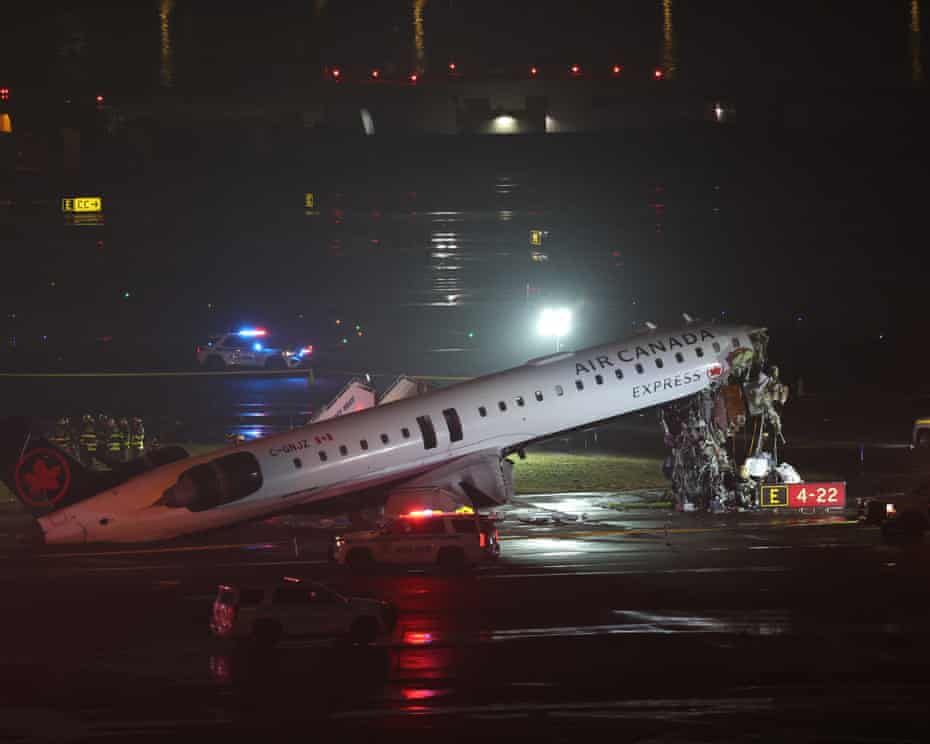
The “Air Canada LaGuardia collision” disrupted operations at a major US airport after a plane struck a ground vehicle, forcing authorities to halt all flights and declare an emergency response.
The “Air Canada LaGuardia collision” occurred at LaGuardia Airport in New York City, where officials confirmed a runway incident involving an aircraft and a service vehicle late at night.
Authorities reported that emergency crews responded quickly after receiving alerts about a “plane and vehicle on runway,” triggering immediate safety protocols and halting all incoming and outgoing flights.
The incident involved an Air Canada Express aircraft, which reportedly collided with a Port Authority vehicle while operating on the airport’s runway system.
Officials from the New York City Fire Department confirmed firefighters arrived promptly at approximately 11:38pm following reports of the collision.
While initial reports described the event as a crash, authorities later clarified it was a collision between the aircraft and a ground vehicle, though details remain limited.
The New York Police Department acknowledged the incident but stated that further information was not immediately available as investigations began.
Flight tracking services indicated the aircraft involved was part of Air Canada Express operations, highlighting the growing reliance on regional carriers in busy airport hubs.
Emergency management officials warned the public to “expect cancellations, road closures, traffic delays and emergency personnel” near the airport area following the disruption.
The warning urged travelers and commuters to use alternate routes, as congestion and operational interruptions extended beyond the airport into surrounding road networks.
The Federal Aviation Administration responded by issuing a “ground stop” for all flights at the airport, citing safety concerns linked to the incident.
This directive effectively paused all aircraft movements, ensuring emergency teams could secure the runway and assess potential hazards before resuming operations.
Regulatory notices indicated the halt could extend for several hours, with early projections suggesting closures might last until mid-afternoon local time.
Officials described the situation as an “emergency,” though no immediate confirmation was provided regarding injuries or the extent of damage to the aircraft or vehicle.
The airport shutdown underscored how even a single runway incident can significantly disrupt operations at one of the busiest transportation hubs in the United States.
New York City authorities coordinated responses across multiple agencies, ensuring safety measures were enforced while investigations into the cause continued.
Passengers experienced widespread disruption, with flights delayed, diverted, or canceled as airlines adjusted schedules in response to the ongoing emergency.
Airlines operating through LaGuardia faced logistical challenges, including repositioning aircraft and managing passenger backlogs during the suspension of operations.
The incident also highlighted the complexity of ground operations at major airports, where aircraft, vehicles, and personnel must coordinate closely to maintain safety.
Collisions involving ground vehicles, though relatively rare, can pose serious risks, particularly on active runways where timing and communication are critical.
Investigators are expected to review communication logs, vehicle movements, and air traffic control instructions to determine how the collision occurred.
The role of runway visibility, operational procedures, and human factors may also be examined as part of a comprehensive safety review.
Authorities have not yet disclosed whether weather conditions or technical issues contributed to the incident at the time of the collision.
The aircraft involved, a regional jet, is typically used for short-haul routes, making it a common sight at high-traffic airports like LaGuardia.
Port Authority vehicles play a key role in airport operations, including maintenance, emergency response, and logistical support across runways and terminals.
Ensuring coordination between these vehicles and aircraft remains a top priority for aviation safety authorities worldwide.
The shutdown of LaGuardia adds to broader concerns about aviation system resilience, especially during periods of high travel demand.
Travelers were advised to monitor airline updates closely and confirm flight statuses before heading to the airport amid ongoing uncertainty.
Officials emphasized that safety remains the primary concern, with no timeline confirmed for a full return to normal operations.
The Federal Aviation Administration is expected to lead the investigation, working alongside local authorities and airport management teams.
Preliminary findings may take time, as investigators analyze data and reconstruct the sequence of events leading up to the collision.
Such incidents often lead to procedural reviews, with potential updates to safety guidelines and operational protocols across the aviation sector.
The disruption also serves as a reminder of the interconnected nature of air travel, where localized incidents can ripple across national and international networks.
Air Canada has not yet released a detailed statement regarding the incident, though airline officials are expected to cooperate fully with investigators.
Passengers affected by the disruption may face extended delays, with some flights rescheduled or rerouted to nearby airports.
Read also: Iranian missile hits Israel leaving over 100 wounded in escalating conflict
As the situation develops, authorities continue to manage the immediate aftermath while preparing for a gradual resumption of services.
Further updates are expected as officials release more information about the cause, impact, and response to the runway collision incident.
About The Author
