
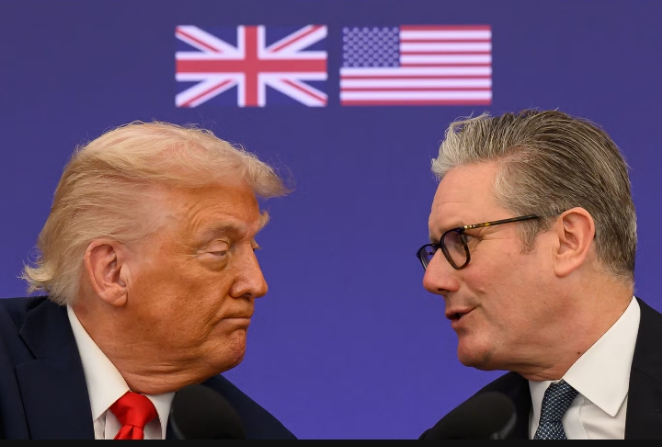
Greenland Annexation – Starmer Greenland Trump call dominated diplomatic attention on Thursday after Downing Street confirmed the UK prime minister directly addressed Greenland’s future during talks with the US president.
Speaking after the conversation, No 10 said Sir Keir Starmer clearly restated Britain’s position that Greenland’s sovereignty must remain a matter solely for Greenland and Denmark.
The phone call came amid escalating controversy triggered by repeated comments from Donald Trump suggesting the United States could seek control of the strategically located Arctic territory.
US officials have fuelled the row by indicating Washington is exploring ways to “acquire Greenland,” including the possible use of military force if diplomatic options fail.
Trump has long argued the island is critical to American national security, citing growing Russian and Chinese activity across the Arctic region.
Downing Street declined to provide a detailed readout of Sir Keir’s remarks but stressed that the prime minister’s position has been consistent and unequivocal.
Earlier the same day, Starmer told MPs that “the future of Greenland can only be determined by the people of Greenland, in cooperation with Denmark.”
The call marked the first direct conversation between Starmer and Trump since US special forces launched a dramatic raid in Caracas over the weekend.
That operation resulted in the capture of Venezuelan president Nicolas Maduro, an action that has drawn global attention and divided international opinion.
A Downing Street spokesperson confirmed the leaders discussed “a range of pressing international security issues” during Wednesday’s exchange.
Cabinet Office minister Pat McFadden described the conversation as part of a “vital and ongoing dialogue” between two closely aligned allies.
Speaking on BBC Breakfast, McFadden said: “The economic and security cooperation between the UK and the US keeps British people safe every single day.”
While London has stopped short of condemning US actions in Venezuela, the Greenland issue has proven far more sensitive within European capitals.
Denmark’s prime minister has warned that any American attempt to seize Greenland would represent a direct threat to Nato’s unity.
Copenhagen has insisted the island’s semi-autonomous status places its future firmly outside the reach of foreign powers.
The controversy has strained transatlantic relations, with several European leaders privately expressing alarm at Washington’s increasingly assertive rhetoric.
US secretary of state Marco Rubio added to tensions by confirming that the administration is examining multiple options to secure control of Greenland.
He said the US could attempt to purchase the territory but “retains the option” of using force if necessary to protect national interests.
Those remarks prompted fierce reactions across Europe, where officials fear the precedent such action would set for international law.
However, some voices have sought to downplay the threat of an outright invasion.
Writing in The Spectator, former UK ambassador to Washington Lord Peter Mandelson dismissed European concerns as “histrionic.”
Mandelson argued Trump was unlikely to invade Greenland and accused European governments of exaggerating risks due to “geopolitical impotence.”
He called instead for a stronger American role in Greenland to counter growing influence from Moscow and Beijing.
Sir Keir’s intervention reflects growing pressure on the UK to balance its alliance with Washington against broader European stability.
Read also:Democrats decry Venezuela attack as Republicans defend Trump after Senate briefing
The prime minister’s call also took place as deputy prime minister David Lammy prepared for talks with US vice-president JD Vance.
Greenland is expected to feature prominently during their meeting, scheduled for Thursday in Washington.
Lammy’s visit coincides with events marking the 250th anniversary of America’s declaration of independence from Britain.
The two politicians share a long-standing personal relationship, with Lammy hosting Vance and his family at Chevening last year.
Beyond Greenland, Starmer and Trump also discussed the seizure of the Russian-flagged oil tanker Marinera earlier on Wednesday.
US forces intercepted the vessel in the Atlantic in an operation that risks provoking a fresh confrontation with Moscow.
The UK later confirmed British armed forces provided logistical support during the seizure as the tanker passed near Scottish waters.
Russia’s transport ministry has suggested the action may have breached international maritime law.
Diplomats fear the incident could become another flashpoint in already strained relations between Russia and the West.
Ukraine was also on the agenda, with both leaders continuing negotiations aimed at securing a long-term peace settlement.
The UK and France have committed to deploying troops as part of a peacekeeping force should a deal be reached.
The US has indicated it may provide security guarantees to support European-led efforts, despite Trump’s earlier scepticism.

As tensions rise across multiple fronts, the Starmer Greenland Trump call underscores the delicate balancing act facing Britain’s new government.
For Sir Keir, maintaining close ties with Washington while defending international norms has become an increasingly complex challenge.
About The Author




