
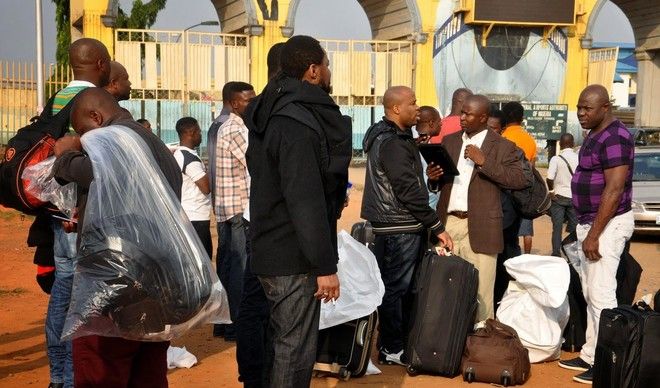

97 Nigerians face deportation- US adds 18 Nigerians to deportation list for fraud crimes. Total now 97 as Trump administration cracks down on criminal immigrants under DHS enforcement.
Just a week ago, news broke that 79 Nigerians convicted of various crimes were set to be sent home. Now, that number has jumped to 97. The Department of Homeland Security quietly updated its website Monday, adding 18 more names to what’s becoming one of the biggest Nigerian deportation operations in recent memory.
The Trump administration isn’t pulling any punches. Under Secretary Kristi Noem’s watch, DHS and Immigration and Customs Enforcement are going after what they call “the worst of the worst”, foreign nationals who came to America and then turned to crime.
These aren’t people caught crossing the border illegally. These are individuals who committed serious fraud offenses on U.S. soil, got convicted in court, and are now facing the consequences. Wire fraud. Mail fraud. Identity theft. These are the charges that keep showing up on the list.
Here’s what most people don’t realize about these crimes: they’re not small-time operations. Wire fraud schemes can wipe out someone’s retirement savings with a single phone call. Identity theft ruins credit scores and takes years to fix. Mail fraud exploits a system Americans have trusted for generations.
One victim loses $50,000. Another loses their entire business. Elderly people hand over their Social Security numbers to scammers who sound professional and trustworthy on the phone. By the time anyone realizes what happened, the money’s gone and the damage is done.
DHS says this Nigerian deportation wave is part of a bigger crackdown on criminal immigrants nationwide. They’re targeting people from multiple countries, but Nigeria’s numbers stand out, 97 people is significant by any measure.

The government released all 18 names. Some of these individuals were already known to law enforcement. Others flew under the radar until their convictions:
Obinwanne Okeke made headlines for a massive fraud conspiracy. Benjamin Ifebajo ran wire fraud schemes. Olugbeminiyi Aderibigbe got caught up in identity theft rings. The list goes on:
Oluwaseyanu Akinola Afolabi
Kolawole Aminu
Oluwadamilola Olufunsho Ojo
Franklin Ibeabuchi
Alex Afolabi Ogunshakin
Joshua Ineh
Stephen Oseghale
Eghosa Obaretin
Adesina Surajudeen Lasisi
Ibrahim Ijaoba
Azeez Yinusa
Charles Akabuogu
Kelechi Umeh
Lotenna Chisom Umeadi
Donald Ehie
Chukwudi Kingsley Kalu
Each person went through the criminal justice system. They had lawyers. They had trials. They had chances to appeal. The courts found them guilty, and now immigration law kicks in.
The official statement from DHS doesn’t mince words: “The U.S. Department of Homeland Security is highlighting the worst of the worst criminal aliens arrested by U.S. Immigration and Customs Enforcement. Under Secretary Noem’s leadership, the hardworking men and women of DHS and ICE are fulfilling President Trump’s promise and carrying out mass deportations, starting with the worst of the worst, including the illegal aliens you see here.”
That’s the policy in black and white. Criminal conviction plus immigration status equals deportation. No exceptions, no special considerations.
American immigration law is pretty straightforward on this point. If you’re not a U.S. citizen and you get convicted of certain crimes, you’re going to be deported. Period.
The law uses terms like “aggravated felony” and “crimes involving moral turpitude.” Fraud over $10,000? That’s an aggravated felony. Identity theft? Same thing. These crimes trigger automatic removal proceedings.
You still get due process. Immigration judges hear your case. You can hire a lawyer. You can appeal. But if you’re convicted of these specific crimes, your chances of staying in America are basically zero.
The Nigerian deportation cases all followed this same path: criminal conviction first, then immigration proceedings, then deportation orders. Some of these cases took years to work through the system. Others moved faster. But they all ended up in the same place.
Nigeria’s government has to take these people back. That’s how international law works. When a country deports someone, the home country has to accept them.
This creates an awkward situation. The U.S. and Nigeria have strong ties, trade deals, security cooperation, student exchanges. Deporting 97 people doesn’t destroy that relationship, but it doesn’t help either.
Nigerian officials have to coordinate the logistics. Where do these people go when they land in Lagos? How do they reintegrate into society? What kind of monitoring happens next? These are questions both governments are probably discussing behind closed doors right now.
This isn’t just about Nigeria. ICE has ramped up enforcement across the board. Arrests are up. Deportations are up. The administration’s message is clear: if you commit crimes in America and you’re not a citizen, you’re leaving.
Statistics from ICE show a major shift in priorities. Under previous administrations, deportation focused heavily on people caught at the border. Now, there’s much more emphasis on finding and removing criminals who are already inside the country.
Some people see this as smart policy, why wouldn’t you deport foreign criminals? Others worry about due process, family separation, and whether everyone’s really getting a fair shake in immigration court. The debate isn’t new, but the numbers are getting attention.
Here’s what gets lost in all this: the vast majority of Nigerians in America are law-abiding people. They’re doctors, engineers, small business owners, students. They pay taxes, raise families, and contribute to their communities.
When 97 people get deported for fraud, it creates a perception problem for everyone else. Fair or not, some people hear “Nigerian” and “fraud” in the same sentence and start making assumptions.
Community leaders have been vocal about this. They argue correctly that you can’t judge an entire immigrant population by the actions of a few criminals. Every group has bad actors. That doesn’t mean everyone from that group is suspect.
The Nigerian deportation process moves forward whether anyone likes it or not. These 97 individuals will be put on planes and sent back to Nigeria. Some might try last-minute legal maneuvers, but their options are limited at this point.
DHS will probably add more names. If they found 18 more people in a week, there are likely others in the pipeline. The question is whether this stays focused on serious criminals or starts expanding to include people with minor offenses.
Immigration advocates worry about scope creep, that enforcement targeting “the worst of the worst” gradually becomes enforcement targeting anyone without papers. Government officials insist they’re staying focused on public safety threats.
One aspect that doesn’t get enough attention: what happens to the stolen money? In many fraud cases, victims never see a dime. The criminals spend it, hide it, or send it overseas before anyone catches on.
Federal prosecutors can seek restitution as part of criminal sentences, but collecting that money is another story entirely. Once someone gets deported to Nigeria, good luck getting them to make monthly payments to victims in Ohio or Texas.
Some high-profile cases result in asset seizures, the government grabs houses, cars, bank accounts before the defendant can hide everything. But plenty of victims just eat the loss and try to rebuild.
97 people. 18 added in one week. Mostly fraud-related offenses. These numbers raise questions: Is this the tip of the iceberg? Are there hundreds more cases being reviewed? Or is this a one-time sweep that caught most of the worst offenders?
DHS hasn’t said how many more Nigerian deportation cases are pending. They also haven’t explained why so many cases involve fraud specifically. Is there an organized element to this? Are different defendants connected to the same criminal networks? The public information doesn’t give us those answers.
What we do know: fraud schemes targeting Americans have become increasingly sophisticated. Scammers use technology, social engineering, and knowledge of the financial system to steal massive amounts of money. When investigators finally catch these operations, they often find international connections.
Deportation isn’t instant. Even with a final order, the process takes time. Countries have to agree on flight schedules, arrange security, handle documentation. Some deportees fight until the last possible moment, filing emergency appeals and motions.
Most of these 97 cases will probably be resolved within the next few months. A handful might drag on longer if there are complicated legal issues. But the direction is clear. These individuals are leaving the United States.
For victims of their crimes, deportation might bring some satisfaction. The person who stole from them is being punished and removed from the country. But it doesn’t undo the damage or return the stolen money.
The expansion of the Nigerian deportation list from 79 to 97 names represents more than just numbers on a government website. It reflects policy choices about who belongs in America, how we treat convicted criminals who aren’t citizens, and what kind of enforcement we’re willing to fund.
Reasonable people disagree about immigration policy. Some want more enforcement, more deportations, stricter rules. Others want more compassion, more consideration of individual circumstances, more paths to legal status.
But there’s general consensus on this much: people who come to America and commit serious fraud crimes probably shouldn’t get to stay. These 97 cases fall into that category. They had their day in court. They were found guilty. Now they’re going home.
The real question is whether this approach makes America safer or just makes for good headlines. Time will tell.
Read more news at: ireport247news.com


