Okomu National Park intensifies the elephant rescue mission as experts, communities, and conservation groups unite to rehabilitate a distressed calf and reinforce long-term wildlife protection.
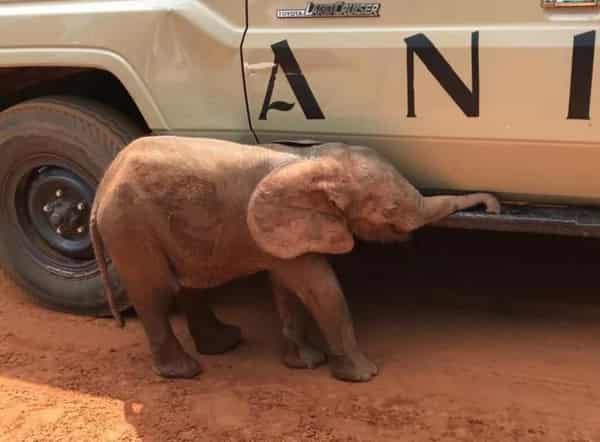
The Okomu National Park in Edo State has become the centre of an extraordinary wildlife intervention following the discovery and rehabilitation of a young elephant calf rescued from an oil palm plantation.
What began as a moment of uncertainty quickly evolved into a complex, collaborative response that showcased the growing strength of conservation networks in Nigeria.
This remarkable operation has drawn local and international attention, highlighting both the challenges and the promise of wildlife protection in West Africa’s rainforests.
The story began on November 30, 2025, when workers at the Okomu Oil Palm Company spotted a very young male elephant wandering alone, visibly weak and disoriented.
The calf, believed to be about two months old, had somehow strayed deep into the plantation.
Sensing the urgency of the situation, the workers secured the area, gave the baby elephant water, and quickly contacted authorities at Okomu National Park.
Their timely action prevented the infant from slipping further into distress.
According to Osaze Lawrence, Conservator of the Park, the call triggered an immediate response from park rangers and personnel of the Africa Nature Investors (ANI) Foundation.
Their first priority was to stabilise the calf and then attempt to reunite it with its herd. The team guided the elephant into the forest, hoping it would reconnect with its family group naturally.
For a moment, it seemed the plan had worked. The calf walked several metres into the wild, prompting the rescuers to assume that nature had taken its course.
However, the situation changed unexpectedly a few hours later. A commercial motorcyclist passing through a nearby area reported seeing a confused and exhausted baby elephant lingering by the roadside.
This alarming discovery confirmed that the calf had failed to reunite with its herd and was still wandering in search of help.
It was evident that the young elephant lacked the strength and survival skills to navigate the forest alone, and that a full-scale elephant rescue operation would be essential to save its life.
Rangers recovered the calf and transported it to a secure ANI camp inside the park.
By this time, the young elephant had entered a dangerous phase of physical weakness. It required specialised milk, hydration support, and round-the-clock veterinary monitoring.
Lawrence noted that the calf’s condition gradually improved after receiving medication and steady feeding.
Day and night, caregivers continued to supervise its progress, adjusting treatment as necessary and ensuring that stress levels remained minimal.
One of the most remarkable aspects of this case is the degree of collaboration involved.
Park authorities, local communities, conservation groups, veterinarians, and even international wildlife experts contributed to the unfolding elephant rescue.
Among the experts was Liz O’Brien, a British wildlife specialist based in Zambia, who flew to Nigeria to support the rehabilitation effort.
O’Brien described the experience as historic, noting that interventions of this scale are rare in Nigeria.
She stressed the importance of equipping local conservationists with deeper skills so that Nigeria can independently handle future wildlife emergencies.
“You cannot always rely on people flying in,” she said.
“The next generation of conservation workers must be fully prepared.”
Her mission included hands-on training sessions with rangers and caregivers, ensuring that the knowledge gained from this rescue extends far beyond a single incident.
O’Brien explained that raising an orphaned elephant is a long-term commitment requiring patience, resources, and specialist knowledge.
The calf will need at least two years of milk feeding and several additional years of carefully managed exposure to the wild before it can be a candidate for release.
The ultimate aim, she said, is to return the animal to the area where it became separated from its herd, allowing it to live freely once it reaches maturity.
“Wild animals belong in their natural habitat,” she emphasised.
Beyond the technical aspects, the elephant rescue has revealed a heartening shift in community attitudes.
Peter Abanyam, ANI’s Project Manager in Okomu, praised the role of local residents in reporting the wandering calf.
He explained that years of outreach and conservation education have changed how communities interact with wildlife.
Instead of perceiving elephants as threats or nuisances, many locals now see themselves as partners in safeguarding endangered species.
“When the calf approached the main road, villagers immediately alerted our gate,” Abanyam said.
“This shows that awareness and concern for wildlife have grown significantly.”
The species involved—an African rainforest elephant—is classified as endangered, making the successful rescue even more significant.
Abanyam stressed that every individual elephant counts in the fight against extinction. He also warned that as elephants roam closer to farmlands in search of food, the risk of human–wildlife conflict could increase if park boundaries remain poorly defined.
He called for clearer demarcations, particularly in the southern part of the park where agricultural expansion is rapidly advancing.
“We could face a serious crisis if boundaries continue to blur,” he cautioned. “Communities need to know exactly where the park begins and ends.”
As the rehabilitation continues, the calf at the centre of this growing elephant rescue narrative appears to be getting stronger each day.
Its survival is not only a victory for the park but also a symbol of what becomes possible when communities, experts, and conservation organisations work together.
About The Author