
Acting Inspector-General of Police Tunji Disu: Career, Education and Rise to Police Leadership
Nigeria’s security architecture entered a new phase on February 24, 2026, following the appointment of Acting Inspector-General of Police Tunji Disu, who assumed leadership of the Nigeria Police Force after the exit of Kayode Egbetokun.
The appointment, approved by President Bola Ahmed Tinubu, places a seasoned officer with decades of operational, investigative and administrative experience at the helm of the country’s foremost law enforcement institution.
As the Nigeria Police Force navigates complex internal security threats, the emergence of Acting Inspector-General of Police Tunji Disu signals continuity in professionalism and renewed focus on institutional reform.
Early Life and Educational Background
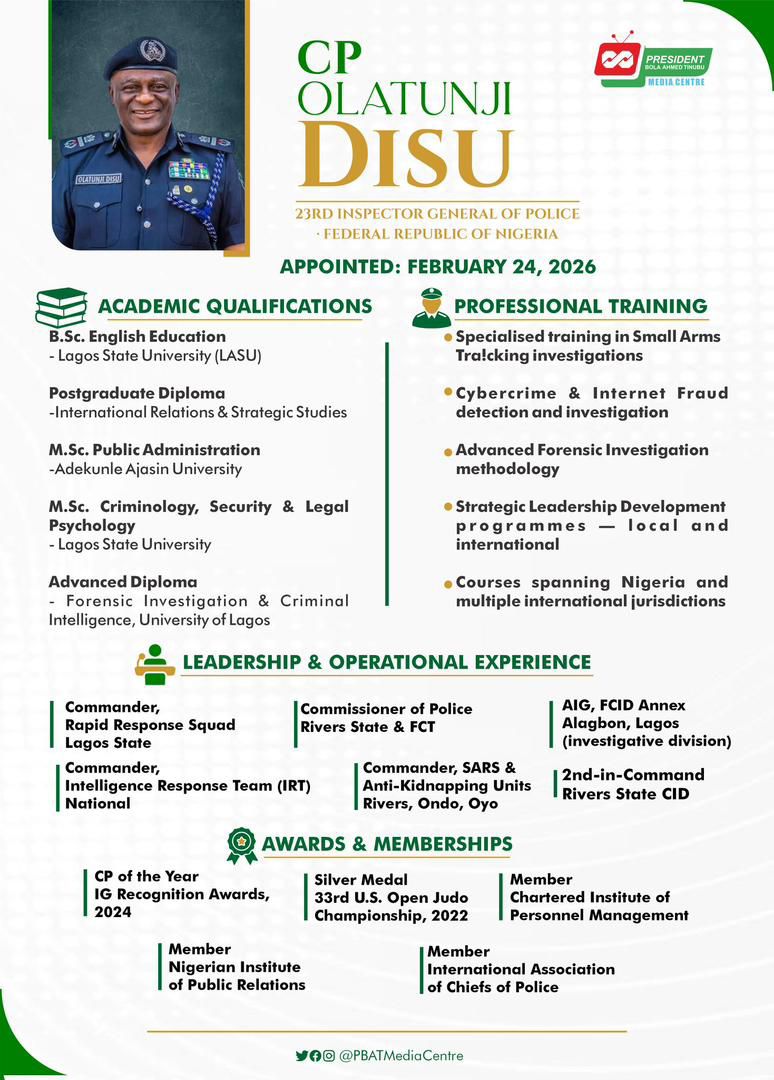
Acting Inspector-General of Police Tunji Disu’s academic foundation played a defining role in shaping his policing philosophy. He holds a Bachelor’s degree in English Education from Lagos State University (LASU), a qualification that earned him direct entry into the Force as a Cadet Assistant Superintendent of Police (ASP) on May 18, 1992.
Beyond his first degree, Disu invested significantly in professional development. Over the course of his career, he attended several strategic and tactical training programmes both locally and internationally, including courses in intelligence-led policing, counter-terrorism operations and strategic leadership management.
These trainings enhanced his operational command capabilities and administrative acumen.
Colleagues describe him as an officer who combines academic depth with field experience — a blend increasingly necessary in modern policing.
Entry into the Nigeria Police Force
Upon enlistment in 1992 as an ASP, Acting Inspector-General of Police Tunji Disu began a steady ascent through the ranks of the Nigeria Police Force. Unlike many who enter at lower cadres, his university qualification positioned him within the officer corps from inception.
His early assignments exposed him to investigative duties, public order management and community policing operations. These foundational postings allowed him to build credibility at both divisional and command levels.
Strategic Command and Operational Roles
Over the years, Disu occupied several high-responsibility positions within the Force. Before his latest elevation, he served as the Commissioner of Police in the Federal Capital Territory (FCT), Abuja — a role that placed him at the center of policing Nigeria’s political and administrative capital.
As FCT Commissioner, he supervised counter-crime initiatives, coordinated high-level security operations and strengthened inter-agency collaboration among security services. His tenure was marked by intelligence-driven crackdowns on criminal networks and enhanced urban patrol architecture.
Prior to that, he served as Commander of the Police Intelligence Response Team (IRT), a strategic unit tasked with tackling high-profile crimes including kidnapping, armed robbery and organized criminal syndicates.
Under his leadership, the IRT recorded significant operational breakthroughs, further cementing his reputation as a results-oriented officer.
He also held roles in Special Tactical Squads and served in various state commands, gaining field-level exposure that strengthened his command presence.
Each of these assignments contributed to the institutional experience that now underpins Acting Inspector-General of Police Tunji Disu’s leadership profile.
Leadership Style and Institutional Reputation
Within policing circles, Disu is widely regarded as disciplined, measured and administratively meticulous. Officers who have worked under his supervision frequently describe a command structure that emphasizes accountability, ethical conduct and operational clarity.
His leadership approach aligns with evolving global policing standards that prioritize intelligence-led operations, data analysis and community engagement.
Analysts note that the modern security landscape demands precisely this type of hybrid leadership — combining operational toughness with strategic planning.
As Acting Inspector-General of Police Tunji Disu assumes national command, these traits are expected to influence reform priorities within the Force.
Transition from Egbetokun
The transition followed the departure of Kayode Egbetokun, who had led the Force since June 2023. Institutional handover protocols were observed at Force Headquarters, reinforcing continuity in command structure.
Leadership change at the level of Inspector-General traditionally triggers the retirement of officers senior to the appointee, in line with service hierarchy rules. Such transitions are structural rather than personal, designed to preserve clarity of command within the Force.
The elevation of Acting Inspector-General of Police Tunji Disu therefore fits within established administrative precedent.
Expectations and Reform Outlook
Nigeria continues to grapple with diverse security threats ranging from urban criminal networks to rural banditry and organized transnational crime. Observers believe that Disu’s investigative background and intelligence coordination experience will shape policy direction in the coming months.
Security analysts expect emphasis on:
- Strengthening intelligence coordination across commands
- Enhancing technology-driven policing frameworks
- Deepening inter-agency collaboration
- Reinforcing internal discipline and anti-corruption measures
Given his background in specialized response units, Acting Inspector-General of Police Tunji Disu is anticipated to prioritize operational efficiency and rapid-response architecture.

A Career Defined by Steady Progression
What distinguishes Disu’s rise is not sudden elevation but progressive accumulation of responsibility. From ASP in 1992 to leading the entire Nigeria Police Force in 2026, his career spans more than three decades of service.
Such longevity within the institution provides institutional memory — a critical asset in reform execution.
The appointment of Acting Inspector-General of Police Tunji Disu marks a defining moment for Nigeria’s law enforcement leadership. His educational grounding, diverse command roles and intelligence-focused background collectively position him for the demands of national police administration.
As he formally settles into office, attention will shift from appointment debates to measurable outcomes: operational performance, internal reform and public trust rebuilding.
For now, the trajectory of Acting Inspector-General of Police Tunji Disu reflects a career shaped by preparation, strategic exposure and institutional loyalty.