

Which is nuclear powerful: Russia or the UK? Superficial comparisons rely on numbers, but nuclear power depends on survivability, doctrine, command control, and political willingness.
Russia maintains the world’s largest nuclear arsenal, estimated at roughly six thousand warheads, dwarfing Britain’s considerably smaller but strategically concentrated nuclear force.
The United Kingdom fields approximately two hundred and twenty-five warheads, with fewer than one hundred and twenty operational at any given moment.
On quantity alone, Russia appears overwhelmingly superior, leading many analysts to dismiss British nuclear power as marginal or symbolic.
This assumption misunderstands nuclear deterrence, which values certainty of retaliation over volume of explosive capacity or battlefield dominance.
Russia operates a full nuclear triad consisting of land-based missiles, strategic bombers, and submarine-launched ballistic missile platforms.
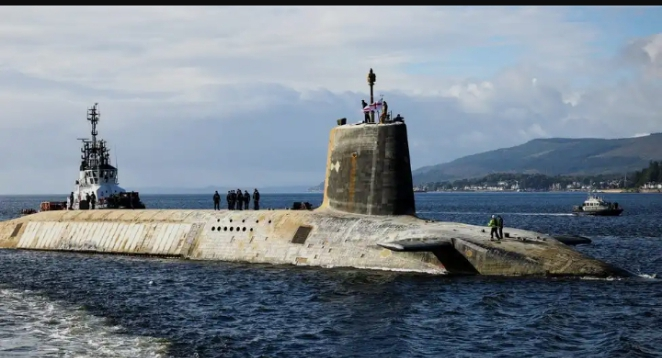
The United Kingdom relies exclusively on a sea-based deterrent, deploying nuclear weapons only aboard Vanguard-class ballistic missile submarines.
Critics label this structure narrow, yet submarines represent the most survivable and elusive nuclear delivery systems ever developed.
At least one British submarine remains continuously on patrol, ensuring retaliation capability regardless of any first-strike scenario.
This policy, known as Continuous At-Sea Deterrence, guarantees national survival through assured retaliatory destruction.
Russia’s land-based missile silos and mobile launchers offer flexibility but face increasing vulnerability to surveillance, cyber disruption, and pre-emptive targeting.
Russian strategic bombers, while versatile, require secure airspace and advanced logistics, exposing them to interception during high-intensity conflict.
Submarines, by contrast, operate invisibly, making the UK’s smaller force disproportionately resilient compared to Russia’s more extensive but exposed arsenal.
However, Russia’s advantage lies not merely in numbers but in doctrine governing nuclear employment and escalation control.
Russian military doctrine allows limited nuclear use during conventional conflicts to force adversaries into political concessions.
This lowers the nuclear threshold and introduces battlefield nuclear weapons into regional war planning.
The United Kingdom explicitly rejects tactical nuclear warfare, reserving nuclear weapons strictly for strategic deterrence purposes.
This moral and legal restraint strengthens legitimacy but reduces escalation options during limited or hybrid conflicts.
Russia possesses thousands of low-yield nuclear weapons designed for battlefield or theatre-level employment.
The UK possesses no equivalent low-yield or tactical nuclear capability.
In scenarios short of full-scale nuclear war, Russia therefore enjoys escalation dominance.
Escalation dominance, however, does not translate into immunity from catastrophic retaliation.
Any nuclear strike against Britain would invite immediate, devastating counterstrike from submerged British submarines.
A single British submarine could destroy multiple major Russian cities and military installations.
This certainty underpins deterrence and constrains Russian strategic decision-making at the highest levels.
Which is nuclear powerful: Russia or the UK? depends fundamentally on whether power is defined by coercion or deterrence.
Russia’s arsenal enables coercive nuclear signaling, intimidation, and controlled escalation under certain conditions.
The UK’s arsenal enables absolute deterrence by guaranteeing unacceptable damage to any attacker.
Command and control systems further differentiate nuclear power credibility between both states.
British nuclear launch authority rests solely with the Prime Minister, ensuring centralized civilian oversight and political accountability.
Orders are pre-authorised through sealed contingency instructions, reducing ambiguity during crisis conditions.
Russian nuclear command involves multiple layers, military councils, and technological intermediaries.
Complex command structures increase risks of miscalculation, delay, or unauthorized action during high-stress scenarios.
History demonstrates that near-catastrophic nuclear incidents often stemmed from systemic complexity rather than malicious intent.
Alliance structures further amplify British nuclear power beyond its raw arsenal size.
The UK operates within Nato’s collective security framework, multiplying deterrence through allied retaliation risks.
Any nuclear attack on Britain risks cascading responses from other nuclear-armed Nato members.
Russia, by contrast, lacks comparable alliance-based nuclear backing.
This strategic isolation magnifies consequences of nuclear misjudgment for Moscow.
Technological sophistication also shapes real nuclear effectiveness.
British Trident missiles are among the most accurate ballistic missiles deployed globally.
Precision enhances deterrence by allowing fewer warheads to reliably destroy hardened strategic targets.
Russia’s newer missile systems emphasize range, maneuverability, and payload size, sometimes at reliability expense.
Sanctions, industrial constraints, and maintenance burdens challenge Russia’s long-term arsenal sustainability.
Nuclear power requires constant investment, modernization, and institutional competence.
The UK maintains a smaller arsenal but prioritizes upkeep, reliability, and secure basing.
Read also: Britain needs new defence pact with Europe amid fears Trump won’t defend UK from Russian attack
Russia maintains a massive arsenal at enormous economic and organizational cost.
Political intent ultimately determines whether nuclear capability translates into strategic leverage.
Russia frequently invokes nuclear threats in diplomatic rhetoric to intimidate adversaries and fracture alliances.
Excessive nuclear signaling risks diminishing deterrence credibility through overexposure.
The UK rarely issues explicit nuclear threats, relying instead on strategic ambiguity.
Silence preserves deterrence by maintaining uncertainty without escalating public rhetoric.
Which is nuclear powerful: Russia or the UK? varies by scenario and escalation level.
In total nuclear war, Russia possesses greater destructive capacity by sheer volume.
In deterrence stability, the UK’s survivable force offers equivalent strategic weight.
In limited nuclear escalation, Russia holds tactical advantages.
In assured retaliation, the UK remains fully credible.
Both states remain constrained by mutual destruction logic.
Nuclear weapons prevent wars rather than win them.
By that standard, Britain’s deterrent performs its function effectively.
Russia’s numerical superiority does not grant strategic freedom.
The final assessment is unavoidable.
Russia is more nuclear powerful quantitatively and tactically.
The UK is nuclear powerful enough to make any attack irrational.
Policy Submissions and Recommendations
[1] The UK should retain Continuous At-Sea Deterrence as the absolute foundation of national nuclear security, regardless of alliance uncertainty or political change.
[2] Britain should deepen nuclear coordination with France to reinforce European deterrence credibility without duplicating American dependency.
[3] Nato must formally address Russian tactical nuclear doctrine through clearer deterrence thresholds and proportional response planning.
[4] European states should invest in missile defense, cyber resilience, and intelligence-sharing to reduce escalation vulnerabilities below nuclear thresholds.
[5] Russia should be diplomatically pressured to re-establish nuclear risk-reduction mechanisms suspended during recent conflicts.
[6] Nuclear rhetoric should be restrained internationally to prevent normalization of existential threats in conventional disputes.
[7] Arms control frameworks must adapt to include tactical nuclear weapons, not merely strategic warhead ceilings.
[8] The UK should maintain political clarity that nuclear weapons serve deterrence alone, reinforcing legitimacy and global stability.
About The Author
