The VAR safety scrutiny deepens after the Premier League defends Mbeumo’s goal despite Mac Allister’s head injury, prompting urgent player welfare reforms.
The Premier League is under intense fire as the VAR Safety Scrutiny widens following Bryan Mbeumo’s controversial goal against Liverpool, allowed to stand despite Alexis Mac Allister suffering a head injury in the buildup. The league’s official defense, supported by PGMOL, has only amplified the backlash. Critics argue that football’s video review system, meant to uphold fairness, is failing its moral obligation to protect players on the pitch.
This growing VAR Safety Scrutiny has transformed what should have been a thrilling football weekend into a debate about ethics, safety, and the limitations of technology in the modern game.
A scandal rooted in technicality over humanity
The defining moment came in the opening minutes of Manchester United’s 2–1 win over Liverpool. Mac Allister collided with his teammate Virgil van Dijk and fell to the ground, visibly hurt. Despite the midfielder clutching his head, referee Michael Oliver allowed play to continue, and Bryan Mbeumo went on to score.
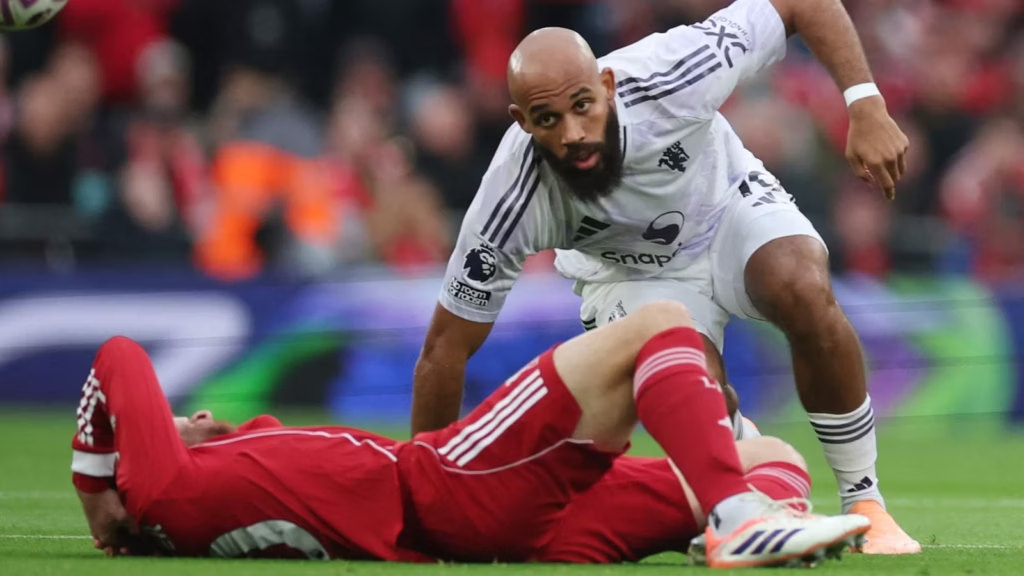
The Premier League later stated that VAR could not intervene because no foul had occurred—Mac Allister’s injury resulted from accidental contact with a teammate. Under the current rules, video officials cannot stop play for non-foul incidents. This technical limitation, however, highlights a serious flaw in the system.
The incident reveals the very core of the VAR Safety Scrutiny: a failure to prioritize human safety over procedural rigidity. The system, designed to ensure justice, has ironically exposed its inability to act when compassion is most needed.
When “unseen” becomes unforgivable
The explanation that the referee “didn’t see” the injury offers little comfort to fans and professionals who expect better. The purpose of VAR is to identify incidents that the referee may miss, yet when a player’s health is endangered, the system stands idle.
Football has come a long way in recognizing the dangers of head trauma, but this incident suggests that progress is being undermined by bureaucracy. The ongoing VAR Safety Scrutiny questions why a system that can analyze an offside by millimeters cannot intervene when a player risks concussion or worse.
Former players and medical experts have called for urgent reform. They argue that any goal scored while a defender is incapacitated by a head injury must be automatically reviewed and potentially disallowed. The principle is simple: no rule should outweigh a player’s safety.
Inconsistency Deepens Distrust
The outrage didn’t end there. Later in the same match, Liverpool appealed for a penalty after Amad Diallo’s arm appeared to block a cross. After a lengthy review, officials ruled that the arm was in a “natural position.”
To fans, this showcased VAR’s inconsistency, capable of ruling subjectively on handball yet blind to a visible injury. The incident deepened the VAR Safety Scrutiny, exposing a double standard in how the system interprets fairness. When the same technology enforces technical laws but ignores welfare, credibility suffers.
The public’s frustration is no longer about a single match; it’s about the values underpinning the game. If VAR exists to ensure justice, then justice must also mean protecting the health of those playing it.
The Ethics vs. Rules Debate
Liverpool manager Arne Slot captured the mood perfectly, remarking that his players “don’t pretend it’s a head injury.” His comment implies that referees and VAR officials must treat visible injuries as emergencies, not as procedural inconveniences.
The Premier League insists its officials followed the existing rules, but that is precisely the issue. The rules themselves are inadequate. This realization sits at the center of the VAR Safety Scrutiny, which has shifted focus from individual referees to the governing laws of the sport.
Ethics should always supersede technicalities. Football, after all, is a human game. When the law of the game contradicts the welfare of players, the law must evolve.
Reforming the rules for player welfare
There is now growing pressure on the International Football Association Board (IFAB) and PGMOL to update VAR protocols. The solution seems clear: video officials must be allowed to stop play for suspected head injuries, regardless of whether a foul occurred.
This reform would not undermine referees’ authority; it would strengthen the game’s integrity. As long as VAR Safety Scrutiny exposes such loopholes, the Premier League’s reputation will remain at risk. Fans, clubs, and players demand a system that protects as much as it polices.
Medical specialists have emphasized that prompt attention after a head impact can prevent long-term damage. It is therefore unacceptable that technology powerful enough to detect the position of a fingertip cannot identify a player lying motionless on the pitch.
—
Football’s Moral Test
The Mbeumo incident is more than a refereeing controversy—it’s a defining moment in football’s moral evolution. For years, the sport has campaigned for player safety through concussion protocols and stricter medical checks. Yet, when the test came, VAR failed to uphold those very standards.
This is why the VAR Safety Scrutiny must continue until reform becomes reality. The system’s success should not be measured by how many offsides it catches but by how many players it helps protect.
Until the laws prioritize humanity over procedure, the debate will persist—and every questionable decision will reopen the wound left at Anfield.
From scandal to change
The controversy surrounding Mac Allister’s injury has forced football to look inward. The ongoing VAR Safety Scrutiny is not an attack on technology but a demand for empathy and accountability within it.
Football cannot afford to wait for another dangerous oversight to act. The Premier League and IFAB must implement immediate changes that empower VAR to intervene for player safety, regardless of technical definitions.
At its heart, this is not about rewriting history or overturning a result; it’s about protecting lives and preserving the integrity of the sport. If the system that governs fairness cannot also protect those who make football possible, then it must change.
Only when VAR becomes a tool for safety as much as accuracy will the VAR Safety Scrutiny finally end, and football can truly claim to have put people before protocol.
Read more news at: ireport247news.com
About The Author