US waives sanctions on Syria– The United States has announced a temporary suspension of the Caesar Act sanctions on Syria, marking a historic turning point in Washington’s long-fraught relationship with Damascus.
The decision followed President Ahmed al-Sharaa’s visit to the White House, where he held private talks with President Donald Trump aimed at opening a new chapter in US-Syria relations.
The US Treasury Department confirmed that the sanctions waiver will last for 180 days, halting restrictions on most civilian transactions but maintaining targeted measures against specific entities.
A statement from the Treasury said President Trump is “delivering on his commitment to give Syria a chance at greatness” by allowing it to rebuild and thrive economically.
The announcement outlined that comprehensive sanctions are no longer in effect, allowing for trade in civilian-use goods, technology, and software without the need for special licenses.
However, the waiver does not apply to transactions involving Russia and Iran, which remain under heavy restrictions due to ongoing US concerns over regional destabilisation.
According to the statement, “This suspension aims to empower the Syrian people, regional partners, and international investors to contribute to Syria’s recovery while maintaining accountability for harmful actors.”
The meeting between Trump and al-Sharaa was conducted behind closed doors, without press access, sparking widespread speculation about the precise details of the conversation.
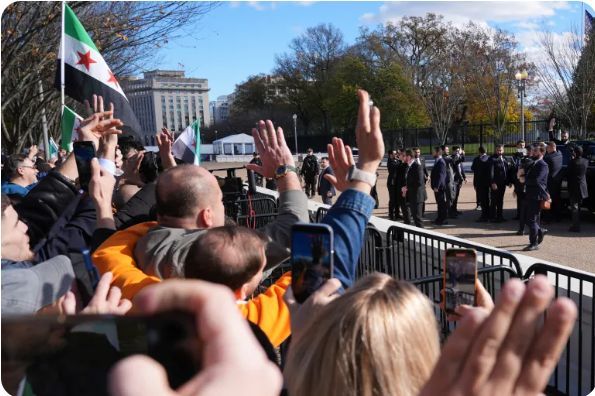
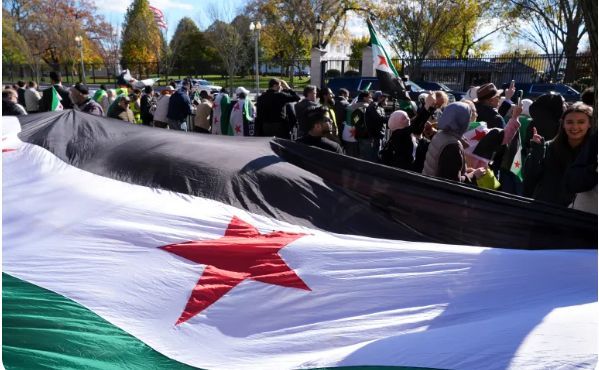
Live images outside the White House showed large crowds waving Syrian flags and cheering as al-Sharaa departed, with supporters calling the event a “moment of renewal.”
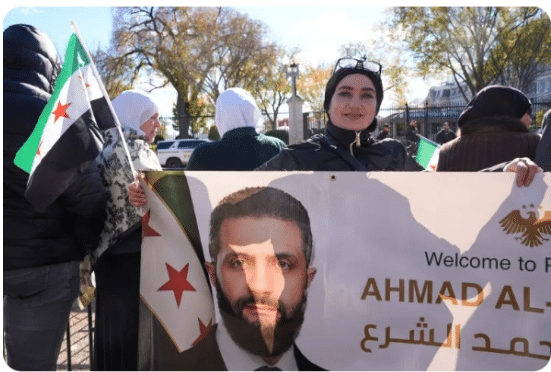
Eyewitnesses described the Syrian leader waving from his motorcade window as people chanted messages of unity, hope, and reconstruction after more than a decade of isolation.
For Syria, the easing of sanctions represents a vital economic lifeline following years of crippling restrictions that devastated trade, banking, and the private sector.
The Caesar Act, imposed in 2020, was designed to penalise individuals and entities linked to the former government of Bashar al-Assad over human rights violations.
The suspension announced by the Trump administration marks the most significant step yet toward re-engaging with Damascus since the outbreak of the Syrian war in 2011.
According to the US government, sanctions will still apply to “the worst of the worst,” including human rights abusers, drug traffickers, and individuals tied to destabilising regional networks.
The Treasury statement also noted that Syria’s designation as a State Sponsor of Terrorism remains under review, meaning full normalisation is still some distance away.
Despite the cautious optimism, analysts believe the temporary nature of the waiver could limit its economic impact unless the measure is extended or made permanent.
An expert based in Damascus said al-Sharaa “is walking a delicate line — maintaining domestic support while appearing acceptable to Western leaders seeking to test diplomatic re-engagement.”
Images of the Syrian president playing basketball with US military officials were widely circulated, underscoring an effort to project a softer image of cooperation and renewal.
Just weeks earlier, al-Sharaa had appeared at dawn prayers in Damascus, demonstrating his continued outreach to conservative and religious groups at home.
Observers believe this dual approach — strong domestic symbolism paired with international diplomacy — reflects a broader attempt to reposition Syria as a legitimate global actor.
In Washington, reactions to the sanctions decision have been mixed, with some lawmakers urging full repeal of the Caesar Act and others demanding continued caution.
US Congressman Joe Wilson, who met with al-Sharaa earlier in the day, declared, “A free, united, prosperous Syria is the biggest opportunity since the end of the Cold War.”
He added emphatically, “We must give Syria a chance and achieve a complete and total repeal of Caesar.” His comments were echoed by several Republican and independent figures.
The Caesar Act has long been criticised for inadvertently punishing ordinary Syrians rather than the political elite it was meant to target, worsening the humanitarian crisis.
Critics of the waiver argue that the Trump administration should have sought congressional approval to permanently amend or repeal the act before granting such broad relief.
However, due to the ongoing government shutdown, Congress remains in recess, leaving the White House to act unilaterally through executive and departmental powers.
A senior administration official clarified that “the president already has the authority to waive sanctions every six months,” framing the current move as a legitimate use of existing power.
For al-Sharaa, the gesture is symbolic but short of what he hoped for — a permanent lifting of restrictions that would allow unrestricted trade and foreign investment.
One US analyst described the decision as “a cautious olive branch,” designed to test the willingness of Damascus to engage constructively with Western economic systems.
White House officials did not release a joint statement or photo opportunity, reinforcing speculation that the two leaders discussed sensitive security and political matters privately.
Still, supporters view the event as a major breakthrough, especially given the long-standing hostility between Washington and Damascus since the onset of the Syrian conflict.
Outside the White House, Syrian-American communities gathered in celebration, holding banners bearing messages of peace, sovereignty, and friendship between the two nations.
Motiah Boustany, a Syrian-American from West Virginia, described the moment as “the first real sign that Syria is being given a chance to return to the global stage.”
US House Foreign Affairs Committee Chairman Brian Mast also met with al-Sharaa, later revealing that the two discussed “a Syria free of war, ISIS, and extremism.”
Mast said, “We had a long and serious conversation about how to build a future for the Syrian people that looks forward instead of back.”
He added that al-Sharaa told him he wanted to “liberate from the past and be a great ally to the United States of America.”
For the Trump administration, the sanctions waiver aligns with its broader effort to recalibrate Middle East policies and encourage regional stability through selective engagement.
A senior Treasury official said the decision is part of a “regulatory posture encouraging international banks and companies to contribute to Syria’s recovery.”
The United Nations estimates Syria’s population at over 25 million, with more than 6 million displaced abroad since 2011, including millions in Türkiye, Lebanon, and Jordan.
Those figures underline the scale of humanitarian and economic rebuilding Syria faces, even if sanctions relief brings some short-term stability and investor confidence.
The suspension also permits the transfer of most US-origin goods for civilian use, potentially reopening long-dormant supply chains for medicine, software, and consumer technology.
Nevertheless, certain high-risk exports, including items on the Commerce Control List, still require special licenses due to national security and dual-use technology concerns.
The waiver, which replaces an earlier partial relief issued in May, is intended as a trial measure to assess compliance, stability, and diplomatic goodwill.
Some analysts suggest it could serve as a test case for a broader sanctions overhaul affecting other nations under similar restrictions.
Others warn that without legislative backing from Congress, the waiver could expire without renewal, leaving businesses uncertain about the sustainability of any new trade links.
For ordinary Syrians, the prospect of easier financial transactions and access to foreign goods offers a small but tangible sign of relief after years of hardship.
Economists in Damascus estimate that if maintained, the sanctions suspension could add billions in foreign investment and remittances over the next year.
However, many stress that a true economic revival depends on political reconciliation, security guarantees, and an enduring peace that allows displaced citizens to return.
Diplomatic observers see al-Sharaa’s Washington trip as an attempt to demonstrate moderation while seeking legitimacy from Western governments still wary of Syria’s past leadership.
In the streets of Damascus, state media celebrated the meeting as “a victory for sovereignty,” hailing Trump’s decision as proof of Syria’s reemergence from isolation.
Regional reactions have been muted, with neighbouring states waiting to see whether Washington’s gesture signals a permanent policy shift or a temporary experiment.
European capitals, while cautiously optimistic, continue to link full engagement with Syria to clear human rights progress and democratic reforms within the country.
For now, the 180-day suspension stands as the boldest move yet by the Trump administration toward re-engaging a nation once deemed untouchable by American diplomacy.
Whether the step becomes a prelude to full normalisation or remains a symbolic gesture will depend on how both governments manage the next phase of this fragile thaw.
As one Washington analyst summarised, “This is not just about sanctions. It’s about rewriting a chapter of history that both sides have long avoided reopening.”
The suspension of the Caesar Act, though limited in scope, has opened a diplomatic door many thought permanently closed — one that could reshape the balance of the Middle East.
For now, Syria’s Ahmed al-Sharaa leaves Washington with cautious optimism, a sense of victory, and the hope that his visit marks the beginning of a new era in US-Syria relations relishing US waives sanctions on Syria development.
About The Author