
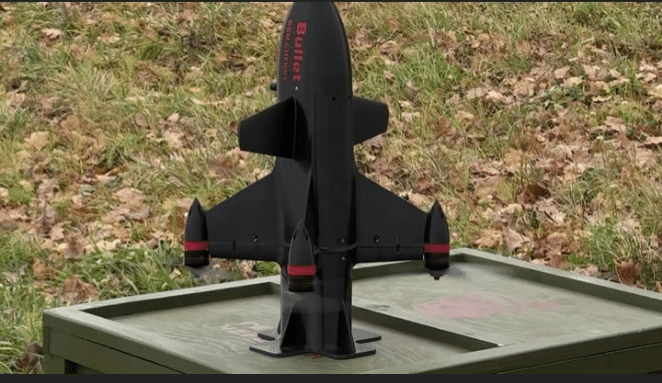
Naive assumptions and misplaced trust in foreign powers left Ukraine vulnerable, surrendering nuclear weapons and its massive Soviet-era arms industry, only to face a full-scale Russian invasion decades later.
Today, the Ukraine weapons industry is flourishing, fueled by ingenuity and necessity, producing missiles and drones using carbon printers, lawnmower engines, and salvaged Soviet technology for battlefield advantage.
The FP-5 Flamingo cruise missile, Ukraine’s latest long-range weapon, travels 3,000km at 900kmph with over a tonne payload, demonstrating Kyiv’s ability to innovate independently of allied restrictions.
“The Flamingo is a symbol of our independence. We don’t wait for others; we make it ourselves,” said Iyna Terech, CTO of Fire Point, the company behind these weapons.
Prototypes painted pink allowed easy retrieval after test flights, and the missile’s primary advantage lies in Ukraine’s unrestricted ability to target Russian infrastructure, bypassing Western limitations entirely.
The US limited the use of ATACMs, while Europe hesitated on Tomahawk missile access, leaving Kyiv reliant on its own industrial creativity and domestic production to maintain operational freedom.
Flamingo missiles have already struck deep into Russian territory, targeting oil refineries and critical military facilities, causing measurable fuel shortages and a 10% spike in Russian pump prices.
Ukraine focuses on Fluid Catalytic Cracking plants within refineries, crucial to Russia’s energy infrastructure, exploiting vulnerabilities caused by Western export bans and sanctions on industrial components.
“War teaches efficiency. We prioritize effectiveness over paperwork. Weapons must work, or soldiers die,” Terech explained, emphasizing the speed and adaptability of the Ukrainian weapons development ecosystem.
Fire Point also produces FP1 and FP2 Shahed-style drones, carrying 150kg payloads and capable of striking targets as far as Moscow, rivaling costlier American missiles in destructive capability.
These drones, fabricated from carbon-printed wings and repurposed lawnmower engines, are assembled quickly, often within hours, allowing mass production to meet the unrelenting demands of the front line.
Electronics are designed to resist Russian jamming, ensuring reliability under combat conditions. Ukraine now shoots down approximately 90% of incoming Shahed-type drones, reflecting the high technical standard of domestic manufacturing.
FP1 and FP2 drones cost roughly $50,000 each, significantly lower than Russian equivalents estimated at $80,000, highlighting Kyiv’s competitive advantage in low-cost, high-impact weapons for sustained defense operations.
European support provides indirect leverage, with Kyiv receiving technical assistance and strategic guidance, but Ukraine’s start-ups operate with minimal bureaucracy to accelerate weapon deployment efficiently.
The war has evolved into a grinding stalemate, pitting Russia’s manpower advantage against Ukraine’s ingenuity, technological adaptation, and growing self-reliance in weapons production and battlefield strategy.

Kyiv’s historical arms production, once third-largest in the Soviet Union, collapsed post-independence, leaving a vacuum that today’s start-ups like Fire Point are rapidly filling to counter modern threats.
Antonov’s factories, Kharkiv’s tank and missile production facilities, and Kyiv’s anti-aircraft missile plants form the backbone of the resurgent Ukraine weapons industry, blending old infrastructure with modern innovation.
Following the 1994 nuclear disarmament, Ukraine relied on Western security guarantees, a trust that was ultimately betrayed, forcing the nation to rebuild its defense capacity from scratch and embrace independent arms production.
Start-ups such as Fire Point and General Cherry exemplify this transformation, producing long-range missiles and thousands of intercept drones weekly, providing critical tactical support to frontline units facing Russian Shaheds.
Combat has shifted from traditional trench warfare to a deadly environment where infantry is hunted by autonomous drones, underscoring the urgent need for rapid domestic weapons development and adaptation.
3-D printers hum around the clock in secret factories, assembling quadcopters, missile components, and semi-autonomous drones, representing the core of Ukraine’s innovative, start-up driven military-industrial complex.
Despite being valued at just $1bn, the Ukrainian weapons industry is growing fast, with new technologies such as vertical-climbing bullet drones capable of speeds over 200kmph enhancing battlefield capabilities.
Fast growth and battlefield successes have instilled confidence in Kyiv’s defense ecosystem, positioning Ukraine as potentially one of the most technologically advanced military powers in Europe.
“Self-reliance is no longer optional. We must grow our security with our own hands,” Terech emphasized, reflecting the national ethos driving Ukraine’s weapons innovation and resilience under fire.
Kyiv’s start-ups now produce approximately 60% of the nation’s military hardware, a remarkable leap from reliance on foreign arms and a testament to Ukrainian ingenuity under extreme pressure.
Flamingo missiles, Shahed drones, and other homegrown munitions exemplify the blend of low-cost production, high technological sophistication, and battlefield effectiveness that defines Ukraine’s modern arms approach.
Price competitiveness ensures Ukrainian weapons remain a viable alternative to costlier Western or Russian systems, strengthening the country’s strategic autonomy while optimizing allied support for maximum impact.
Europe must recognize the lessons of Ukraine’s experience, as Terech warns: “Diversification is essential. Relying solely on others is a risk. Europe should build its security using its own resources.”
Ukraine’s arms industry is not only a response to immediate wartime needs but a strategic investment in long-term national and regional security, influencing the future balance of military power.
As conflict persists, innovation continues to accelerate, with engineers and scientists producing drones, missiles, and other munitions at unprecedented speed, demonstrating the resilience and ingenuity of Ukraine’s defense sector.
“The war is harsh, but it teaches hard lessons. Independence and creativity in arms production are not luxuries—they are necessities for survival,” Terech concluded, reflecting the mindset of Ukraine’s defense innovators.

Kyiv’s start-ups have redefined how wars are fought, merging traditional Soviet-era knowledge with modern IT systems, producing weapons that challenge much larger adversaries and reshape European defense thinking.
From salvaged engines to 3-D printed drones, Ukraine has turned improvisation into a technological edge, proving that necessity drives innovation, and a determined nation can rebuild its military-industrial capabilities.
While the war drags on, Ukraine demonstrates that small, agile defense companies can achieve strategic impact, redefining operational doctrines and inspiring other nations to rethink conventional arms production strategies.
Ukraine’s arms industry resurgence offers a cautionary tale: reliance on foreign powers is insufficient. National security and self-reliance in weapons production are now core pillars of Kyiv’s strategy and Europe’s future.
The combined effect of Flamingo missiles, Shahed drones, and domestic innovations underscores Ukraine’s growing capacity to influence battlefield outcomes independently, reducing dependency on Western restrictions and bureaucratic delays.
Kyiv’s trajectory from a dismantled post-Soviet arms industry to a dynamic start-up-driven defense ecosystem highlights resilience, creativity, and the urgent imperatives of modern warfare in the face of persistent aggression.
Frontline soldiers report that drone strikes by Ukrainian-made FP2 units have saved lives by intercepting Russian Shaheds, giving infantry critical seconds to seek cover and maintain operational effectiveness.
“The moment the FP2 intercepts an incoming drone, the entire squad feels relief. It’s small technology with huge impact on survival,” explained Lieutenant Andriy Petrov of the 59th Assault Brigade.
Kyiv also integrates civilian engineers and hobbyists into production networks, blending industrial expertise with grassroots innovation, creating a flexible workforce able to respond rapidly to evolving battlefield demands.
The industry now encompasses hundreds of start-ups across Ukraine, from small carbon-printing workshops to larger drone fabrication plants, all coordinated with national defense priorities to maximize tactical outcomes.
Ukraine’s strategy demonstrates a new model for asymmetric warfare: limited resources, rapid innovation, and domestic production can compensate for adversaries’ larger armies and superior conventional equipment.
“Adaptation is survival,” says Mykola Hrytsenko, a drone engineer. “We design everything to be efficient, cheap, and replaceable. Mass production doesn’t mean perfection—it means practicality under fire.”
European allies provide components, technical data, and logistics support, but the actual weapons design and assembly occur entirely within Ukraine, emphasizing independence and avoiding political restrictions on deployment.
Kyiv’s success has attracted international attention, with defense analysts praising the Ukraine weapons industry as a blueprint for resilient, start-up driven military production in small or mid-sized nations.

Lessons learned in Ukraine are already influencing defense planning in Europe, as countries recognize the necessity of rapid prototyping, cost-effective production, and independent operational authority in modern conflicts.
The Ukraine weapons industry illustrates that survival in modern warfare depends as much on innovation, flexibility, and self-reliance as it does on raw numbers of troops and traditional firepower.
About the Author




