


The threat of tariffs imposed by US President Donald Trump has sparked anxiety among Canadian manufacturers, who are bracing for the worst. The White House’s August 1 deadline has “set off some panic” among both workers and employers, experts say. Canadian Prime Minister Mark Carney has until Friday to strike a deal with Trump or face tariffs of 35 percent on all goods deemed not compliant with the 2020 US-Mexico-Canada Agreement (USMCA), atop previous duties.
Canadian manufacturers employ 1.7 million people, exceeding one-tenth of the country’s gross domestic product, and last year exported to the US $257 billion worth of goods they produced, with 530,000 manufacturing jobs directly tied to exports. Passenger vehicles and parts made up $45 billion of that, exceeding 30,000 direct export-dependent jobs. The industry is already feeling the impact, with thousands of layoffs across the automotive and metals industries this year.

The uncertainty surrounding the tariffs has created a sense of volatility, with companies freezing their expansion plans and making tough decisions. “Volatility continues to be the new certainty,” said Alex Greco, senior director of manufacturing at the Canadian Chamber of Commerce. Trump’s volatile approach “just creates a chill on overall investment,” eroding confidence in cross-border supply chains.
The auto sector is expected to suffer significantly if the tariffs are sustained. “If these tariffs are sustained, it’s going to hurt,” said Julian Vikan Karaguesian, a McGill University economics lecturer who worked in Canada’s finance ministry on trade issues. The industry is highly integrated, with car factories by the Michigan-Ontario border increasingly entangled since the 1965 Canada-US Auto Pact.
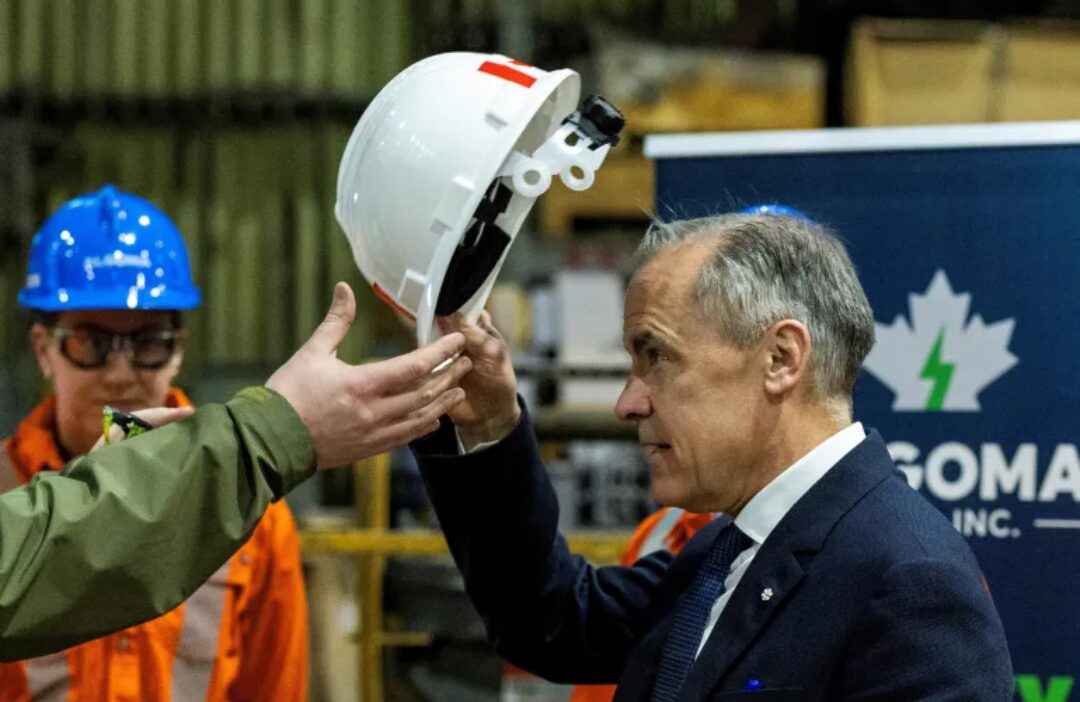
Even for USMCA-compliant auto parts, tariffs on raw metals for cars will have “cascading impacts,” Greco said. One-quarter of imported US steel is Canadian, and over half of its imported aluminium. Steel coils and a flag of Canada are seen in the factory before Canada’s Prime Minister-designate Mark Carney visits the ArcelorMittal Dofasco steel mill in Hamilton, Ontario, Canada.
The labour movement is divided on the issue, with some US labour leaders backing Trump’s “America First” economic agenda. The United Auto Workers head endorsed “bringing back American jobs.” However, Canadian auto workers are worried about their jobs and the impact of tariffs on their industry.

As the deadline looms, Canadian manufacturers are preparing for the worst. The impact of tariffs on the industry will be significant, and companies will have to make tough decisions to stay competitive. The uncertainty surrounding the tariffs has created a sense of volatility, and it remains to be seen how the situation will unfold.