The Trump SNAP suspension faced a major legal setback after two federal judges ruled that the administration must continue providing food stamp benefits to millions of low-income Americans.
The rulings arrived hours apart, with judges in Rhode Island and Massachusetts both issuing orders compelling the government to use contingency funds during the prolonged government shutdown.
One federal judge ruling came from John McConnell in Providence, who issued a temporary restraining order preventing the U.S. Department of Agriculture from halting food stamp benefits on November 1.
The plaintiffs, a coalition of cities, unions, and nonprofit groups, argued that the abrupt Trump SNAP suspension was unlawful and would devastate families already struggling with rising food insecurity.
Judge McConnell agreed that suspending SNAP aid amid the government shutdown could cause “irreparable harm,” directing the USDA to use available funds to maintain benefits temporarily.
In a parallel case, Massachusetts District Judge Indira Talwani ordered the administration to clarify its funding plans and maintain operations of the nation’s largest anti-hunger program.
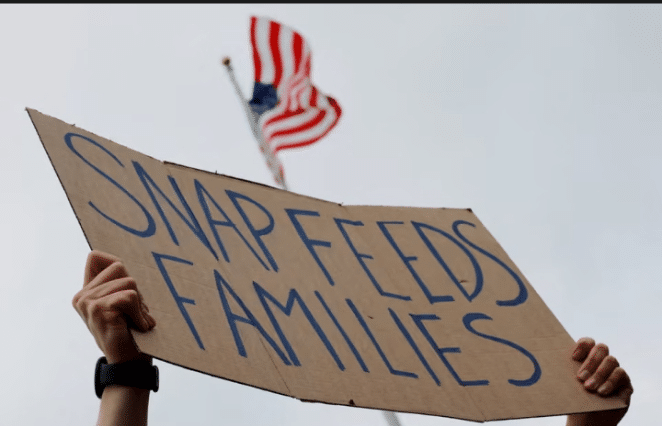
The Trump SNAP suspension plan would have halted payments to nearly 42 million Americans, roughly one in eight citizens, beginning the first week of November.
According to court documents, the USDA claimed it lacked sufficient appropriations authority to pay the $9 billion monthly cost of the program without congressional approval.
However, both judges noted that contingency funds totaling more than $5 billion remained available and could legally sustain food stamp benefits for at least part of November.
Democracy Forward, the legal advocacy group representing the Rhode Island plaintiffs, emphasized that the administration’s refusal to release emergency reserves violated congressional intent.
Their attorneys argued that Congress had explicitly authorized the USDA to draw from those reserves when “necessary to carry out program operations,” including during fiscal disruptions.
The Trump SNAP suspension triggered immediate backlash nationwide, as governors and mayors warned of an imminent hunger crisis if federal food assistance were interrupted.
During the ongoing government shutdown, which began on October 1, millions of households reliant on SNAP feared losing the only steady source of grocery funds they had left.
President Donald Trump responded on Truth Social, claiming he did “not want Americans to go hungry,” blaming Democrats for prolonging the shutdown that froze government appropriations.
“I have instructed our lawyers to ask the Court to clarify how we can legally fund SNAP as soon as possible,” Trump wrote, pledging to act once given “appropriate legal direction.”
Critics dismissed the statement as political deflection, arguing that the Trump SNAP suspension was a deliberate pressure tactic aimed at forcing Democrats to reopen the government.
The administration has previously redirected federal funds to protect politically favored programs, such as military pay and border enforcement, while sidelining public assistance schemes.
This selective reallocation underscored a broader strategy in which SNAP, a lifeline for low-income Americans, became collateral in partisan budget warfare.
In court filings, the USDA defended its position by asserting that the contingency fund was intended for natural disasters, not for fiscal emergencies caused by political gridlock.
Officials warned that a court-ordered disbursal could be “operationally fraught,” potentially delaying food stamp benefits and leaving households with less than half their normal allotment.
Nevertheless, the department’s own lapse plan released in September suggested otherwise, noting that Congress intended SNAP operations to continue even during a government shutdown.
That document, which referenced “multi-year contingency funds,” was quietly removed from the USDA website days before the first lawsuit was filed, drawing accusations of bad faith.
The federal judge ruling also highlighted inconsistencies in the administration’s public statements, including a new USDA web notice blaming Senate Democrats for the budget impasse.
“The well has run dry,” the notice declared, incorrectly asserting that there would be “no benefits issued November 01,” despite available reserves and prior legal precedent.
Anti-hunger advocates called the message misleading and politically charged, arguing it sowed panic among beneficiaries who depend on their monthly SNAP debit cards.
In response to the Trump SNAP suspension, several states declared food emergencies and mobilized local resources to fill the impending gap in federal nutrition aid.
New York Governor Kathy Hochul announced a $65 million allocation to food banks, declaring, “Unlike Washington Republicans, I won’t sit idly by as families struggle to put food on the table.”
California Governor Gavin Newsom pledged $80 million in state funds and deployed the National Guard to assist overwhelmed food pantries across the state.
Governors from Delaware, Oregon, and Virginia also issued emergency declarations, coordinating with local nonprofits to offset the effects of the Trump SNAP suspension.
Experts warn that any prolonged disruption of food stamp benefits could strain food banks, which have already reported record demand amid inflation and economic stagnation.
Feeding America, the largest hunger-relief organization in the U.S., estimates that food insecurity could surge by 30% if SNAP payments are delayed beyond two weeks.
Such consequences illustrate the cascading effects of the government shutdown, which has shuttered critical services and frozen pay for hundreds of thousands of federal employees.
The federal judge ruling in both cases temporarily stabilizes the situation, but uncertainty remains as the Justice Department considers appealing the orders.
Legal analysts predict the administration will argue that judicial interference in budgetary decisions violates the separation of powers doctrine.
However, public policy experts counter that the USDA has both the funds and authority to maintain food stamp benefits during appropriations lapses, citing prior shutdown precedents.
For low-income Americans, the court victories offer short-term relief but little reassurance about the months ahead if the political standoff persists.
“I don’t know what I’d do without that card,” said Angela Rivera, a single mother in Maryland. “It’s the only way I can feed my kids right now.”
Across the nation, families expressed similar concerns, fearing that future appeals could reinstate the Trump SNAP suspension and plunge millions back into food insecurity.
Advocacy groups are calling on Congress to pass an emergency funding bill that guarantees SNAP operations regardless of future shutdowns.
Economists note that the program not only sustains families but also stabilizes the economy by injecting billions into local grocery markets each month.
The suspension of such payments, they warn, could lead to reduced consumer spending, increased poverty, and long-term economic strain.
For now, the federal judge ruling ensures SNAP cards remain funded, but both courts required the administration to submit detailed plans for November disbursements by early next week.
Should the government fail to comply, plaintiffs are expected to seek contempt orders, potentially escalating the legal showdown even further.
Democracy Forward announced it will continue monitoring compliance, emphasizing that the Trump SNAP suspension was “unlawful, unnecessary, and morally indefensible.”
The group’s director, Skye Perryman, stated, “We will not allow millions of low-income Americans to be used as pawns in political brinkmanship.”
As hunger relief networks brace for future uncertainty, the broader debate over the role of social welfare programs in U.S. governance is once again front and center.
Analysts see the current legal standoff as a defining moment for the balance between executive discretion and humanitarian obligation.

The Trump SNAP suspension saga underscores how deeply intertwined social policy, politics, and the courts have become during the nation’s longest-running budget impasse.
While Friday’s rulings temporarily restore a lifeline to struggling families, the outcome of forthcoming appeals will determine whether that relief endures beyond November.