

South Korea Yoon Suk Yeol life sentence has sent shockwaves through the nation after a court jailed the former president for leading an insurrection tied to a failed martial law bid.
The South Korea Yoon Suk Yeol life sentence was delivered by judges in Seoul, marking the first time an elected leader in the democratic era received maximum punishment.
A central district court ruled that Yoon’s December 2024 martial law declaration amounted to an unconstitutional attempt to subvert civilian government and paralyse parliamentary authority.
Judges found the order was designed to “blockade the assembly hall,” deploy troops, and prevent lawmakers from meeting, debating, or voting during a national emergency.
The ruling confirmed prosecutors’ claims that Yoon sought to dismantle democratic checks under the guise of restoring order against alleged “anti-state forces.”
The court noted Yoon’s consistent refusal to apologise, his absence from hearings, and the “severe social cost” inflicted on South Korean society.
According to the judgment, the failed martial law severely damaged military neutrality and eroded international confidence in South Korea’s democratic institutions.
Although prosecutors demanded capital punishment, the court opted for life imprisonment, citing incomplete execution and limited physical force during the six-hour crisis.
Legal experts said the verdict reflects judicial determination to protect constitutional order following the most serious democratic threat in decades.
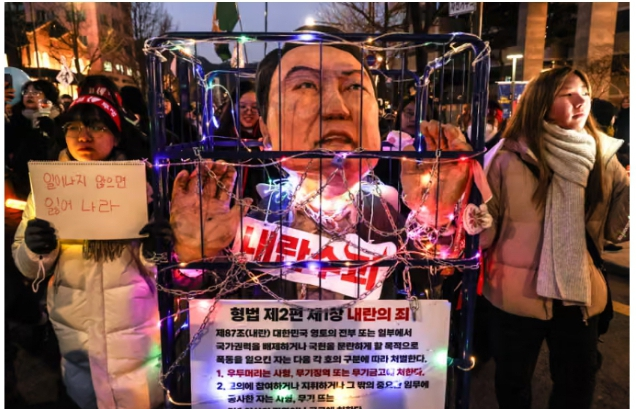
The South Korea Yoon Suk Yeol life sentence was broadcast live, with the former leader showing little visible emotion as the ruling was read aloud.
Under South Korean law, leading an insurrection carries penalties ranging from death to life imprisonment with or without labour.
Prosecutors argued Yoon mobilised armed forces to surround parliament, arrest political opponents, and seize control of the election commission.
Yoon defended his actions by claiming unproven election fraud, an assertion judges described as “unsupported and destabilising.”
Within hours of the declaration, lawmakers breached security lines to overturn martial law in an emergency parliamentary vote.
Parliament moved swiftly to impeach Yoon, and the constitutional court formally removed him from office months later.
Outside the courthouse, Yoon supporters waved national and US flags, chanting slogans while accusing the judiciary of political bias.
Some demonstrators collapsed in tears after the sentence, shouting that “the country is finished,” as police struggled to maintain order.
Nearby, progressive activists celebrated the ruling, calling it a victory for democracy and civilian supremacy over the military.
The court also sentenced several senior officials involved in the plot, including former defence and police chiefs.
Judges described the episode as a “self-coup,” warning that elected power abusing the military poses greater danger than traditional uprisings.
Analysts said the ruling sets a precedent that no political office shields leaders from criminal accountability.
Yoon still faces multiple criminal trials, including a treason charge linked to alleged attempts to provoke regional military tension.
His legal team condemned the ruling as a “show trial” and vowed to appeal, insisting history would “vindicate” their client.
Life imprisonment in South Korea allows parole consideration after twenty years, subject to conduct and expressions of remorse.
Historians note parallels with past cases involving former presidents, including Park Geun-hye, who was later pardoned.
Every former South Korean leader jailed since democratisation has eventually received clemency, raising debate over Yoon’s long-term fate.
However, public sentiment remains deeply divided, with polls showing strong support for strict punishment.
Observers say the South Korea Yoon Suk Yeol life sentence underscores the resilience of democratic institutions under extreme stress.
The verdict may reshape civil-military relations and redefine presidential accountability for future administrations.
International allies are watching closely, viewing the case as a defining moment for Asian democratic governance.
As South Korea moves forward, the scars of the martial law crisis remain visible across political and social lines.
The nation now faces the challenge of restoring unity while reaffirming constitutional rule and democratic trust.

About The Author


