Rufai Oseni questions Prof Amupitan CV, citing inconsistencies in his education, law degree, and rapid rise in academia, urging transparency in INEC appointment.
Renowned broadcaster and social commentator Rufai Oseni has raised critical concerns about the credentials of Professor Joash Ojo Amupitan, recently named as Chairman of the Independent National Electoral Commission (INEC) by President Bola Ahmed Tinubu.
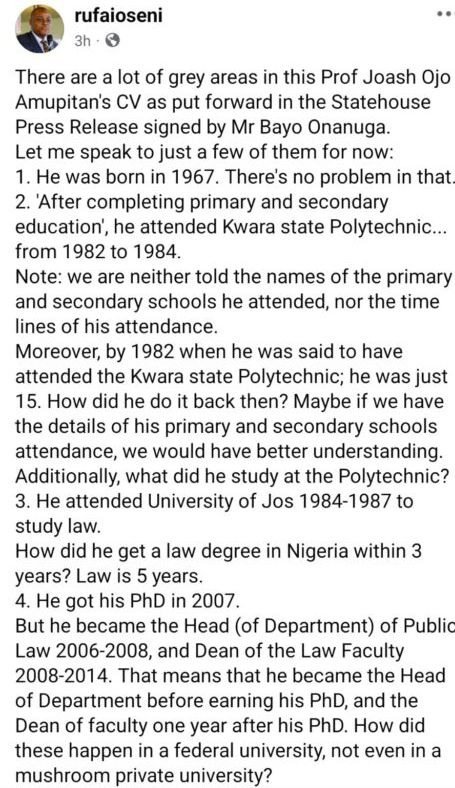
In his statement, Rufai Oseni questions Prof Amupitan CV, highlighting what he called “grey areas” and inconsistencies in the academic record presented by the Presidency through a State House press release signed by Mr. Bayo Onanuga, Special Adviser to the President on Information and Strategy on Thursday, October 9.
Oseni’s detailed analysis of the CV questions the accuracy of Amupitan’s educational history, law degree duration, and unusually rapid academic promotions.

He noted that public transparency demands clear, verifiable information—especially for such a sensitive national office.
The first point of concern Oseni raised is the incomplete information about Prof Amupitan’s early education.
The CV claims that Amupitan was born in 1967, and after completing both primary and secondary education, he attended Kwara State Polytechnic between 1982 and 1984.
However, the document does not provide the names of his primary or secondary schools or the years he attended them.
Oseni noted that in 1982, Amupitan would have been just 15 years old, questioning how he could have completed both educational stages so early and qualified for polytechnic admission at such a young age.
He further observed that the CV does not indicate what course of study Amupitan pursued at Kwara State Polytechnic. According to Oseni, this lack of detail “creates a gap that undermines public confidence in the authenticity of the academic timeline.”
Another major irregularity noted in the CV relates to Amupitan’s time at the University of Jos, where he reportedly studied Law from 1984 to 1987.
In Nigeria, a Law degree (LLB) traditionally spans five years, making the three-year timeline unusual and improbable.
“How did he get a Law degree in Nigeria within three years?” Oseni asked. His question forms the central argument as Rufai Oseni questions Prof Amupitan CV, calling on authorities to clarify whether there was an error in the date, a special arrangement, or a misrepresentation.
Oseni emphasized that under the Nigerian university system, law programs cannot be completed in three years, even under accelerated academic conditions.
The lack of explanation, he said, “raises legitimate concerns that must be addressed publicly.”
Equally troubling, according to Oseni, is the sequence of Amupitan’s university appointments.
The CV indicates that he obtained his PhD in 2007, yet he served as Head of the Department of Public Law from 2006 to 2008, before earning the doctorate. Soon after, he became Dean of the Faculty of Law (2008–2014), just a year after completing his PhD.
Oseni argued that such progression is “highly uncommon in the Nigerian university system,” where positions like Head of Department and Dean typically require a PhD and several years of post-doctoral teaching and research experience.
“This is not a private university,” Oseni remarked. “Such appointments in federal institutions are guided by merit, seniority, and academic qualifications. The sequence shown in this CV demands an explanation.”
His comments have reignited public discussion about academic integrity in the appointment of individuals to top national positions.
For Oseni, the issue goes beyond one man’s record—it concerns the integrity of public service appointments in Nigeria.
When Rufai Oseni questions Prof Amupitan CV, he frames it as part of a broader call for accountability in governance and due diligence in vetting candidates for sensitive roles.
“The Independent National Electoral Commission is central to Nigeria’s democracy,” he said.
“Its leadership must not only be competent but also transparent. Nigerians deserve to see complete, verified records before appointments are confirmed.”
He urged the Presidency to release a clarified version of the CV and correct any errors or omissions to maintain public trust in the system.
Since Oseni’s remarks went public, reactions have flooded social media and academic circles. Some scholars and civic activists praised him for demanding transparency and professionalism, while others suggested that the inconsistencies might stem from clerical errors in the State House publication.
Still, many insist that given the sensitivity of the appointment, every detail in the document must be properly verified.
Legal practitioners also weighed in, with some noting that in certain rare cases, senior lecturers can head departments without a PhD, though they agreed that becoming Dean within a year of completing a doctorate remains highly irregular.
The controversy, they argued, underscores the need for stricter vetting procedures and full disclosure during presidential appointments.
As Rufai Oseni questions Prof Amupitan CV, the issue has grown beyond academic nitpicking into a test of Nigeria’s commitment to transparency, accountability, and institutional integrity.
The matter highlights how errors or omissions in public records can quickly escalate into national debates about trust in leadership.
Oseni insists his concern is not personal but principled. “The people who packaged this CV owe Nigerians explanations. We must get used to doing things right,” he said.
Until clarifications are provided by the government or the nominee himself, public skepticism is likely to persist.
The scrutiny surrounding Prof Joash Ojo Amupitan’s credentials has now become a symbol of a broader national demand for honesty and verification in governance.
More news at ireport247news
About The Author