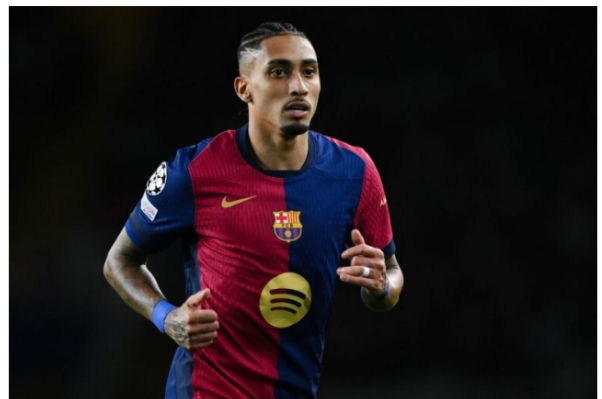
Barcelona winger Raphinha Ballon d’Or disappointment became a major talking point after the Brazilian international openly reflected on missing out on football’s most prestigious individual award, despite enjoying what he described as one of the strongest seasons of his professional career.
Raphinha was a central figure in Barcelona’s success during the campaign, playing a decisive role as the club secured three major trophies and advanced to the Champions League semi-finals under new head coach Hansi Flick.
His performances across domestic and European competitions earned widespread praise, yet they were ultimately not enough to see him crowned the world’s best player.
The Ballon d’Or was instead awarded to Ousmane Dembélé, a decision that sparked debate among fans and pundits alike, particularly given Raphinha’s consistency and influence throughout the season.
Speaking candidly about the outcome, the Brazilian admitted the final result left him feeling frustrated and undervalued.
“I was upset. I expected more. I expected to be in the top three at least,” Raphinha said in an interview with Sofascore. “I knew winning would be difficult because the Champions League weighs a lot, so I was upset with the position I ended in.”
The former Leeds United winger made it clear that his disappointment was not driven by arrogance, but by a genuine belief that his season-long contribution deserved stronger recognition.
He pointed to the importance of evaluating players across an entire campaign rather than placing excessive weight on one competition or defining moment.
Raphinha enjoyed one of the most productive seasons of his career, contributing goals, assists and relentless pressing from the right flank.
His work rate, tactical discipline and attacking output made him a key component in Flick’s system, particularly during crucial matches where Barcelona’s margin for error was slim.
Beyond the numbers, Raphinha’s leadership on the pitch stood out. He frequently took responsibility in high-pressure situations, delivering decisive performances in domestic title races and knockout ties in Europe. Those close to the club viewed him as one of the players who set the tone for Barcelona’s resurgence.
Despite this, the Ballon d’Or voting process did not fall in his favour. Raphinha acknowledged that many aspects of the award are outside a player’s control, including narrative, timing and the weighting given to specific competitions.
“I understand it involves many things I cannot control,” he said. “There are many things that are complicated to keep highlighting.”
While the disappointment lingered, Raphinha was keen to stress that no individual award could diminish what he and his teammates achieved across the season. He emphasised personal pride in his performances and collective success with the club.
“What I can say is that I’m very satisfied with the season I had, and no individual award will erase what I did last season,” he added.
When asked to rank himself among the world’s best players, Raphinha showed confidence rather than hesitation. In his view, the Ballon d’Or should reward consistency, influence and sustained excellence over the course of a full season.
“I would place myself in first place,” he said. “In my understanding, an individual award cannot be based on a single competition.”
Raphinha argued that his case was built on a complete body of work rather than isolated highlights. He pointed to the trophies Barcelona won, the numbers he produced and the overall contribution he made on both ends of the pitch.
“Based on what I delivered during the season, the titles I won, the numbers I achieved and everything I contributed on the pitch, I think I deserved to win,” he stated.
The Brazilian also highlighted a broader issue within modern football awards, where Champions League performances often carry disproportionate influence.
While he acknowledged the importance of Europe’s elite competition, he questioned whether it should outweigh domestic success and season-long consistency.
“As it is an award that is practically based on a single competition, Dembélé deserved to win,” Raphinha said. “Especially since he also had a spectacular season.”
In making that point, Raphinha was careful to show respect for his fellow nominees. He praised Dembélé’s achievements and also acknowledged the emergence of younger stars who enjoyed standout campaigns.
“Lamine also had a spectacular season,” he added, referencing Barcelona’s teenage sensation who played a significant role despite his age.
Still, Raphinha maintained that if the Ballon d’Or were judged purely on overall seasonal performance, the outcome would have been different.
“But in my view, if it were something based on the season itself, I think I deserved to win the award,” he concluded.
The debate surrounding Raphinha’s Ballon d’Or ranking reflects a wider conversation in football about how individual excellence should be measured.
Read also:Fulham Villarreal send condolence messages to Samuel Chukwueze over mother’s death
In an era dominated by data, narratives and major tournament moments, players who deliver consistently across multiple competitions can sometimes feel overlooked.
For Barcelona, however, Raphinha’s importance goes far beyond awards. His performances were instrumental in the club’s return to the top tier of European football, and his influence under Flick has solidified his status as a key figure in the squad.
As Barcelona look ahead to future challenges, Raphinha’s comments serve as both motivation and a reminder of his ambition. While individual recognition may have eluded him this time, his focus appears firmly set on continuing to deliver at the highest level.
Whether or not a Ballon d’Or eventually comes his way, Raphinha’s season has already secured its place as one of the most impactful of his career, defined by resilience, consistency and a clear belief in his own worth among football’s elite.
About The Author