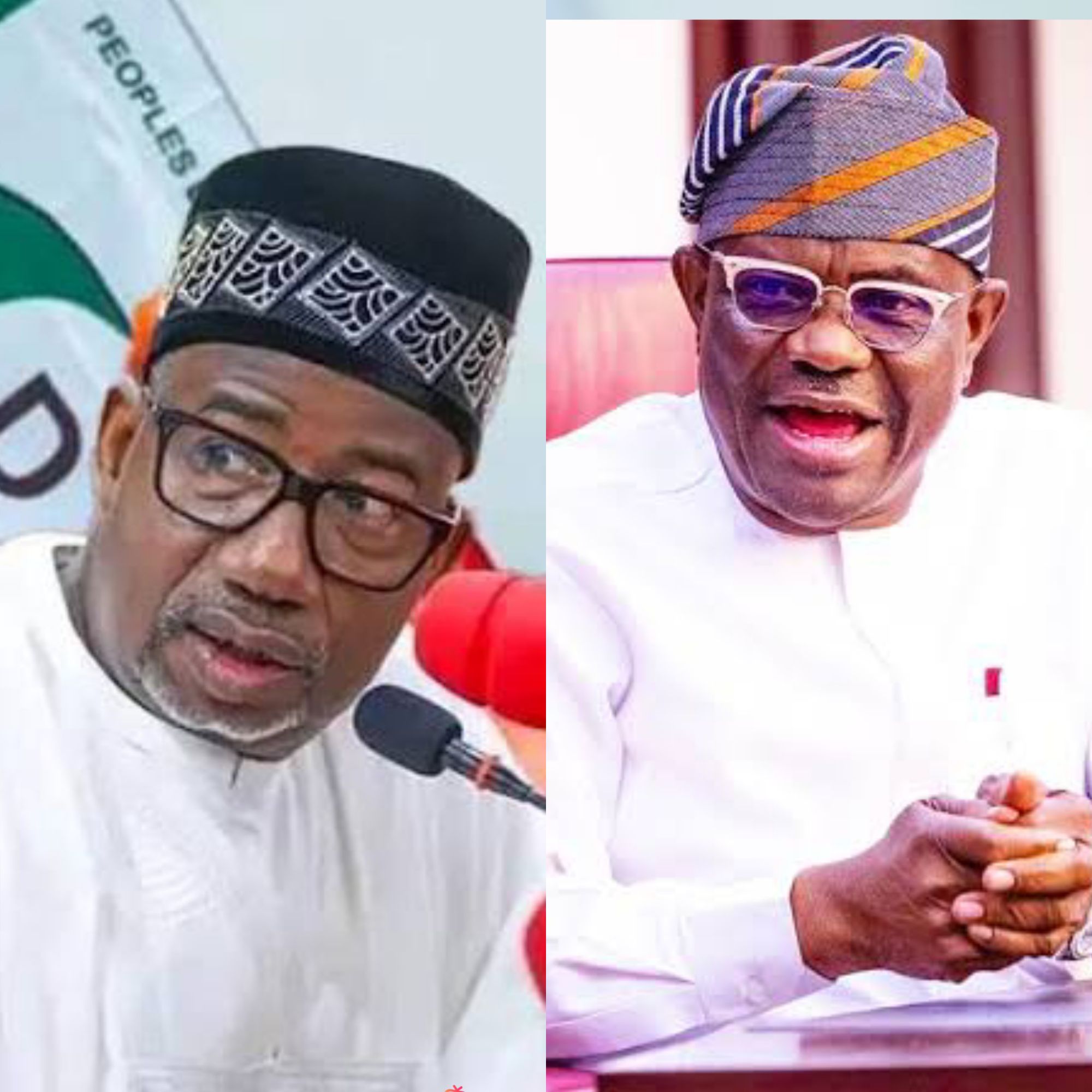
The PDP crisis escalates as Bauchi Governor Bala Mohammed and FCT Minister Nyesom Wike exchange sharp accusations over loyalty, power and political control.
The growing of the Peoples Democratic Party (PDP) crisis took a dramatic turn on Wednesday as Bauchi State Governor, Bala Mohammed, and the Minister of the Federal Capital Territory (FCT), Nyesom Wike, engaged in a fierce public confrontation that has further exposed internal fractures within Nigeria’s main opposition party.

What began as political disagreements quickly escalated into direct accusations, personal attacks and counterclaims, raising serious concerns about the future cohesion of PDP ahead of critical political realignments in the country.
Governor Mohammed ignited the controversy during an appearance on Channels Television’s Sunrise Daily, where he accused Wike of deliberately working to destabilise Bauchi State and destroy his political career.
According to the governor, the FCT minister was central to a coordinated campaign of intimidation and misinformation aimed at portraying him as sympathetic to banditry and terrorism.
Mohammed described the allegations as reckless and dangerous, stressing that Bauchi remains one of the most stable states in the North-East region.
He argued that attempts to link him with insecurity were not based on facts but driven by political motives intended to weaken him as an influential opposition voice.
“I am a sitting governor, and my state is among the most secure in northern Nigeria,” Mohammed said.
“Yet, I am being branded a terrorist simply because of politics.”
The Bauchi governor maintained that such claims were part of a broader strategy to silence dissent within the PDP.
He likened the situation to a deliberate effort to tarnish his reputation, invoking the proverb that a bad name is often given to justify destruction.
Central to Mohammed’s accusation was his claim that Wike had threatened to put fire in Bauchi by encouraging political unrest and attacks against his administration.
He described the alleged threat as deeply troubling, especially coming from a senior government official.
Mohammed further alleged that unnamed powerful forces were pressuring him to abandon the PDP and defect to the ruling All Progressives Congress (APC).
Although he did not specify the source of the pressure, he identified Wike as a major figure in what he described as a calculated political siege.
In response, Mohammed said he had written formally to the Attorney General of the Federation and copied security agencies, seeking protection and legal redress.
He warned that he might escalate the matter to the international community, framing the situation as political victimisation and a violation of his fundamental rights.
The governor also accused Wike of undermining the PDP from within, arguing that the FCT minister could not genuinely claim to be an opposition figure while openly aligning himself with the APC-led Federal Government.
“He is an undertaker in our party,” Mohammed said.
“You cannot be in two places at the same time. It is against the rules of politics and common sense.”
The clash comes amid heightened tension between the Bauchi State Government and the Economic and Financial Crimes Commission (EFCC).
Mohammed alleged that the Federal Government was using the anti-graft agency to harass his administration following terrorism financing charges involving $9.7 million against the state’s Commissioner for Finance, Yakubu Adamu, and others. He insisted that the case was politically motivated and part of the ongoing PDP crisis.
Wike, however, dismissed all the allegations, describing them as baseless excuses for internal failures within Bauchi State and the PDP.
Speaking during a visit to Abua-Odual Local Government Area of Rivers State, the FCT minister said Mohammed lacked the political structure and party unity required to manage his state and prepare a credible successor.
According to Wike, Mohammed’s problems stemmed from poor leadership and unresolved internal disputes, not from external interference.
He recalled a previous encounter in which the Bauchi governor allegedly attempted to interfere in party leadership matters in Rivers State, warning that such actions would attract consequences.
Reacting to the claim that he threatened to destabilise Bauchi, Wike denied ever making such statements and challenged Mohammed to face his political realities rather than blaming others.
“He says all his problems are because of me,” Wike said. “If you have challenges, face them.”
The FCT minister also rejected suggestions that the EFCC was acting on his behalf, insisting that he had no interest in Bauchi’s finances. He argued that if the state’s records were clean, its leaders had nothing to fear from investigations.
Wike went further to question Mohammed’s performance during his tenure as FCT minister between 2010 and 2015, accusing him of mismanaging land allocations and failing to deliver infrastructure projects.
He claimed that many projects currently underway in Abuja were neglected during Mohammed’s time in office.
Addressing personal insults reportedly directed at him, including references to his educational background and early life, Wike said his political journey spoke louder than name-calling.
He highlighted his rise from humble beginnings to becoming a local government chairman, two-term governor and two-time minister.
Reaffirming his support for President Bola Ahmed Tinubu, Wike said his political decisions were guided by conscience, performance and the tangible benefits delivered to Rivers State.
As the PDP crisis continues to deepen, the public exchange between Mohammed and Wike underscores the growing struggle for influence, loyalty and relevance within Nigeria’s opposition politics.
The outcome of this internal battle may shape not only the future of the PDP but also the broader landscape of Nigerian opposition politics in the years ahead.
Ireport247news
About the Author