

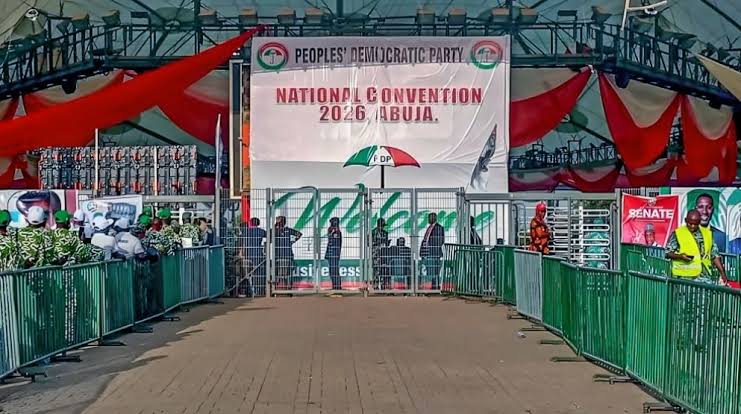
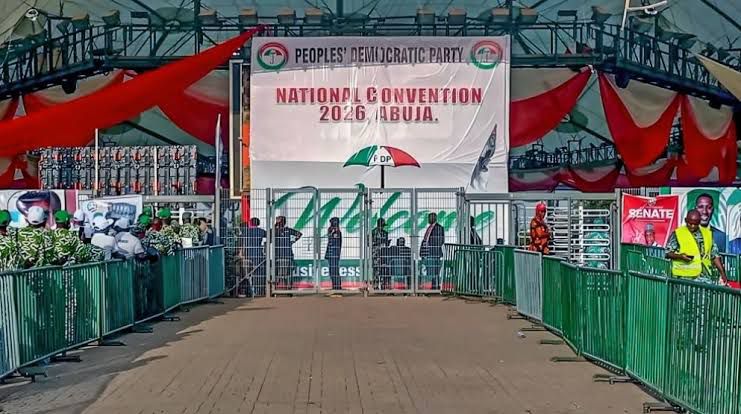
The People’s Democratic Party (PDP) Convention held in Abuja on Sunday marked a significant turning point for the opposition party, blending leadership restructuring with visible internal tensions.
Delegates from several states converged at the Moshood Abiola National Stadium Velodrome, where the party unveiled a new National Working Committee (NWC), even as divisions within its ranks became increasingly apparent.
From the outset, the gathering carried both symbolic and strategic importance. For many stakeholders, the convention represented an opportunity to reposition the PDP ahead of future electoral contests.
However, the event also exposed the fragile unity within the party, as disagreements over legitimacy, leadership, and participation created parallel narratives around the exercise.
A major highlight of the convention was the emergence of a new 19-member National Working Committee, in line with the provisions of the party’s constitution.
The leadership structure, which is expected to guide the party for the next four years, was largely decided through a consensus arrangement backed by influential figures within the party.
Abdulrahman Mohammed was affirmed as National Chairman, alongside key officials occupying strategic roles across the party hierarchy.
Other appointments covered critical portfolios such as national secretary, organising secretary, publicity secretary, treasurer, and legal adviser, among others.
The formation of this team is widely viewed as an attempt to stabilise the party and provide a clear direction amid ongoing uncertainties.
Supporters of the process described it as orderly and necessary, noting that the PDP needed a cohesive leadership to regain its footing as a viable opposition force.
The consensus model, according to insiders, was adopted to avoid prolonged disputes and ensure a smooth transition into a new phase of party administration.
Despite these efforts, participation at the convention reflected a mixed picture.
While delegates from states such as Kebbi, Ekiti, Benue, Bauchi, and Oyo turned out in large numbers, others chose to stay away, citing unresolved legal and political concerns. This uneven attendance underscored the widening cracks within the party.
In Ekiti State, a faction aligned with former Governor Ayo Fayose actively participated in the convention, insisting that the gathering was legitimate and representative of the authentic PDP structure.
Similarly, delegates from Benue State, led by former Governor Samuel Ortom, confirmed their presence and engagement in the proceedings.
Kebbi State officials also expressed satisfaction with the organisation of the convention, stating that all their delegates were mobilised and took part fully in the exercise.
Their position reinforced the narrative that the convention enjoyed substantial grassroots backing across several regions.
In contrast, some state chapters openly rejected the exercise. The Edo State leadership described the convention as unlawful, pointing to an ongoing case before the Supreme Court.
Party officials in the state warned members against participating, arguing that proceeding with the convention under such circumstances could undermine the rule of law and deepen internal disputes within the PDP.
Gombe State adopted a similar stance, although its reasons were framed around unresolved internal challenges.
The state leadership indicated that it would not take part in the convention until certain issues were addressed, further highlighting the fragmented nature of the party at this critical moment.
Perhaps one of the most striking developments emerged from Sokoto State, where divisions within the party took a more dramatic turn.
While the official state leadership aligned with the boycott, a rival faction openly defied the directive and attended the convention.
This group maintained that Sokoto remained an integral part of the PDP and should not be excluded from national activities.
The Sokoto situation illustrated the broader struggle for control and influence within the party.
Competing factions across multiple states continue to assert legitimacy, often aligning with different national figures and power blocs. This dynamic has made it increasingly difficult for the party to present a united front.
Amid these tensions, prominent leaders used the convention as a platform to advocate reconciliation.
Figures such as Nyesom Wike, Bukola Saraki, Sule Lamido, and Okezie Ikpeazu emphasised the need for unity, urging members to set aside differences and work towards rebuilding trust within the party.
Their message centred on the idea that internal cohesion is essential for the PDP to effectively challenge its political rivals.
Without resolving its internal disputes, the party risks weakening its position and losing relevance in the broader political landscape.
In Ogun State, the situation reflected a microcosm of the national divide.
Some members attended the convention, aligning with one faction, while others stayed away in support of an alternative bloc.
Party officials confirmed that reconciliation efforts are ongoing, suggesting that dialogue remains a key strategy for resolving differences.
Observers note that the success of these reconciliation efforts will largely determine the future trajectory of the party.
If the PDP can bridge its internal gaps, it stands a better chance of regaining public confidence and strengthening its electoral prospects. However, failure to do so may lead to further fragmentation.
Another notable aspect of the convention was the strong turnout of party stakeholders and former officeholders.
Their presence added weight to the proceedings and signalled continued interest in the party’s direction.
However, it also highlighted the influence of political heavyweights in shaping internal decisions.
While the newly constituted National Working Committee is expected to steer the party forward, it faces an immediate challenge: managing competing interests and restoring unity.
The task ahead goes beyond administrative leadership; it requires careful negotiation, inclusiveness, and a commitment to transparency.
The convention ultimately delivered mixed outcomes. On one hand, it provided the PDP with a renewed leadership structure and a potential pathway for rebuilding.
On the other hand, it exposed unresolved conflicts that could hinder progress if left unaddressed.
As the party moves forward, attention will shift to how the new leadership engages with aggrieved factions and addresses concerns raised by dissenting voices.
The coming months will be critical in determining whether the convention serves as a foundation for renewal or a reminder of persistent divisions.
In the final analysis, the Abuja gathering was more than just a routine political event. It was a defining moment for the PDP, capturing both its aspirations and its challenges.
The decisions taken and the reactions that followed have set the stage for what lies ahead in the party’s ongoing journey toward relevance and cohesion.
Ireport247news
About The Author
