

In a deadly escalation of violence, Pakistan security crisis deepened as three suicide bombers targeted the Federal Constabulary headquarters in Peshawar, killing three personnel and wounding several.
The attack unfolded early Monday morning, with one bomber detonating explosives at the main gate, while two others attempted to force entry but were shot dead by guards.
Peshawar Capital City Police Officer Mian Saeed Ahmad said, “initially, three militants tried to attack the headquarters. One detonated explosives at the gate, the other two were neutralized promptly.”
Dunya News reported that the slain officers were stationed at the gate, and their deaths underscore ongoing risks to personnel amid Pakistan security crisis across the Khyber Pakhtunkhwa province.
Peshawar Police Chief Saeed Ahmad told the Associated Press that many security personnel were on parade drills during the attack, and rapid response prevented a larger tragedy.
“The terrorists involved in today’s attack were on foot and failed to reach the parade area,” Ahmad added, highlighting the preparedness of security forces against Pakistan Taliban violence.
Local authorities immediately cordoned off the area around the FC headquarters, located in a densely populated part of Peshawar, to prevent further casualties among civilians nearby.
According to Dawn, six civilians were injured and taken to Lady Reading Hospital, all in stable condition, reflecting the collateral impact of the ongoing Pakistan security crisis.
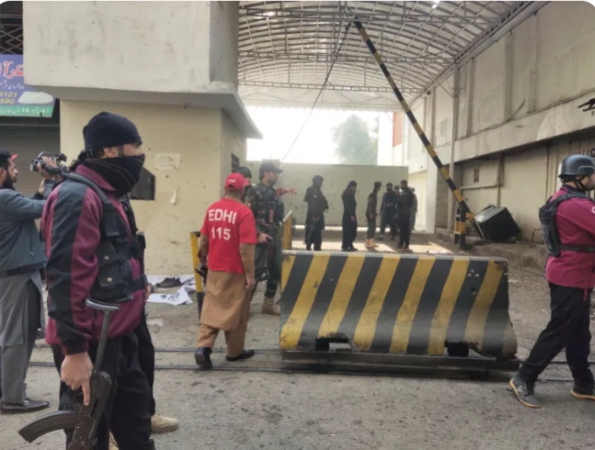
Emergency services at both Lady Reading and Khyber Teaching Hospital were placed on high alert, ready to respond to additional casualties following the Peshawar FC headquarters bombing.
Eyewitnesses described chaos as rescue teams examined the wreckage and attempted to clear the site, illustrating the broader strain on local emergency responders during Pakistan security crisis events.
No group has officially claimed responsibility for the attack, though the Pakistan Taliban, allied with the Afghan Taliban, have previously carried out similar assaults targeting security infrastructure.
The incident comes less than two weeks after a suicide bombing outside a court in Islamabad killed 12 people, reflecting a surge in militant attacks that exacerbate Pakistan security crisis nationwide.
Pakistani officials accuse factions of the Pakistan Taliban of operating freely from across the Afghan border, raising tensions between Islamabad and Kabul over cross-border militancy in the region.
Prime Minister Shehbaz Sharif condemned the attack and praised the FC for their “timely” response, emphasizing that Pakistan will not tolerate acts undermining national integrity during the ongoing Pakistan security crisis.
“The perpetrators of this incident should be identified as soon as possible and brought to justice,” Sharif added, highlighting accountability measures amid repeated threats to security personnel.
President Asif Ali Zardari also expressed “heartfelt condolences” and commended the bravery of the security forces who contained the attack quickly, preventing what could have been a mass casualty event.
Security analysts noted that the location of the FC headquarters in a crowded urban area increases vulnerability, making rapid response training and perimeter security crucial in mitigating Pakistan security crisis.
Officials confirmed that investigations into the attackers’ identities and possible networks are ongoing, with intelligence agencies working to prevent further Pakistan Taliban violence and potential coordinated assaults.
The latest attack has further strained Pakistan-Afghanistan relations, with Islamabad urging Kabul to crack down on militant groups allegedly operating with impunity from Afghan territory.
Experts warned that repeated attacks on paramilitary forces and civilians could destabilize Khyber Pakhtunkhwa security, with implications for national counterterrorism strategies across Pakistan’s border regions.
Local residents expressed fear and anger, with many citing repeated bombings as a sign of persistent threats that compound daily life challenges during Pakistan security crisis episodes.
Healthcare workers at Lady Reading Hospital emphasized the need for continued vigilance, noting that timely medical interventions were essential in saving civilian lives after the Peshawar FC headquarters bombing.
The attack underscores ongoing challenges in Pakistan’s fight against militancy, with analysts calling for enhanced intelligence sharing, stricter border monitoring, and stronger local security measures amid repeated Pakistan Taliban violence.
Authorities continue to investigate and secure the site, with cordons in place and public warned to avoid the area, reflecting ongoing efforts to prevent further escalation in the Pakistan security crisis.
Prime Minister Sharif reiterated that Pakistan remains committed to thwarting terrorist designs, with security forces poised to respond rapidly to protect lives and maintain stability during this prolonged security crisis.

Residents and officials alike called for renewed national unity and vigilance, stressing that Pakistan security crisis cannot be resolved without cooperation between local communities, law enforcement, and intelligence agencies.
This attack represents another tragic chapter in Pakistan’s struggle against extremist violence, reinforcing the urgent need for continued reform, intelligence-led operations, and cross-border collaboration to address the Pakistan security crisis.


