

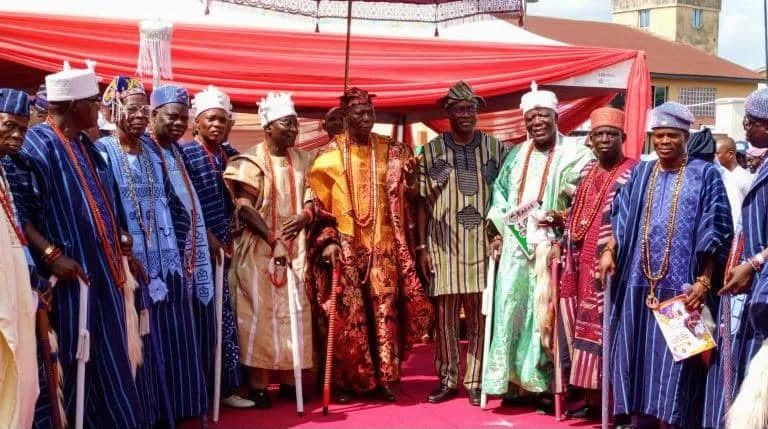
Governor Seyi Makinde has urged Oyo monarchs to remain politically neutral, sparking fresh debate over traditional rulers who supported his 2023 re-election bid.
Oyo 2027: Makinde, monarchs and the question of political neutrality
The debate over the political involvement of traditional rulers has resurfaced in Oyo State as political activities gather momentum ahead of the 2027 governorship election.
Governor Seyi Makinde, on Saturday, cautioned traditional rulers across the state to remain politically neutral, warning that monarchs who openly support political parties or candidates could expose themselves to avoidable political attacks.
Makinde spoke at the grand finale of the week-long first coronation anniversary celebration of His Royal Majesty, Oba Samuel Adebayo Adegbola Ajobo Olurin I, the Eleruwa of Eruwa.
The ceremony also featured the commissioning of the newly renovated Eleruwa Palace and the conferment of chieftaincy titles on Governor Makinde and his wife, Engr. Tamunominini Makinde.
Speaking on the political role of traditional rulers, the governor stressed that monarchs should remain accessible to politicians across party lines and avoid openly endorsing particular candidates.
According to him, traditional rulers occupy a position where political actors should be able to approach them for royal blessings irrespective of their political affiliations.
The governor also spoke about plans to intensify nationwide consultations regarding his presidential ambition, adding another political dimension to his remarks at the Eruwa event.
His comments have, however, triggered renewed discussions among residents and political observers who recall the involvement of some traditional rulers in the political campaigns surrounding his 2022 and 2023 re-election bid.
Several prominent monarchs were publicly associated with Makinde’s campaign, with some expressing support for his administration and endorsing his candidacy ahead of the 2023 governorship election.
This has led to a question now gaining attention in political circles: Why is Makinde calling for political neutrality among traditional rulers now, given the public support some monarchs gave him during the last governorship election?
Monarchs linked to Makinde’s 2023 re-election campaign
During the build-up to the 2023 Oyo governorship election, some prominent traditional rulers openly expressed support for Makinde.
Among those cited was the late Oba Lekan Balogun, the Olubadan of Ibadanland, who was associated with support for the governor in 2022.
Others included Oba Francis Olushola Alao, the Olugbon of Orile-Igbon, and Oba Khalid Olabisi Oyeniyi, the Okere of Saki, who were also reported to have backed Makinde during the political period.
Traditional rulers in the Oke-Ogun axis also reportedly aligned themselves with the governor during the 2023 campaign period, with some adopting him as their preferred candidate.
At the time, such endorsements attracted considerable political attention because of the influence traditional institutions continue to exercise across communities in Oyo State.
Why Makinde’s latest position is generating debate
The latest controversy is not necessarily about whether traditional rulers should participate in politics.
At its heart is a question of consistency and whether the principle of political neutrality should apply equally regardless of the political party or candidate involved.
Critics of Makinde’s position have pointed to the 2022 and 2023 election period, when some traditional rulers publicly supported his bid for a second term.
They argue that if monarchs were able to publicly identify with his candidacy during the previous election cycle, the governor’s latest warning against similar political endorsements deserves closer scrutiny.
Supporters of Makinde, however, may interpret his comments differently.
They could argue that the governor is advocating a broader principle aimed at protecting the dignity and neutrality of traditional institutions rather than attempting to influence the political choices of monarchs.
Under this interpretation, monarchs remaining accessible to all political actors would allow them to maintain relationships with politicians across party lines without being perceived as partisan figures.
Traditional rulers and politics in Oyo State
Traditional rulers occupy a significant position in Yoruba society.
Apart from serving as custodians of culture and tradition, monarchs often play important roles in community development, conflict resolution and maintaining social cohesion.
Their influence means that political parties and candidates frequently seek meetings, endorsements, prayers and royal blessings during election periods.
However, openly supporting a political candidate can also expose a monarch to criticism from members of the community who belong to opposing political parties.
This appears to be part of the concern raised by Makinde when he warned that monarchs who openly align themselves with political parties or candidates could become vulnerable to political attacks.
The debate therefore extends beyond the governor himself and raises a larger question about the appropriate role of traditional institutions in Nigeria’s democratic system.
Makinde’s presidential ambition adds another dimension
Makinde’s comments also came against the backdrop of his stated intention to intensify nationwide consultations regarding his presidential ambition.
The governor, who has completed his second term as Oyo State governor, has increasingly been mentioned in discussions surrounding the political realignment ahead of the 2027 general elections.
His decision to speak about the need for traditional rulers to remain politically neutral while also discussing nationwide political consultations has therefore attracted additional attention.
For some observers, the timing makes the issue particularly significant because politicians seeking support ahead of 2027 will likely engage traditional institutions across the country.
What does it mean for Oyo 2027?
The issue could become increasingly important as political parties and potential candidates begin positioning themselves for the 2027 Oyo State governorship election.
A number of political actors are expected to intensify consultations across the state’s major zones, including Ibadan, Oke-Ogun, Ogbomoso, Ibarapa and Oyo.
Traditional rulers will remain important stakeholders because of their influence within their respective communities.
If the principle of political neutrality becomes the expected standard, questions may arise over whether monarchs who previously endorsed candidates should now adopt a different approach.
On the other hand, some may argue that traditional rulers, as citizens, should retain the freedom to hold personal political opinions, provided their public conduct does not undermine their traditional responsibilities.
A question of consistency
The renewed debate surrounding Seyi Makinde and Oyo monarchs ultimately raises a broader question about consistency.
The governor is now asking traditional rulers to avoid openly endorsing political parties and candidates and instead remain accessible to all political actors.
Yet, during the 2022 and 2023 election period, several monarchs were publicly linked to his re-election campaign.
Whether Makinde’s latest position represents a new approach, a clarification of his expectations for traditional institutions, or simply an appeal for monarchs to protect themselves from political controversy will remain a subject of public discussion.
As Oyo State politics gradually moves towards another election cycle, the role of traditional rulers is likely to remain a major talking point.
For now, the central question remains: Is Governor Seyi Makinde advocating a consistent principle of royal neutrality ahead of 2027, or does his current position mark a shift from the political realities witnessed during his 2023 re-election campaign?
That is a question Oyo residents, political stakeholders and traditional institutions will continue to examine as the road to 2027 unfolds.
About The Author
