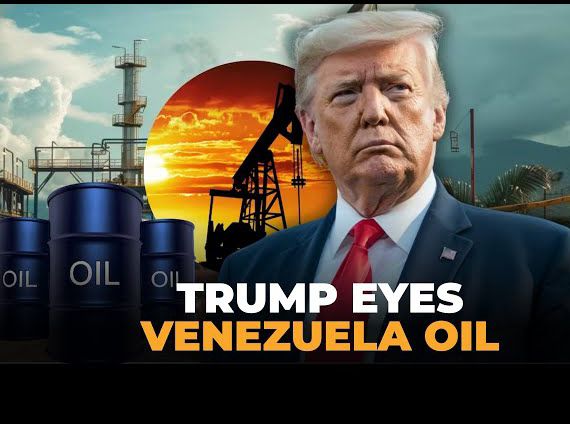
Global oil prices declined sharply on Wednesday as market sentiment turned bearish following fresh signals from United States President Donald Trump suggesting a potential influx of Venezuela’s $2bn crude into the global market.
The prospect of additional supply, estimated at up to 50 million barrels and valued at nearly $2 billion, unsettled traders already wary of weakening demand and geopolitical uncertainty.
Brent crude slipped below the psychologically significant $60-per-barrel mark during evening trading, while West Texas Intermediate (WTI) also recorded notable losses.
Analysts attributed the downturn largely to expectations that US access to Venezuelan oil could materially alter near-term supply dynamics, particularly in the Atlantic Basin.
Oil prices drops as Trump eyes Venezuela’s $2bn crude
Market volatility intensified after President Trump disclosed that Venezuela’s interim authorities had agreed in principle to provide between 30 million and 50 million barrels of crude oil to the United States at prevailing market prices.
The announcement immediately sparked speculation that global supply could expand faster than previously anticipated, exerting downward pressure on prices.
Energy analysts noted that the potential deal would primarily benefit US Gulf Coast refineries, which are structurally configured to process heavy crude grades similar to Venezuela’s flagship Merey blend.
Increased access to such feedstock could reduce reliance on alternative suppliers and ease refinery margins, but at the same time deepen concerns about oversupply in a market already struggling to find balance.
According to industry trackers, Brent crude closed at approximately $59.99 per barrel, while WTI hovered near $56.10.
Several forecasters now warn that prices could retreat further if Venezuelan barrels begin flowing consistently into the US market over the coming weeks.
Supply Dynamics Shift as Venezuela’s Exports Realign
The emerging supply narrative comes against the backdrop of severe disruption to Venezuela’s traditional oil export routes.
The South American country’s state-owned oil company, Petróleos de Venezuela S.A. (PDVSA), has reportedly been unable to ship crude cargoes to Asia for nearly a week due to an ongoing US naval “oil quarantine” imposed offshore.
Shipping data indicates that tanker movements to China, Venezuela’s largest oil customer in recent years, have slowed markedly.
Chinese refiners have responded by scaling back purchases, citing reduced pricing incentives and growing logistical risks.
The discount between Brent crude and Venezuela’s Merey blend has narrowed in recent weeks, eroding the economic appeal of Venezuelan oil for Asian buyers.
With Asia-bound exports constrained, attention has shifted toward the United States as a potential alternative outlet.
Analysts believe that any redirection of crude from floating storage toward US refineries could accelerate supply inflows, reinforcing the downward momentum that has already caused oil prices to fall as Trump eyes Venezuela’s $2bn crude.
Chevron’s Role and US Strategic Calculations
At present, Chevron remains the only Western oil major authorised by the US Treasury to operate within Venezuela.
Under its limited licence, the company transports Venezuelan crude to the US Gulf Coast, where it is refined and sold domestically.
Industry sources suggest that Chevron’s existing infrastructure could be leveraged to facilitate increased volumes if Washington grants broader operational flexibility.
Beyond commercial considerations, the unfolding developments reflect a broader strategic recalibration by the Trump administration.
US officials have framed the potential crude transfer as both an economic and geopolitical maneuver, aimed at curbing illicit Venezuelan oil shipments while tightening Washington’s grip on global energy flows.
Secretary of State Marco Rubio recently underscored that the naval blockade disrupting Venezuela’s tanker traffic was unlikely to be lifted in the near term, reinforcing the notion that any oil access would be tightly controlled and politically conditional.
Political Upheaval Adds to Market Uncertainty
Venezuela’s oil sector is also grappling with profound political instability following the capture of President Nicolás Maduro by US forces late last year.
Maduro and his wife, Cilia Flores, were transferred to the United States to face longstanding federal charges, including allegations of narco-terrorism and drug trafficking, which they have denied.
In the aftermath, Venezuela’s Supreme Court announced that Vice President Delcy Rodríguez had assumed office as Acting President, citing constitutional necessity and institutional continuity.
The abrupt leadership transition has heightened uncertainty surrounding the future direction of the country’s oil policy, even as Trump publicly stated that the United States would effectively “run” the oil-rich nation.
Energy economists warn that while political upheaval may unlock short-term supply opportunities, it also raises longer-term risks related to governance, contract stability, and investment confidence in Venezuela’s energy sector.
Global Market Implications and Price Outlook
The latest price decline underscores the fragility of the global oil market at a time when demand growth remains uneven and geopolitical flashpoints persist.
Traders are increasingly sensitive to signals that could tip the supply-demand balance, particularly from major producers or politically volatile regions.
Analysts say the fact that oil prices fall as Trump eyes Venezuela’s $2bn crude reflects not only immediate supply expectations but also broader concerns about the direction of US energy diplomacy.
Should additional Venezuelan barrels enter the market, they could compound existing pressures from non-OPEC producers and dampen any near-term recovery in prices.
Looking ahead, market participants will closely monitor developments surrounding the US–Venezuela negotiations, enforcement of maritime restrictions, and signals from major consuming economies.
Any confirmation of sustained crude transfers could push prices lower, while delays or political reversals may provide temporary relief.
For now, the energy market remains on edge, navigating a complex mix of geopolitics, policy shifts, and economic uncertainty—factors that continue to redefine global oil pricing in 2026.
About The Author