

Aminu Bello Masari protected my life. He was the Speaker and had to pretend to be with the president. But I can tell you, he was against the third-term agenda.
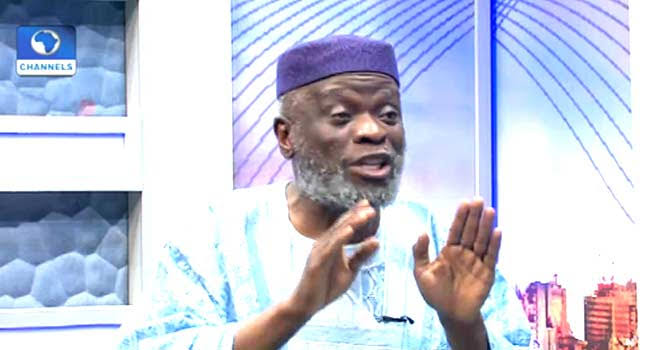
Former President Olusegun Obasanjo is accused of attempting to bribe members of the National Assembly with N70 million each in order to support his failed third-term agenda, according to Senator Olusola Adeyeye, who has confirmed the allegations.
The details of how lawmakers were harassed and financial incentives were dangled in front of them to extend Obasanjo’s time in office beyond 2007 were described by Adeyeye during an interview that took place on Channels TV’s Sunday Politics programs.
He was eventually persuaded to go on the trip, despite the fact that he had first been reluctant to do so, as Adeyeye explained.
In spite of this, he found out that his absence was a part of a plan to exclude him from important discussions regarding the agenda for the third term while he was in Amsterdam on his way to China.
He claimed that he was the one who initially broke the news about the attempt to bribe someone, but the media chose to disregard his discoveries.
Adeyeye stated, “That was when my struggle began, I remember very well that the Speaker said I was to lead a delegation of the House of Representatives to China.
“I said, Mr Speaker, it does not happen that a member of the opposition will lead a parliamentary delegation to a different country. I did not feel competent. I was not the leader of my party. Dr. Wunmi Bewaji was. So if they wanted to pick a member of the opposition, why not Bewaji?
“I got to Amsterdam, and I opened the newspaper and realised that they had kept me away so that I wouldn’t be present for what was supposed to be discussed at that time in the House.
“I am grateful to Aminu Bello Masari. Not only because he sent me away to protect my life but also because he gave me plenty of coverage.
“Aminu Bello Masari protected my life. He was the Speaker and had to pretend to be with the president. But I can tell you, he was against the third-term agenda.
“I did news conferences twice, and the newspapers did not take it seriously. Sometimes, if you want your stories to be on the front page of a newspaper, believe me, you are going to pay for it.
“A principal officer of the House disclosed that the presidency had made plans to give each of us N50 million,” he said.
“That principal officer corrected me and said it was not going to be N50 million, it was N70 million. N70 million in 2006 was big money. I said if that is the case, we will lose this battle, Obasanjo will win this battle.
“The only way to make Obasanjo lose the battle is to make more noise as much as possible so that the press, the unions, and academia will join us in fighting Obasanjo.”
Former military leader of Nigeria from 1976 to 1979 came back to power in 1999 as a democratically elected president.
Reports surfaced in 2007 as his second term was coming to a close that he was seeking a constitutional modification that would enable him to run for a third term.
The decision caused a national uproar, with opposition parties, civil society organizations, and even some members of the governing Peoples Democratic Party (PDP) opposing the concept.
Controversies arose when MPs claimed that Obasanjo had tried to utilize financial incentives to win their support and the democratic process for his own benefit.
About The Author





