Nigerian Senate witnesses tension as Deputy President Barau Jibrin declares he’s not afraid of Trump while Akpabio dismisses fake report causing diplomatic stir.
The Nigerian Senate became unusually animated on Tuesday when Deputy Senate President Barau Jibrin stood up during plenary and announced that he was not afraid of Trump.
His declaration came as lawmakers were reacting to a false report linking Senate President Godswill Akpabio to alleged comments about U.S. President Donald Trump’s criticism of Nigeria.
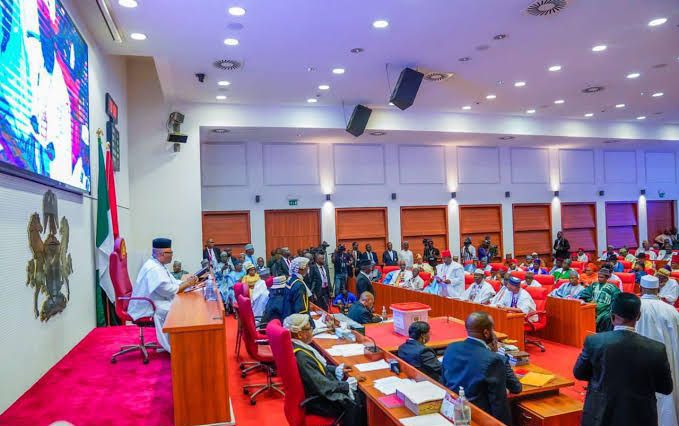
What began as a clarification soon turned into a moment of tension and laughter, highlighting how misinformation can spark unnecessary drama in Nigeria’s political space.
The controversy started when an online post circulated a false story suggesting that Akpabio had responded to President Trump’s supposed remarks accusing Nigeria of mistreating Christians.
The publication, which used an old photo from a Senate delegation visit to Port Harcourt, claimed that Akpabio had said Nigeria could handle its issues without “foreign interference.”
But Akpabio, clearly displeased, dismissed the story outright. “Someone sat somewhere, wrote lies, and even attached unrelated pictures,” he told lawmakers.
“They said I responded to Trump, who am I to answer President Trump?”
He made it clear that the Senate had not made any official statement about Trump’s alleged comments and that only the Presidency was constitutionally empowered to speak on behalf of the country in such matters.
To show how seriously he took the incident, Akpabio revealed that he had petitioned both the Nigeria Police Force and the Department of State Services (DSS). He asked their cybercrime units to track and prosecute those responsible for the fabricated report.
According to him, the intention behind the fake publication was to “discredit the Senate, mislead Nigerians, and stir diplomatic tension.”
Akpabio urged the media to verify information before publishing and reminded Nigerians that false stories have consequences that reach far beyond local politics.
“What we need in this country is peace,” he said. “Fake news threatens that peace and can harm our image globally.”’
As Akpabio concluded his comments with a rhetorical question “Who am I to answer President Trump?” his deputy, Barau Jibrin, interrupted with a statement that caught everyone off guard: “I’m not afraid of Trump.”
The remark drew attention across the chamber. Barau went on to say that as a Nigerian and an elected representative, he had the right to speak his mind on international issues.
“I will say what I believe,” he declared. “Nigeria is a sovereign nation. I’m the Deputy Senate President, and I’m not scared of Trump.”
His insistence, “Don’t be scared of Trump, speak your mind” stirred murmurs and laughter among senators.
Though spontaneous, his words struck a chord with many who saw them as an assertion of national pride and political independence.
Attempting to douse the excitement, Akpabio smiled and advised his deputy, “Don’t allow people to ascribe to you what you didn’t say.”
Barau responded lightly, “That’s true, you didn’t say it, but you shouldn’t be afraid to say it either.”
The brief exchange relaxed the mood, though it underscored a larger issue, how easily false narratives can shift the tone of political debate.
Akpabio later addressed the broader implications of the incident, warning journalists and social media users to stop spreading misinformation that could harm Nigeria’s diplomatic image.
He said the country’s reputation should not be put at risk because of careless reporting or politically motivated propaganda.
“Fake news has become a serious problem,” he warned. “It can destroy relationships, fuel unnecessary hostility, and damage our democracy. Only the Presidency has the right to respond to statements made by foreign leaders like President Trump.”
The Senate President’s tone was firm yet measured. His message was clear: Nigeria’s leadership must remain cautious and coordinated in foreign relations, while its citizens should act responsibly in the information space.
Beyond the laughter and political theatrics, analysts believe the moment symbolized something deeper.
Akpabio’s restraint showed the value of diplomacy in leadership, while Barau Jibrin’s statement that he was not afraid of Trump resonated as a patriotic assertion of Nigeria’s sovereignty.
The exchange highlighted the tension between diplomacy and independence — between choosing words carefully and speaking boldly.
In a democracy like Nigeria’s, both elements are essential: diplomacy preserves relationships, while courage defends national pride.
The Nigerian Senate session also served as a reminder of the dangers of digital misinformation, which can distort facts, strain international ties, and inflame domestic politics.
The Senate reaffirmed its commitment to truth, stability, and responsible communication, reminding Nigerians that integrity in public discourse is essential for peace at home and respect abroad.
More news at ireport247news