


Nigeria crude imports decline as local refining capacity improves
Nigeria crude imports for domestic refining fell sharply in April as the Dangote Petroleum Refinery and other local processors sourced nearly all their feedstock from domestic producers, a shift that industry analysts say could gradually reduce the country’s dependence on imported fuel and ease pressure on foreign exchange demand.
Data released by the Nigerian Midstream and Downstream Petroleum Regulatory Authority showed that domestic refineries received 18.37 million barrels of crude in April 2026, of which 17.96 million barrels came from local sources. Only 410,000 barrels were imported during the month.
The figures mark a significant reversal from earlier months when refiners relied more heavily on imported crude amid supply shortages and pricing disputes with upstream producers.
Imports stood at 9.43 million barrels in March and 4.25 million barrels in February, according to NMDPRA data reviewed by ireportmedia.
The latest supply recovery comes months after the Dangote refinery publicly complained about inadequate domestic crude allocations, warning that inconsistent feedstock supply could undermine refining operations and fuel availability.
Industry executives and energy analysts say the latest improvement reflects a combination of stronger local crude availability, improved implementation of the naira-for-crude arrangement and rising pressure on producers to prioritise domestic refining obligations.
Two industry executives familiar with recent crude allocation discussions said domestic supply conditions improved materially in April after renewed coordination between regulators, producers and refiners over cargo scheduling and payment structures tied to the naira-for-crude framework.
Dangote refinery operates near full capacity
The Dangote refinery accounted for the bulk of crude processed during the month and operated at an average capacity utilisation of 99.12 per cent, according to the regulator’s April fact sheet.
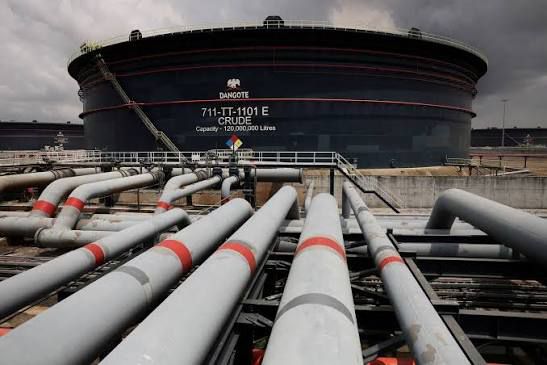
The refinery reportedly achieved full operational capacity on most days during the month, underscoring its growing role in Nigeria’s downstream fuel market.
Market participants said the steadier crude flows reduced the refinery’s reliance on spot cargoes and short-notice supply arrangements that had previously complicated feedstock planning earlier in the year.
With more stable crude supply, the plant produced an average of 53.6 million litres of petrol daily, alongside 23.6 million litres of diesel and 22.9 million litres of aviation fuel.
Domestic petrol supply from the refinery averaged 40.7 million litres per day, while about 17.1 million litres were exported.
Diesel and aviation fuel exports also remained substantial, reflecting the refinery’s increasing regional footprint as one of Africa’s largest processing facilities.
The improved refining output helped raise Nigeria’s total daily petrol supply to 44.4 million litres in April, up from 40.1 million litres in March.
At the same time, petrol imports continued to decline sharply.
NMDPRA figures showed imported PMS volumes dropped to 3.7 million litres daily in April as domestic supply increasingly displaced imported products.
Energy self-sufficiency improves, but price pressures remain
The regulator described the latest figures as evidence of Nigeria’s growing energy self-sufficiency, long viewed as a strategic objective for Africa’s biggest oil producer.
Fuel imports have historically been among Nigeria’s largest sources of foreign exchange demand, frequently placing pressure on the naira during periods of elevated global oil prices and weaker crude production.
For decades, Nigeria exported crude oil while relying heavily on imported refined petroleum products because of limited domestic refining capacity and repeated breakdowns at state-owned refineries.
Dangote’s ramp-up is beginning to redraw Nigeria’s downstream fuel balance after decades of import dependence.
Three modular refineries — WalterSmith, Edo Refinery and Aradel — collectively supplied roughly 0.559 million litres of diesel daily to the domestic market during the period, although utilisation rates varied.
Still, the gains in domestic refining have yet to translate into significantly lower pump prices for consumers.
Some downstream marketers said privately that improving domestic refining volumes have eased immediate supply concerns, although pricing volatility remains heavily exposed to international crude markets and foreign-exchange conditions.
Retail petrol prices remained elevated across the country in April, driven partly by global crude market volatility and renewed geopolitical tensions in the Middle East.
In Maiduguri, petrol prices reached as high as N1,413 per litre, according to NMDPRA data, while Lagos recorded average prices of around N1,271.50 per litre.
Industry participants say exchange-rate instability, logistics costs and international oil price movements continue to exert pressure on domestic fuel pricing despite improving local refining capacity.
Read Also: Nigeria telecom network quality under pressure despite ₦2.5tn telco investment
State-owned refinery shutdowns remain a major constraint
The continued inactivity of Nigeria’s three major state-owned refineries remains one of the biggest structural gaps in the country’s downstream sector, according to marketers and refinery operators familiar with ongoing supply discussions.
Although rehabilitation projects have been announced repeatedly over the past decade, operational output from the facilities remains largely absent from national fuel supply.
Energy economists say Nigeria’s refining transition remains incomplete without sustained output from both public and private facilities, particularly as domestic fuel demand continues to rise.
Daily petrol consumption — measured by truck-out volumes — averaged 51.1 million litres in April, slightly above the government’s 2026 benchmark of 50 million litres per day.
Fuel sufficiency levels stood at an average of 18 days for petrol and 39 days for diesel during the month.
Some downstream operators privately expressed concern that unresolved commercial tensions over crude pricing formulas, supply obligations and feedstock allocation terms could still disrupt supply stability later in the year if unresolved.
Naira-for-crude policy faces crucial test
The April figures are likely to strengthen government arguments that the naira-for-crude initiative is beginning to improve domestic refining economics and reduce import dependence.
Under the arrangement, local refiners can purchase crude in naira rather than dollars, a mechanism designed to ease foreign exchange pressure and improve supply predictability.
However, questions remain over the long-term sustainability of the framework, particularly if global oil prices remain volatile or crude production levels weaken.
Several energy analysts noted that while import substitution is improving, Nigeria’s downstream market still faces deeper structural challenges linked to infrastructure deficits, pricing policy uncertainty and weak state refining capacity.
For policymakers, the broader test now is whether rising domestic refining capacity can translate into sustained reductions in fuel imports, foreign-exchange demand and supply volatility over time.
While April’s figures suggest meaningful progress, industry executives caution that long-term stability will still depend on consistent crude production, commercially viable pricing structures and the eventual return of state-owned refining capacity.s.
Read more @ireport247news
About The Author
