The New Zealand mega strike drew an estimated 100,000 nurses, teachers, and public service employees on Thursday, demanding urgent government investment in essential public services nationwide.
This coordinated walkout united multiple sectors, including more than 60,000 school teachers, 40,000 nurses, and 15,000 salaried public service staff, highlighting widespread dissatisfaction.
Despite severe weather forcing cancellations in Wellington and other regions, tens of thousands rallied, carrying signs and chanting calls for increased funding and staffing.
“Patients should not have to be harmed, or die, before things improve,” Becks Kelsey, a nurse, told the Auckland crowd firmly and without hesitation.
She continued, “We demand the government invests in the very fabric of our community, not cut the threads that hold it together.”
Secondary school teacher Paul Stevens said colleagues are leaving both the profession and the country because they feel undervalued and unsupported by authorities.
“We need our politicians to do their job and acknowledge political choices that gradually starve essential public services of what they require,” Stevens emphasized.
Multiple unions voted to strike after collective bargaining with the coalition government stalled, citing inadequate pay, unsafe staffing levels, and poor working conditions.
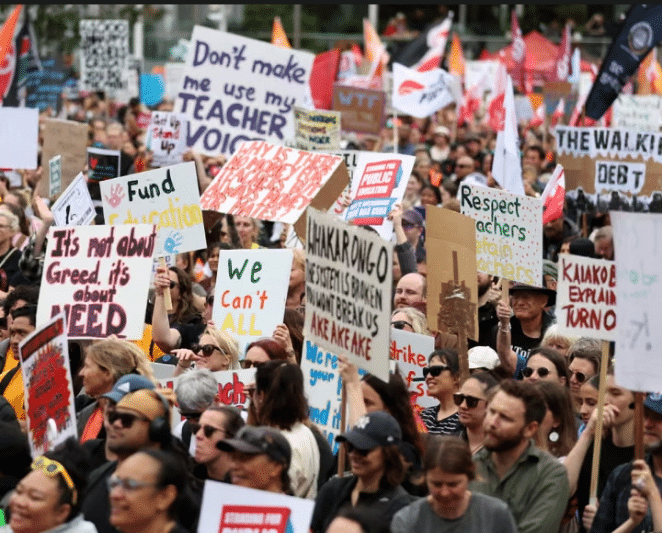
While sector-specific demands varied, the core grievances were consistent: insufficient pay, unsafe staffing, inadequate resources, and risks to both workers’ and citizens’ welfare.
“We fear for the safety of our patients,” said Noreen McCallan, a nurse in Hawke’s Bay. “Staff shortages are overwhelming, leaving patients to wait far too long.”
Teacher Liam Rutherford in Palmerston North warned that superficial adjustments would not address systemic underfunding, emphasizing the need for significant government investment in education.
“The current government offer won’t help recruit or retain teachers. The pull of Australia for better pay is simply too strong,” Rutherford added.
New Zealand’s hospitals face overcapacity, lengthy wait times, and severe staff shortages, with some facilities describing daily operations as approaching catastrophic failure.
Schools are also under pressure, with authorities warning that more than 1,200 teaching positions could remain unfilled this year, threatening education quality and student outcomes.
Meanwhile, government funding cuts and canceled pay equity claims have exacerbated strain on public services, even as economic growth remains a stated priority.
At the same time, record numbers of New Zealanders are leaving for Australia, seeking higher wages and better working conditions, particularly in healthcare and education.
The coalition government has criticized the strike, with Prime Minister Christopher Luxon dismissing it as politically motivated rather than addressing workers’ legitimate concerns.
Senior ministers for education, health, and public services labeled the strike “unfair, unnecessary, and unproductive,” highlighting disruptions caused to patients and students.
Public service minister Judith Collins described the walkout as a “stunt” that would inevitably harm thousands dependent on essential services.
Many schools were forced to close, and hospitals reduced non-essential operations; nonetheless, public support for the strike remains high despite temporary disruption.
A Talbot Mills poll found 65% of the public backed the industrial action, including nearly half of voters who typically support the coalition government.
Opposition parties supported the strike, with Labour leader Chris Hipkins attributing responsibility to the prime minister for failing to safeguard essential services.
“Luxon is out of touch and worsening New Zealand’s health and education systems,” Hipkins said. “Boardroom pay rises and corporate incentives take priority over citizens’ welfare.”
Healthcare workers reported overcapacity, staff exhaustion, and prolonged patient wait times, with some describing the situation as a “catastrophic failure waiting to happen.”
Teacher shortages persist, with professionals warning that inadequate pay and poor working conditions prevent retention and recruitment, especially as neighboring countries lure talent.
“Nations succeed when they invest in education and healthcare, yet New Zealand’s policy choices undermine both sectors,” said Kelsey, reinforcing the unions’ demands.
Unions stress that without meaningful investment, workforce attrition will continue, and public service delivery will deteriorate, risking long-term societal consequences.
The strike represents one of New Zealand’s largest coordinated public sector walkouts, illustrating deep systemic issues in staffing, funding, and government responsiveness.
Despite government opposition, rallies demonstrated strong solidarity among teachers, nurses, and public service staff, highlighting widespread dissatisfaction with policy priorities.
Analysts warn that failing to address staffing shortages, unsafe conditions, and pay inequities could worsen healthcare and education crises in coming years.
“The street message is clear: essential workers will not remain silent while their sectors collapse and citizens suffer,” Rutherford emphasized during a rally.
The coalition government faces mounting pressure to negotiate substantively, as ongoing protests threaten the stability of health and education service delivery.
Without swift action, further industrial action could follow, potentially including extended strikes affecting hospitals, schools, and public service operations nationwide.
The New Zealand mega strike has become a focal point for debates over labor rights, funding priorities, and sustainability of essential services under current political leadership.
Union leaders insist the government must revise budget allocations, invest in recruitment, and restore pay equity to prevent workforce attrition.
Public sentiment indicates widespread understanding of the issues, even when service disruptions cause temporary inconvenience, showing strong support for systemic reform.
Healthcare and education professionals argue that sufficient staffing, fair pay, and adequate resources are critical to maintaining public service quality and public safety.
The strike warns policymakers that continued inaction could result in long-term decline of public services and diminished public trust.
Negotiations remain possible, though trust between unions and the government has eroded amid high-profile protests and public demonstrations.
Political analysts predict the mega strike may influence upcoming elections, shaping debates on public spending, labor relations, and treatment of essential workers.
Union leaders warn that further delays in resolving disputes will likely escalate industrial action, increasing pressure on policymakers to act decisively.
The New Zealand mega strike demonstrates the power of coordinated public sector action to challenge government policies, even in adverse weather and political resistance.
Demonstrators stress that without decisive action, essential services will continue to deteriorate, affecting citizens’ welfare, healthcare, and education outcomes in the long term.
Observers note a global trend: public sector workers increasingly take collective action to demand fair pay, adequate staffing, and safe working conditions.
The scale of participation and public support shows that frustration among essential workers is systemic, reflecting structural challenges affecting multiple sectors simultaneously.
The government must choose between meaningful negotiation and continued disruption, with risks to public service quality and social cohesion if ignored.
Union representatives emphasize that ensuring safe staffing levels, competitive pay, and proper working conditions is both an operational and moral imperative.
Workers maintain that their action aims to safeguard public welfare, asserting that patient safety, student learning, and service effectiveness depend on immediate government intervention.
Analysts suggest the New Zealand mega strike could set a benchmark for other nations facing public service funding and staffing crises, demonstrating collective action effectiveness.
Protests highlight the link between public policy, labor rights, and societal well-being, showing consequences of prolonged underinvestment in essential sectors.
Unions remain firm: without urgent government investment, workforce attrition will worsen, public services will deteriorate, and societal impact will grow over time.

Public support for the strike reinforces that citizens prioritize protection and enhancement of essential services over partisan disputes or short-term political strategies.
The New Zealand mega strike ultimately reflects deep structural issues, emphasizing the urgent need for transparent, timely, and effective government action to restore workforce morale and public trust.