The National Drug Law Enforcement Agency (NDLEA) has recorded a significant breakthrough with the arrest of a 58-year-old suspected drug baron, Uzoma Valentine Ilomuanya, whose name has remained on the agency’s wanted list for over a decade and a half.
The development marks a decisive moment in the ongoing anti-narcotics campaign spearheaded by the NDLEA across Nigeria and beyond.
The suspect was apprehended in Lagos on February 23, 2026, during what officials described as a carefully coordinated and intelligence-led operation.
According to the agency’s spokesperson, Femi Babafemi, the arrest was executed by operatives of the NDLEA Special Operations Unit after weeks of surveillance and discreet tracking.
Authorities said the operation was carried out without incident, bringing an end to years of pursuit.
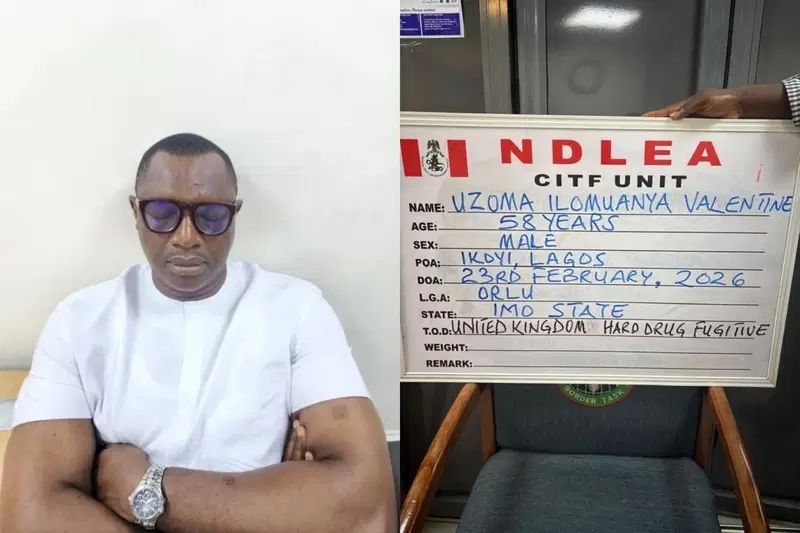
For more than 15 years, Ilomuanya had allegedly evaded arrest while maintaining links to drug trafficking activities spanning Nigeria and the United Kingdom.
His history with law enforcement dates back to 2003, when he was first arrested and convicted in the UK for drug trafficking offences.
He received a nine-year sentence but was released after serving only two years following a successful appeal.
Rather than disengage from illicit activities, investigators believe he remained active within international drug networks.
In July 2011, British authorities again arrested him for drug-related crimes. Although he was granted administrative bail, he reportedly absconded and returned to Nigeria, breaching the conditions of his release.
That move intensified collaboration between British officials and the NDLEA, as both sides sought to track his movements.
The turning point in Nigeria came in November 2018 when NDLEA operatives uncovered two clandestine methamphetamine laboratories allegedly linked to him.
One facility was discovered at his residence in Obinugwu, Orlu Local Government Area of Imo State, while another was found at a property on Barrister Declan Uzoma Close in Lagos.
During the raids, officers reportedly recovered 77.960 kilograms of methamphetamine alongside sophisticated production equipment used in large-scale drug manufacturing.
Following that discovery, Ilomuanya was charged before a Federal High Court in Lagos.
However, after being granted bail, he reportedly jumped bail and disappeared once again, prolonging what officials described as a “cat-and-mouse” chase between him and law enforcement agencies.
His disappearance reinforced concerns about the reach and resilience of organized drug trafficking networks operating within the country.
The recent arrest has been described by the NDLEA leadership as a testament to persistence and enhanced intelligence-sharing frameworks.
Chairman and Chief Executive Officer of the agency, Brig. Gen. Mohamed Buba Marwa (Rtd), stated that the capture sends a strong warning to individuals who believe they can exploit legal systems or international borders to escape justice.
Marwa emphasized that the NDLEA remains committed to dismantling narcotics syndicates and ensuring that Nigeria does not serve as a haven for global drug traffickers.
He noted that intelligence-driven operations, international cooperation, and improved surveillance mechanisms have strengthened the agency’s ability to track fugitives over extended periods.
Security analysts say the case highlights the evolving strategies used by transnational drug networks, including the establishment of hidden laboratories and the use of multiple jurisdictions to avoid prosecution.
The NDLEA has in recent years intensified collaboration with foreign law enforcement bodies, sharing data and coordinating investigations aimed at disrupting supply chains.
Community leaders in parts of Imo State and Lagos have reacted with mixed emotions to the news, with some expressing shock over the scale of operations allegedly linked to the suspect.
Others commended the NDLEA for sustaining its efforts despite previous setbacks, including instances where suspects exploited bail conditions to evade trial.
Experts in criminal justice reform argue that the case underscores the need for tighter bail monitoring systems and more stringent oversight in high-profile drug cases.
They suggest that strengthening judicial processes could prevent similar scenarios in the future.
Meanwhile, the NDLEA has reiterated that its anti-drug campaign extends beyond arrests to include prevention, rehabilitation, and public awareness initiatives.
Officials stress that combating drug trafficking requires both enforcement and community engagement to reduce demand and discourage local collaboration with international cartels.
As investigations continue, authorities are expected to pursue further inquiries into associates and financial networks connected to the suspect.
The NDLEA has indicated that assets linked to illicit drug production and trafficking may also come under scrutiny as part of broader enforcement measures.
About The Author