A Federal High Court in Abuja has granted former AGF Abubakar Malami, his son and wife bail in a high-profile money laundering case involving alleged N9bn.
The Federal High Court in Abuja has granted bail to former Attorney-General of the Federation and Minister of Justice, Abubakar Malami, SAN, his son Abdulaziz Malami, and his wife Hajia Bashir Asabe, in an ongoing money laundering case filed by the Economic and Financial Crimes Commission (EFCC).
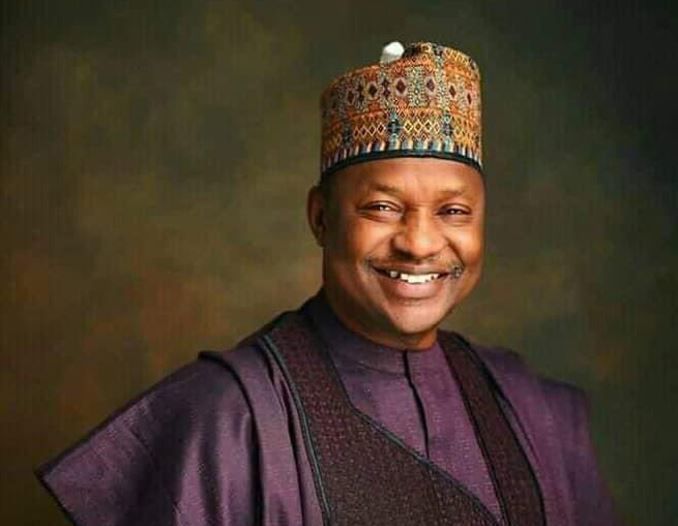
The ruling, delivered on Wednesday by Justice Emeka Nwite, followed arguments by defence counsel urging the court to exercise discretion in favour of the defendants, whom they described as responsible citizens willing to face trial.
The court, however, imposed stringent conditions, reflecting the gravity of the allegations before it.
Justice Nwite granted Malami and his son bail in the sum of N1 billion, while Malami’s wife was admitted to bail in the sum of N500 million.
The court ordered that each defendant must provide two sureties in the same value as their respective bail sums.
According to the ruling, the sureties must be verified owners of landed properties located in Asokoro, Maitama, or Gwarinpa, three high-value districts within the Federal Capital Territory (FCT).
The court further directed that the original title documents of the properties must be submitted for authentication.
In addition, the judge ordered the defendants to deposit their international passports with the court registrar, effectively restricting their movement.
Justice Nwite warned that none of the defendants should travel outside Nigeria without prior approval of the court.
The court also placed obligations on the sureties, mandating them to submit two recent passport photographs and swear to an affidavit of means, confirming their financial capability to guarantee the defendants’ appearance throughout the trial.
Pending the fulfilment of these bail conditions, the court ruled that the defendants should remain in custody of the Nigerian Correctional Service.
The matter was subsequently adjourned until February 17 for continuation of trial.
The money laundering case has drawn significant public attention due to Malami’s former role as the nation’s chief law officer between November 2015 and May 2023, during the administration of former President Muhammadu Buhari.
As Attorney-General, Malami was responsible for overseeing prosecutions and advising the federal government on legal matters.
The EFCC accused Malami and his co-defendants of laundering approximately N9 billion in public funds through a network of companies and property transactions.
He was arraigned on 16 counts, alongside his son and wife, before the Federal High Court.
According to the prosecution, Hajia Asabe was listed as an employee of Rahamaniyya Properties Limited, a firm allegedly used to disguise the proceeds of unlawful activity through real estate investments.
The EFCC claimed that several high-value properties were acquired in Abuja, Kebbi, and Kano States as part of a coordinated effort to conceal illicit funds.
The anti-graft agency further alleged that between July 2022 and June 2025, the defendants used Metropolitan Auto Tech Limited to channel over N1.01 billion into a Sterling Bank account.
The funds, EFCC argued, were deliberately structured to evade detection and mask their true source.
In another transaction highlighted by the prosecution, the defendants were accused of using the same company to divert about N600 million between September 2020 and February 2021.
Q1EFCC investigators told the court that the transactions lacked legitimate commercial justification.
The commission also alleged that in March 2021, the defendants retained N600 million as cash collateral for a N500 million loan obtained by Rayhaan Hotels Limited from Sterling Bank.
According to the prosecution, the defendants allegedly knew the funds were proceeds of crime at the time they were used.
EFCC maintained that these actions amounted to violations of multiple provisions of the Money Laundering (Prohibition) Act, 2011, stressing that the case is backed by extensive documentary evidence and financial records.
The prosecution informed the court that it intends to call a wide range of witnesses, including EFCC investigators, bank officials, real estate agents, and Bureau de Change operators, to establish the alleged financial trail and property acquisitions linked to the defendants.
While the defendants have pleaded not guilty to all charges, the money laundering case is expected to test Nigeria’s anti-corruption framework, especially given Malami’s former position at the centre of the country’s justice system.
Legal observers note that the outcome could have significant implications for accountability and public confidence in anti-graft efforts.
Ireport247news
About The Author