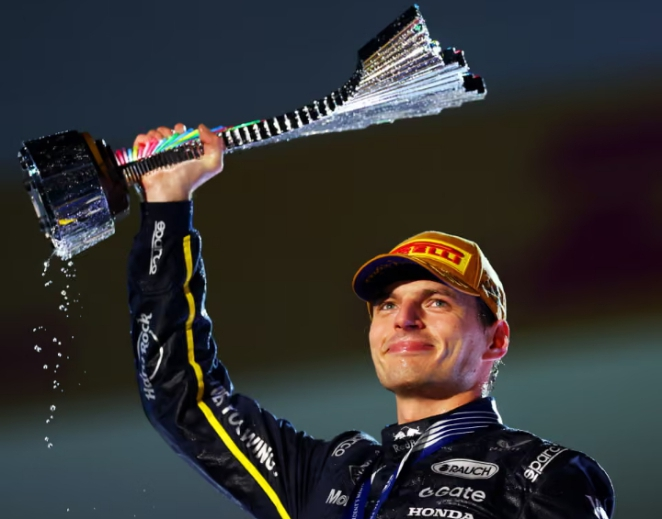
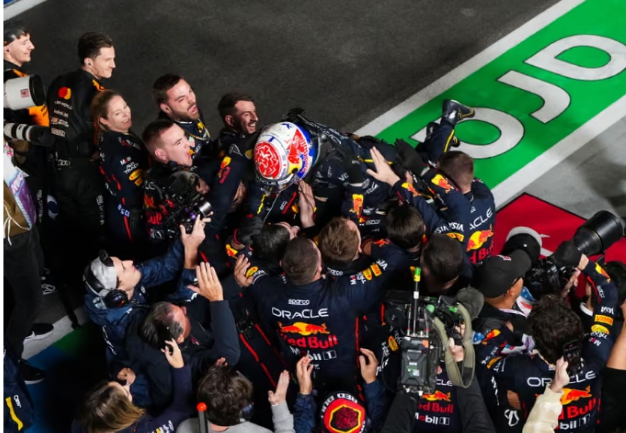
Max Verstappen stormed to victory at the F1 Las Vegas Grand Prix, producing a flawless drive under the bright Nevada lights that strengthened Red Bull’s season momentum.
Lando Norris, the championship leader, finished second, demonstrating tactical mastery and composure despite the pressure, while teammate Oscar Piastri secured fourth, leaving the title race tantalisingly close.
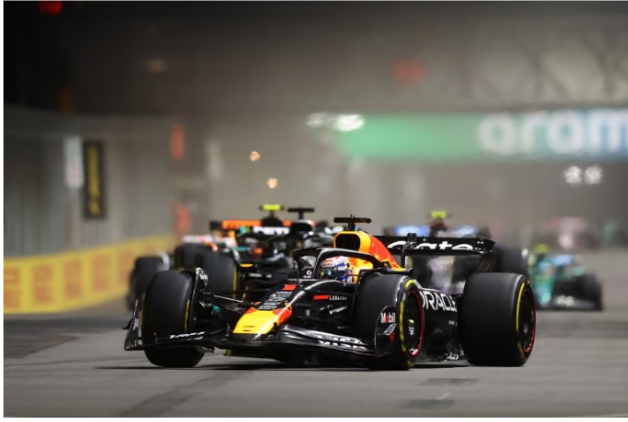
From the start, Norris’s aggressive launch off pole backfired as he ran wide in the first corner, allowing Verstappen to overtake and establish himself firmly at the front.
George Russell capitalised on the chaos to temporarily take second from Norris, showcasing Mercedes’ pace, but ultimately he finished third as the McLarens regained positions later in the race.
Verstappen’s Red Bull proved superior on the dry street circuit, a stark contrast to the wet qualifying session where performance gaps were narrower and lap times fluctuated significantly.
This Las Vegas victory marks Verstappen’s sixth win of the season, a remarkable comeback after he trailed Piastri by over 100 points following the Dutch Grand Prix in August.
The Dutch driver’s turnaround included four wins and three podiums over the last seven meetings, demonstrating resilience and Red Bull’s strategic brilliance under pressure.
Norris’s approach was calculated, emphasising session-by-session focus rather than championship calculations, a mindset that has helped him maximize points even when immediate victory seemed unlikely.
Piastri faced a challenging race after early contact with Liam Lawson, dropping to seventh before using pit strategy and tyre management to recover to fourth by the checkered flag.
Tyre wear and graining were crucial throughout, particularly for McLaren, who had suffered similar issues in last year’s Vegas race and carefully managed rubber to optimise late-race performance.
Russell, meanwhile, found overtaking Verstappen nearly impossible, despite consistent pressure, highlighting the Red Bull driver’s control and pace management on older tyres before his pit stop.
Piastri’s undercut strategy, coming in early on lap 22, allowed him to leapfrog Carlos Sainz and Charles Leclerc, demonstrating McLaren’s tactical flexibility in responding to evolving race conditions.
Norris followed Piastri onto fresh hard tyres a lap later, emerging behind Russell, and then methodically executed his plan to reclaim second, further solidifying his championship position.
Despite Verstappen pitting later on lap 25, he retained a strong lead, underscoring the Red Bull’s consistent performance advantage and the driver’s ability to dictate the race pace effectively.
As the race progressed, Norris received instructions to conserve tyres while pursuing Russell, but both drivers ultimately lacked the pace to challenge Verstappen, who extended his gap to the finish.
The Las Vegas circuit, a relatively new addition to the F1 calendar, presented unique challenges with its street layout and high-speed straights, but Verstappen adapted flawlessly throughout the weekend.
Norris’s consistency this season has been notable, particularly in wet conditions, where his pole performance in Las Vegas highlighted both skill and precise car setup under variable track conditions.
The championship picture remains tight: Norris now leads Piastri by 30 points, with Verstappen trailing by 42, leaving the final two races in Qatar and Abu Dhabi decisive for title aspirations.
For Verstappen to maintain realistic hopes, Norris would need to experience misfortune or fail to finish in one of the remaining races, a scenario that still keeps fans on edge.
Red Bull’s strategy, combining aggressive pace with smart tyre management, has allowed Verstappen to claw back into contention, emphasizing the importance of tactical precision in modern F1 racing.
Piastri’s fourth-place finish salvaged crucial points for McLaren, ensuring he remains mathematically in the title fight, though the pressure intensifies as the season nears its conclusion.
Lewis Hamilton’s recovery to tenth from nineteenth on the grid, alongside Leclerc finishing sixth, highlighted the ongoing midfield battles and the importance of consistent point scoring for constructors’ standings.
Verstappen’s late-season surge has been characterized by resilience, precision overtaking, and adaptability to various circuits, which has allowed Red Bull to maintain momentum despite early-season setbacks.
Norris, meanwhile, has focused on calculated aggression, balancing outright speed with smart tyre conservation, an approach that has enabled him to lead the championship while avoiding unnecessary risks.
The Las Vegas spectacle also included a milestone in the F1 Academy, with Doriane Pin clinching the 2025 championship, emphasizing the growth of female talent in motorsport alongside the main F1 action.
Pin’s fifth-place finish in the final race secured the title, making her the Academy’s third winner after Marta García in 2023 and Abbi Pulling in 2024, and highlighting F1’s inclusive developmental programs.
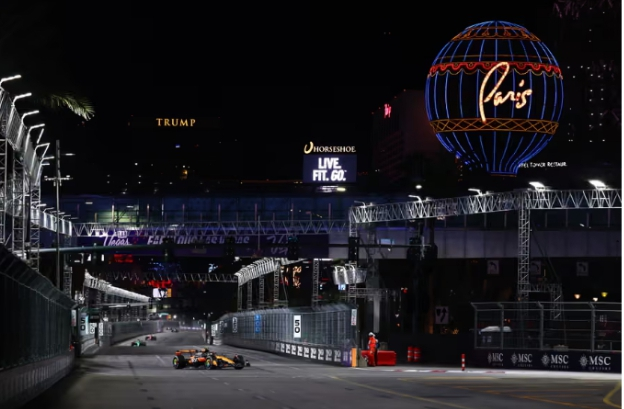
Red Bull’s dominance in Las Vegas underlines Verstappen’s relentless pursuit of the championship and the technical superiority of their car, which remains competitive across various circuits and conditions.
McLaren’s drivers, Norris and Piastri, must continue managing pace, tyres, and strategic pit calls to protect their championship advantage, particularly with only two rounds remaining this season.
The Las Vegas GP reinforced the unpredictability of Formula One, combining street circuit challenges with late-season championship pressure, delivering drama for teams, drivers, and fans alike.
As the series moves to Qatar and Abu Dhabi, every point, pit decision, and overtake will carry immense significance, with Verstappen, Norris, and Piastri each having distinct pathways to success.
Verstappen’s performance in Nevada serves as a reminder that late-season comebacks are possible, but he will need near-perfect execution and external variables to influence outcomes in his favor.
Norris’s measured approach contrasts with Verstappen’s aggression, illustrating different philosophies in championship racing: calculated consistency versus high-risk, high-reward strategies.
Piastri remains a wildcard, capable of scoring maximum points, and McLaren will need both drivers performing optimally to secure constructor and potential driver glory before the season ends.
The Las Vegas Grand Prix also showcased F1’s evolving spectacle in the United States, combining high-speed street action with entertainment elements, attracting a new generation of fans to the sport.
Verstappen’s sixth victory this season positions him as a formidable competitor, and Red Bull’s strategy continues to adapt, balancing tyre performance, fuel load, and track conditions across each race.
Norris, Piastri, and Verstappen now shift focus to the final sprint in Qatar, where championship permutations will crystallize, emphasizing precision, mental toughness, and teamwork in high-pressure scenarios.
Fans can expect intense wheel-to-wheel action, strategic gambles, and critical pit stops, as the 2025 season nears its conclusion with the championship battle still alive.
Max Verstappen’s Las Vegas triumph exemplifies his ability to dominate under pressure, combining experience, skill, and Red Bull’s technical excellence to extract maximum performance from every lap.
As F1 transitions to its closing rounds, each driver faces unique challenges: Norris to protect his lead, Piastri to fight back, and Verstappen to engineer a dramatic resurgence.
The Las Vegas Grand Prix stands as a testament to modern Formula One’s excitement, where technical mastery, strategic insight, and driver courage converge under the global spotlight.
About The Author