Maduro will leave power is no longer merely a political slogan but an uncompromising ultimatum delivered with precision by Maria Corina Machado as Venezuela’s crisis reaches a decisive threshold demanding accountability.
Machado’s renewed declaration stunned observers worldwide, demonstrating her absolute certainty that an irreversible Venezuelan transition is approaching despite government repression, institutional decay, economic collapse, and a population growing intolerant of authoritarian failure imposed through fear.
Her Oslo appearance symbolized defiance against a regime determined to silence dissent, yet her tone revealed intensified determination forged by isolation, persecution, and unbroken commitment to genuine democratic change.
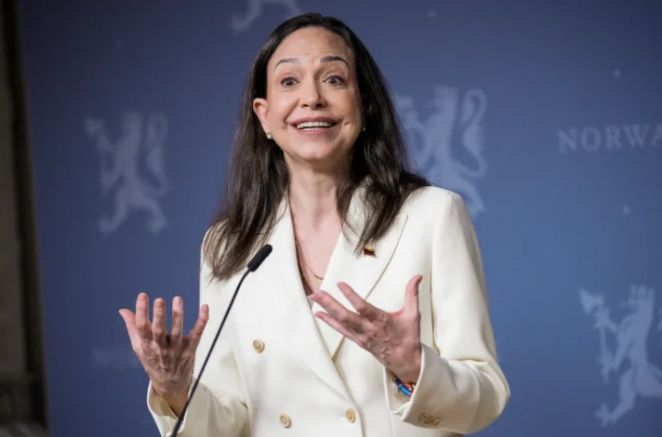
Supporters interpreted her message as confirmation that the opposition momentum has surpassed symbolic protest, transforming into a disciplined, escalating force capable of reshaping Venezuela’s political trajectory despite relentless intimidation from security institutions.
Global reaction reflected a landscape shifting rapidly, with diplomats acknowledging that Machado’s return amplifies the rising international pressure on Maduro, which continues tightening through sanctions, seizures, and targeted diplomatic isolation strengthening external leverage.
Machado insisted her objective remains peaceful democratic restoration, but she warned that Venezuela’s suffering cannot persist indefinitely under leaders who dismantle institutions, plunder national resources, and reject electoral legitimacy affirmed by independent observers.
She emphasized that Maduro’s government no longer commands uniform loyalty, noting internal fractures widening across military structures where officers privately express frustration with corruption, scarcity, and institutionalized political coercion.
Her assertion that Venezuela “has already been invaded” referenced expanding foreign influence embedded within state structures, complicating the national crisis and demonstrating how geopolitical actors sustain authoritarian endurance.
Machado’s remarks targeted these foreign networks directly, naming groups embedded within Venezuela’s security apparatus that operate without accountability, reinforcing instability while enabling criminal enterprises flourishing under state protection.
Her warnings resonated domestically, where citizens increasingly view the government as an occupying force acting against national interests, exploiting suffering while blaming external forces for deliberate policy failures.
Evidence of deepening insecurity grows daily, with Venezuelans enduring scarcity, hyperinflation, healthcare deterioration, and ongoing migration driven by desperation rather than opportunity, despite regime propaganda claiming national recovery narratives.
In Oslo, Machado highlighted these realities, accusing Maduro of weaponizing state institutions to preserve power rather than serve citizens, using courts, security forces, and propaganda mechanisms against democratic aspirations.
Her speech also challenged the claim that recent elections represented legitimate choice, insisting that Venezuelans overwhelmingly supported opposition candidate Edmond Gonzalez, whose victory was systematically suppressed through coercion.
International observers validated opposition claims, finding compelling evidence of manipulation, intimidation, and procedural interference intended to preserve Maduro’s authority regardless of popular sentiment rejecting prolonged authoritarian continuity.
Machado framed the manipulated election as the final confirmation that dialogue without substantive guarantees remains meaningless, warning that patience for diplomatic theatrics is evaporating quickly among Venezuelans.
Meanwhile, rising external intervention further complicates prospects for peaceful transition, with US military presence expanding in the Caribbean and signaling heightened resolve against criminal networks flourishing under state protection.
Machado praised certain American actions, particularly maritime seizures targeting illicit financial networks sustaining regime operations, calling such measures necessary tools weakening insulated circles surrounding Maduro’s leadership.
Yet she remained cautious about endorsing direct military intervention, instead emphasizing Venezuelans must spearhead transition themselves, with foreign allies reinforcing—not replacing—internal efforts pursuing authentic democratic renewal.
Her belief that military institutions will ultimately obey a legitimate civilian authority reflects growing sentiment among mid-level officers increasingly alienated by corruption and deteriorating national defense capabilities.
Security analysts warn, however, that any transition requires strategic negotiation, ensuring that powerful factions within armed forces perceive incentives rather than threats, preventing retaliatory violence or protracted conflict.
Corruption networks remain deeply entrenched, creating a formidable obstacle to rapid transformation, with officials resistant to change fearing prosecution, loss of power, or accountability for systematic abuses documented internationally.
Experts caution that sudden collapse without structured transition could ignite internal chaos, allowing criminal groups to expand further and creating regional instability affecting neighboring countries already managing migration pressures.
Despite these complexities, Machado insisted Venezuela is entering a point of no return where delaying transition risks deeper humanitarian catastrophe, economic collapse, and irreversible erosion of national sovereignty.
Her message directly challenged Maduro’s narrative that Venezuela’s crisis stems exclusively from foreign aggression, countering with evidence linking internal mismanagement to expanded suffering inflicted upon ordinary citizens.
She condemned the regime’s attempt to portray itself as victim rather than perpetrator, arguing that its actions reflect deliberate political engineering designed to cement indefinite rule under authoritarian control.
The Trump administration’s aggressive regional posture intensified debate, with officials refusing to rule out further maritime seizures, signaling a hardened stance toward networks enabling illicit operations tied to Venezuelan elites.
Holsey’s forced retirement exposed deeper tensions within the Pentagon regarding operational strategies in Latin America, suggesting internal disagreements over effectiveness, escalation risks, and long-term regional implications.
These developments created uncertainty within Venezuelan leadership circles, as regime insiders fear shifting geopolitical dynamics may accelerate pressures they can no longer counter through diplomatic posturing.
Machado capitalized on this anxiety, framing it as opportunity for coordinated international action aligned with internal mobilization, reinforcing a dual-front approach undermining the regime’s ability to maintain cohesion.
Her insistence that Maduro’s end is non-negotiable reflects deep conviction derived from public sentiment overwhelmingly rejecting continued authoritarian rule despite repression, surveillance, and economic coercion.
Across Venezuela, frustration deepens as families struggle through blackouts, currency collapse, water shortages, and collapsed healthcare conditions, fostering a population more determined than fearful.
Machado argued that this suffering fuels collective courage, forging unity among communities transcending political divisions previously exploited by the regime to fracture opposition coordination.
Her remarks resonated particularly with younger Venezuelans, many of whom have never experienced stable democracy yet remain determined to reclaim national dignity stripped away during years of authoritarian decay.
She portrayed their resilience as evidence Maduro’s government cannot extinguish civic determination, even through detentions, censorship, propaganda, and manipulation of security institutions used to suppress dissent.
Diplomatic circles acknowledged her return intensifies momentum, making it increasingly difficult for foreign governments to maintain neutral positions as Venezuela’s crisis escalates beyond manageable levels.
Human rights organizations echoed Machado’s warnings, citing systemic abuses, disappearances, and torture within detention centers used against activists, journalists, and military personnel accused of disloyalty.
Such conditions strengthened arguments that international engagement must shift from observation to action, with targeted pressure dismantling authoritarian infrastructure enabling continued repression.
Machado maintained that transition must prioritize institutional reconstruction, restoring judicial independence, rebuilding electoral systems, and eliminating criminal networks deterring investors essential for national recovery.
She emphasized economic renewal requires transparent governance, ending patronage structures enabling massive corruption, smuggling, and state-sponsored criminality undermining long-term national stability.
Her message concluded with renewed certainty: Maduro will leave power, and Venezuela will reclaim its future through collective determination, strategic pressure, and unrelenting pursuit of freedom despite formidable obstacles.
Read also: Von der Leyen slams Trump as Europe rejects US interference in upcoming elections
About The Author