

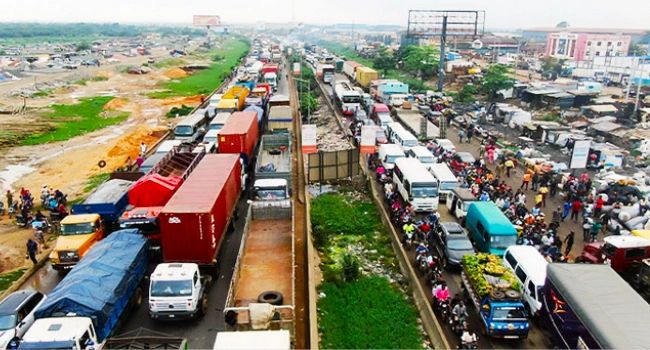
The Federal Road Safety Corps (FRSC) has identified illegal counter-flow driving by motorists as one of the major factors worsening the traffic crisis on the Lagos-Ibadan Expressway.
The development followed a major disruption on the highway after a container reportedly fell across the road around the Kara section, forcing traffic management authorities to deploy personnel to the area.
Kehinde Hamzat, the Lagos State Sector Commander of the FRSC, said the initial obstruction caused by the fallen container was compounded by motorists who attempted to bypass the traffic by driving against the approved direction of movement.
Hamzat made the disclosure on Wednesday during an appearance on Newstrack, a Channels Television programme, while giving an update on the situation and the response of relevant government agencies.
According to him, the traffic situation had initially been progressing relatively normally until shortly before noon on Tuesday when the container fell within the construction area around Kara.
He said FRSC officers immediately responded to the incident and began efforts to manage the traffic and facilitate the removal of the container.
However, the situation became more complicated when some motorists, apparently frustrated by the obstruction, began driving against traffic.
Hamzat explained that the counter-flow movement prevented motorists travelling towards Lagos from moving normally, particularly around the OPIC and Fagbems sections of the expressway.
He said some motorists who were already travelling towards Lagos on the Long Bridge were unaware of the obstruction ahead. Upon encountering the congestion, some reportedly turned around and used the Punch area to join the opposite direction of traffic.
The FRSC commander said such actions created a dangerous situation because the motorists were entering lanes designated for vehicles travelling in the opposite direction.
He explained that what some drivers considered an opportunity to use an apparently free lane eventually resulted in vehicles travelling towards one another and further blocking the highway.
The removal of the fallen container, therefore, did not immediately resolve the problem.
According to Hamzat, the traffic had already spread to several points by the time the obstruction was cleared, while vehicles that had entered the wrong lanes had created additional bottlenecks.
He described the resulting situation as a major gridlock that authorities had been working to dismantle.
“Even when the container that fell had been removed, because of the indiscipline on the part of road users, they blocked everything, and it became a complete gridlock,” he said.
Hamzat said the authorities subsequently intensified their response, with officials from Lagos and Ogun states holding a joint meeting on Wednesday morning to coordinate operations along the affected corridor.
Participants at the meeting included the controllers of works in Lagos and Ogun states, the Commissioners of Police in both states, the FRSC and other stakeholders involved in managing the highway.
The meeting, he said, resulted in a decision to increase the number of personnel deployed to strategic points along the expressway.
The primary focus of the operation was to stop motorists from engaging in counter-flow driving and prevent the situation from deteriorating further.
Hamzat disclosed that officers from the FRSC, police, LASTMA and military personnel had been deployed to the affected areas to enforce traffic rules and guide motorists.
He said additional personnel had also been provided by the Lagos and Ogun State Police Commands, while the FRSC commands in both states increased their manpower.
The commander said the increased deployment was necessary because the traffic had extended beyond the immediate location of the fallen container.
“It is flowing, but at a snail’s speed, because the thing has tripled into every axis of the Lagos and Ogun axis,” he said.
Despite the slow movement, Hamzat expressed the view that continued enforcement would gradually improve the situation.
He said preventing motorists from driving against traffic would allow vehicles already trapped in the congestion to move in an orderly manner and eventually reduce the backlog.
He also disclosed that many of the personnel involved in the operation had remained on the highway for extended periods in an effort to manage the traffic.
“Sincerely, I want to tell you that most of the men slept on the road,” Hamzat said, adding that the number of officers deployed had been increased because of the seriousness of the situation.
He appealed to motorists to cooperate with traffic officials and avoid taking actions that could create additional obstructions.
The FRSC commander particularly urged drivers to desist from making unauthorised U-turns or entering lanes designated for vehicles moving in the opposite direction.
He warned that such behaviour could prolong congestion and create the possibility of crashes, especially on a major expressway carrying large volumes of vehicles.
Hamzat also advised motorists to pay attention to fatigue while travelling, particularly those who have spent several hours behind the wheel because of the prolonged traffic.
He said drivers who become tired should find a safe and convenient location, such as a filling station, where they can park and rest before continuing their journey.
According to him, a short break of between 10 and 15 minutes could help a fatigued driver regain concentration before resuming the trip.
He stressed that road users should not allow frustration caused by traffic congestion to influence their driving decisions.
The sector commander said the traffic authorities remained committed to managing the situation until normal movement was restored.
He described the congestion as a temporary challenge that required cooperation between motorists and the agencies deployed to the highway.
“After the whole thing, I mean, peace will come. That’s exactly what we’re working towards,” he said.
Hamzat added that all relevant agencies needed to remain involved until the backlog had been cleared completely.
“It is not over until it is over. Every hand must be on deck until we see through this,” he said.
The Lagos-Ibadan Expressway is one of the busiest routes connecting Lagos with Ogun State and other parts of southwestern Nigeria.
Because of the volume of vehicles using the road daily, incidents involving articulated vehicles, construction activities, crashes or traffic violations can quickly affect movement across several kilometres.
The latest situation has consequently prompted increased intervention from road safety and security agencies, with motorists being urged to follow official traffic instructions and avoid counter-flow driving as authorities work to restore normal movement along the corridor.