Khamenei’s wife dies from injuries after days of uncertainty following a reported US-Israeli strike in Iran, according to Iranian state media, marking a deeply consequential moment for the country’s leadership, regional politics, and an already volatile Middle East security environment.
Khamenei’s wife dies from injuries was confirmed on Iranian television after presenters announced that Mansoureh Khojasteh succumbed to wounds sustained during the attack, an incident that has intensified scrutiny of recent escalations involving Iran, the United States, and Israel.
The announcement came only days after the killing of her husband, Iran’s supreme leader Ayatollah Ali Khamenei, in what officials described as a strike on his compound in Tehran.
State media framed the deaths as part of a wider campaign targeting Iran’s senior leadership, a claim that has heightened tensions and fueled calls for accountability and retaliation.
Iranian outlets reported that Mansoureh Khojasteh had been critically injured during the same operation that killed Khamenei, with doctors initially fighting to stabilize her condition.
Despite those efforts, presenters said she died from complications related to her injuries, a development that has reverberated through Iran’s political establishment. The loss has been portrayed domestically as both a personal tragedy and a national trauma, with commentators emphasizing the symbolism of an attack that allegedly reached the private family circle of the country’s most powerful figure.
State media further reported that several members of Khamenei’s immediate family were also killed, including his daughter, a grandchild, a daughter-in-law, and a son-in-law. Iranian officials have not released detailed timelines or medical specifics, but the cumulative toll has underscored the scale of the strike and its far-reaching implications.
In Tehran, the atmosphere has been described as tense and somber, with heightened security measures around key institutions and public spaces as authorities brace for potential unrest or further attacks.
The Iranian government has squarely blamed the United States and Israel, characterizing the operation as a coordinated US-Israeli attack intended to destabilize the Islamic Republic.
Officials said the strike represented a dangerous escalation that violated international norms and crossed what they described as long-standing red lines.
Washington and Jerusalem have not publicly confirmed responsibility for the incident, but the allegations have intensified diplomatic strain and raised fears of a broader regional confrontation.
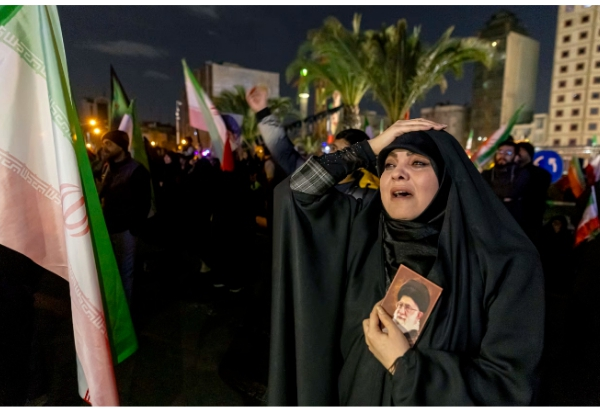
Within Iran, the deaths have prompted an outpouring of official statements and media commentary emphasizing unity and resilience. Senior figures have framed the loss of Khamenei’s wife and family members as a sacrifice that will strengthen national resolve rather than weaken it.
State television repeatedly aired messages calling for calm while also vowing that those responsible would face consequences. Analysts inside Iran have suggested that the incident could accelerate shifts in leadership dynamics and policy posture, particularly regarding security and foreign relations.
Internationally, reactions have been cautious but concerned. Regional governments have expressed alarm at the prospect of further escalation, warning that targeted killings at this level risk triggering unpredictable responses.
Diplomatic sources said the reported deaths have complicated already fragile efforts to manage tensions over Iran’s nuclear program, regional proxy conflicts, and maritime security. The perception that a strike reached the family of Iran’s top leader has amplified fears that norms governing conflict are eroding.
Mansoureh Khojasteh, who largely remained out of the public eye, was nonetheless a significant figure by virtue of her position. Iranian media retrospectives highlighted her role as a stabilizing presence within the family and noted her limited but symbolic appearances at official events.
Her death has been portrayed as emblematic of what officials call the human cost of foreign aggression, a narrative likely to resonate with domestic audiences and shape public opinion in the coming weeks.
The timing of the announcement has also drawn attention. Coming shortly after confirmation of Khamenei’s death, it has reinforced perceptions of a coordinated campaign rather than an isolated incident.
Security analysts say this sequence could influence Iran’s strategic calculations, including decisions about deterrence, retaliation, and alliances. Some observers argue that the scale of the losses increases pressure on Iran’s leadership to respond decisively, while others caution that restraint may be prioritized to avoid a wider war.
As details continue to emerge, independent verification remains limited, with much of the information coming from Iranian state media. Nonetheless, the reports have already had a tangible impact on markets, diplomacy, and regional security assessments.
Energy analysts noted heightened volatility amid fears of disruption, while diplomatic channels have reportedly been activated to prevent miscalculation.
In Tehran, public mourning has been accompanied by heightened security and controlled messaging. Authorities appear intent on shaping the narrative around the deaths, emphasizing sovereignty, resistance, and continuity.
Whether the incident leads to immediate policy shifts or a longer-term recalibration remains uncertain, but there is little doubt that the reported death of Mansoureh Khojasteh has added a deeply personal and emotive dimension to an already fraught geopolitical landscape.
Read also: Israel strikes Lebanon after Hezbollah missiles as Iran war spreads to Beirut
For now, Iran’s official position remains firm: the deaths are the result of a hostile US-Israeli action, and accountability will be sought.
As the region watches closely, the confirmation that Khamenei’s wife dies from injuries has become a focal point in understanding the latest escalation and its potential consequences for Iran and the wider Middle East.
About The Author