Rijana insecurity has emerged as a national concern as Kaduna Governor Uba Sani links the settlement to banditry and urges urgent federal military action.
Kaduna State Governor, Uba Sani, has raised serious concerns over the worsening security situation in parts of Southern Kaduna, describing Rijana settlement along the Abuja–Kaduna Expressway as a central hub of criminal activity fueling violence across the region.

According to the governor, the continued threat posed by armed groups operating from the area has made Rijana insecurity a national challenge requiring decisive intervention.
Governor Sani made the remarks during a visit to Kurmin Wali community in Kajuru Local Government Area, following the recent abduction of worshippers from multiple churches during Sunday services.
The incident, which shocked residents and drew national attention, has further highlighted the fragile security environment in communities located close to Rijana.
While addressing community leaders and residents, the governor stressed that the location of Rijana gives criminal elements easy access to major transport routes, making it attractive for bandits and kidnappers.
He explained that this strategic advantage has allowed criminal groups to launch attacks, retreat quickly, and evade law enforcement, thereby worsening Rijana insecurity and its ripple effects on nearby towns and villages.
The governor recalled that the challenges associated with Rijana were not new.
He noted that during the administration of former Governor Nasir El-Rufai, the state government had openly proposed relocating the settlement due to intelligence reports suggesting it harboured criminal hideouts.
However, the complex social and humanitarian implications of such a move stalled the plan, allowing insecurity to persist.
According to Governor Sani, the latest abduction in Kurmin Wali underscores the urgent need for a more permanent security solution.
He therefore called on the Federal Government to establish a military base in Kurmin Wali, citing its close proximity to Rijana as a key factor.
He argued that a permanent military presence would disrupt criminal networks, deter attacks, and gradually dismantle the structures sustaining Rijana insecurity.
The governor also reassured residents that efforts were ongoing to secure the release of all abducted worshippers.
He expressed confidence in the collaboration between state authorities, the military, and other security agencies, stating that the safety of citizens remains the government’s top priority.
However, the kidnapping incident was initially surrounded by confusion and conflicting accounts.
Reports first emerged over the weekend alleging that armed men had stormed Kurmin Wali and abducted over 100 worshippers during church services.
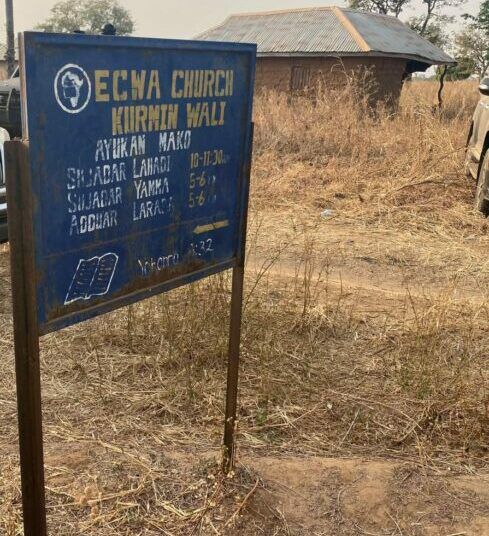
These claims were initially dismissed by state authorities and the Kaduna State Police Command, leading to public skepticism and anxiety.
At the peak of the controversy, the Commissioner of Police in Kaduna State, Muhammad Rabiu, publicly stated that no such incident had occurred.
His comments, which were widely circulated, temporarily calmed fears but later attracted criticism as more information surfaced from the affected community.
On Tuesday, the Nigeria Police Force officially confirmed that the abduction had indeed taken place.
In a statement issued by the Force Public Relations Officer, CSP Benjamin Hundeyin, the police explained that the delay in confirmation was due to conflicting reports received from local sources and the need for thorough verification.
According to the police, the Kaduna State Security Council was immediately convened by Governor Sani upon receiving initial intelligence.
During the meeting, some individuals from the affected local government disputed the reports, describing them as false.
This disagreement, the police said, contributed to uncertainty and reinforced the need for careful fact-checking before making definitive public statements.
The Force clarified that the earlier remarks by the Commissioner of Police were not intended to deny the incident but to prevent unnecessary panic while security agencies confirmed details such as the number of victims and the exact circumstances of the attack.
Following intelligence assessments and operational feedback, the police confirmed the incident and launched coordinated security operations.
In response, the Inspector-General of Police, Kayode Egbetokun, ordered the deployment of tactical units, intelligence assets, and reinforced patrols across Kajuru and surrounding communities.
Search-and-rescue operations were intensified, with security agencies working jointly to track the perpetrators and rescue the victims safely.
Security analysts believe that addressing Rijana insecurity will require more than reactive measures.
They argue that sustained military presence, improved intelligence sharing, community engagement, and socio-economic interventions are necessary to dismantle the criminal networks operating in the area.
As residents of Kurmin Wali and neighbouring communities await the safe return of their loved ones, the incident has reignited national debate on rural security and the need for long-term solutions.
For many observers, the governor’s call for a federal military base represents a critical step toward confronting Rijana insecurity and restoring confidence in affected communities.
Ireport247news