John Bolton, the former national security adviser, surrendered to authorities on Friday amid the unfolding John Bolton indictment, a case shaking Washington and challenging the boundaries of national secrecy.
The John Bolton indictment centers on allegations that the longtime diplomat mishandled sensitive materials and shared classified information after leaving the White House, sparking a legal and political storm across party lines.
Federal prosecutors under the Justice Department charged Bolton with eighteen counts related to transmitting and retaining government secrets, a move that marks a dramatic turn in his decades-long public career.
The John Bolton indictment accuses him of documenting and circulating details from his time as Donald Trump’s national security adviser, including notes about meetings and briefings held in secure locations.
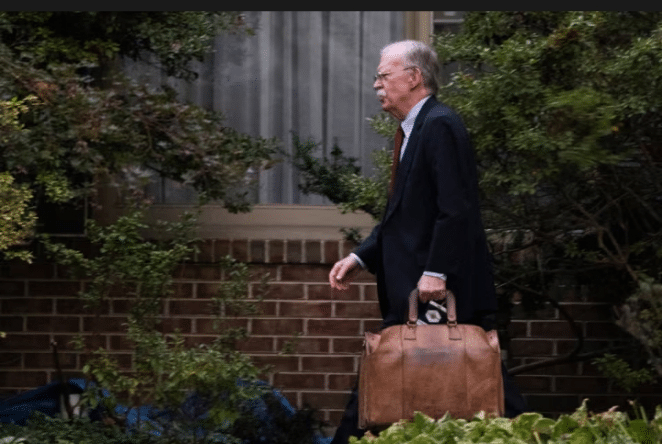
Bolton’s surrender in Maryland followed the unsealing of the indictment late Thursday, when the Justice Department alleged he violated the Espionage Act through the willful retention of top-secret material.
According to the Justice Department, Bolton’s writings included diary entries and notes that described conversations involving classified policy discussions, national defense details, and diplomatic intelligence assessments.
Prosecutors said Bolton shared these materials through personal emails and messaging apps with individuals who lacked security clearances, a claim central to the John Bolton indictment proceedings.
The Espionage Act violations, if proven, could carry significant prison sentences. The law is typically reserved for cases involving unauthorized disclosure of information critical to U.S. security.
Bolton, 76, arrived at the courthouse wearing a dark suit and expression of resolve. “I intend to defend my conduct fully,” he told reporters. “The facts will speak for themselves.”
His attorney, Abbe Lowell, described the charges as an overreach. “This is an unnecessary criminalization of routine record-keeping,” Lowell said, emphasizing that no classified information was ever compromised.
The John Bolton indictment underscores a widening effort by the Justice Department to enforce strict handling of government secrets, a policy reaffirmed during recent prosecutions under the Espionage Act.
Prosecutors argued that Bolton’s daily notes, some handwritten on yellow pads, contained summaries of intelligence briefings, discussions with foreign officials, and the movement of sensitive defense materials.
In one cited example, investigators said Bolton described a meeting inside a secure compartmented information facility, detailing both the participants and the classified topics discussed.
The John Bolton indictment outlines that after leaving the White House in September 2019, he maintained communication with two unnamed individuals, allegedly sending them more than a thousand pages of material.
“Fourteen days after he left the administration, Bolton exited the private chat group used to transmit those notes,” the document reads, confirming the timeline behind the Espionage Act charges.
The case comes amid renewed scrutiny over how senior officials handle classified information, especially after multiple controversies involving public figures in both major political parties.
Donald Trump, who has long maintained a combative relationship with his former adviser, called the case “unfortunate” but added that “Bolton was always a bad guy who never knew loyalty.”
The John Bolton indictment is the third in recent weeks involving individuals once critical of Donald Trump, intensifying speculation about how politics intersects with legal enforcement in the post-Trump era.
Still, officials within the Justice Department insist the timing reflects investigative progress, not political motives, citing evidence gathered over several years since 2022.
Bolton’s supporters see him as a principled conservative caught in a politically charged moment. “He’s no traitor,” said one former colleague. “John Bolton served the country for decades with integrity.”
Critics, however, view the John Bolton indictment as proof that Washington’s elite often blur the lines between memoir writing and mishandling of secrets.
The Espionage Act, first enacted in 1917, has increasingly been used in civilian cases involving digital communication, raising questions about its application to modern record-keeping.
“The Act was never meant for note-taking or personal reflections,” argued one legal scholar, noting that the John Bolton indictment could redefine what counts as unauthorized retention.
The Justice Department maintains that intent matters more than medium. Prosecutors allege that Bolton’s actions were deliberate, citing his decision to use nongovernment channels despite official restrictions.
Bolton has countered that his diaries were personal and known to investigators as early as 2021, long before any allegations of illegal possession of classified information surfaced.
“This is about transparency,” Bolton said in a written statement. “I won’t let Donald Trump or anyone else distort my record or my loyalty to the United States.”
The political context of the John Bolton indictment cannot be ignored. Many Republicans have distanced themselves, wary of defending a man who once called Donald Trump “unfit for office.”
Democrats, while cautious, have pointed to the case as another sign that the Justice Department is applying laws evenly, regardless of political affiliation or former rank.
For career national security officials, the John Bolton indictment sends a chilling signal about post-service record-keeping and the thin line between private documentation and potential prosecution.
Several analysts believe the Espionage Act needs modernization to address today’s digital environment, where personal devices and cloud storage complicate what counts as possession of classified information.
Bolton’s memoirs, often critical of Donald Trump, became bestsellers but also triggered concerns within the White House about potential disclosures, contributing to longstanding tension with the former president.
During the Biden administration, the Justice Department revived its inquiry into Bolton’s records after intelligence agencies flagged discrepancies in how certain materials were archived.
A senior official familiar with the probe said, “This is not political. The John Bolton indictment reflects evidence of deliberate conduct, not accidental oversight.”
Still, many in Washington see echoes of previous disputes, including those involving other high-profile figures accused of mishandling sensitive documents under the Espionage Act.
Bolton’s legal team plans to challenge the classification determinations, arguing that the materials cited in the John Bolton indictment were never officially deemed top secret at the time of writing.
Experts expect a lengthy court battle that could stretch well into the next election cycle, intertwining legal arguments with the enduring shadow of Donald Trump’s presidency.
The Justice Department will likely emphasize the gravity of the alleged breaches, portraying Bolton’s actions as undermining safeguards designed to protect U.S. defense and intelligence systems.
If convicted on all counts, Bolton could face substantial penalties. However, legal analysts caution that the case’s complexity could produce mixed outcomes, including possible dismissals or reduced charges.
Bolton remains defiant. “After 45 years of public service, I will not allow my integrity to be tarnished by politics,” he told reporters outside his Bethesda home before surrendering.
As the John Bolton indictment proceeds, the case will test the balance between transparency, accountability, and the preservation of state secrets — a debate at the heart of American democracy.
For Washington insiders, it’s not just about Bolton. It’s about whether the Espionage Act can fairly distinguish between reckless exposure and legitimate historical documentation.
The Justice Department faces growing pressure to apply consistent standards amid accusations of selective prosecution, especially given recent high-profile document controversies involving Donald Trump himself.
Observers note that the John Bolton indictment may ultimately clarify the legal limits of post-government disclosure, setting precedents for future administrations and public officials.
Whether viewed as justice served or overreach exposed, the unfolding trial of John Bolton will remain one of the most closely watched legal sagas of the decade.
About The Author