
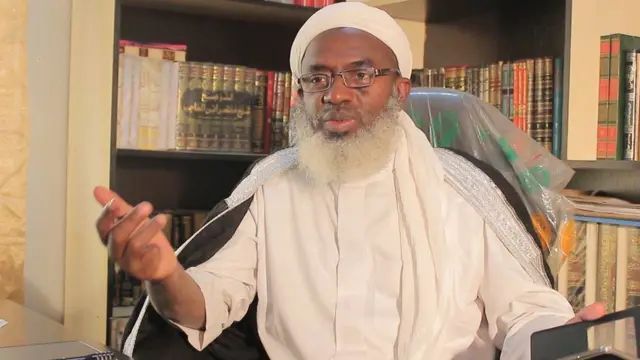
Fresh controversy has erupted over Shariah Law in Nigeria following comments by prominent Islamic scholar Ahmad Gumi, who forcefully defended its application and dismissed foreign criticism as misplaced interference.
His reaction came amid reports that some members of the US Congress urged President Donald Trump to push for the repeal of Islamic legal provisions, including blasphemy laws, operating in parts of northern Nigeria.
In a strongly worded message shared on his verified social media account, Ahmad Gumi insisted that Muslims possess a constitutional and moral right to live according to their religious codes.
He argued that the existence of Shariah Law in certain Nigerian states is neither illegal nor unusual, stressing that it functions within the broader constitutional framework of the country.
According to him, portraying the system as inherently oppressive ignores the realities of Nigeria’s pluralistic structure.
The cleric drew comparisons with the United States, suggesting that American political life often reflects Christian values and advocacy.
He questioned what he described as a global double standard, arguing that while it is considered acceptable for Christian groups in America to influence governance in line with biblical teachings, Muslims are criticized for upholding Qur’anic injunctions.
In his view, Religious Freedom should apply equally to all faith communities, regardless of geography.
The debate intensified after media reports indicated that certain lawmakers in the US Congress formally appealed to President Donald Trump to take diplomatic steps aimed at ending Shariah-based and blasphemy laws in Nigeria.
Although details of the correspondence remain limited, the reports were enough to trigger heated reactions from religious leaders and political observers.
For many Nigerians, the issue raised sensitive questions about sovereignty and the limits of international involvement in domestic legal systems.
Gumi maintained that Shariah Law in Nigeria primarily addresses personal and family matters for Muslims, including marriage, inheritance, and dispute resolution.
He emphasized that non-Muslims are not compelled to submit to Shariah courts, as the conventional legal system remains available to all citizens.
By clarifying this point, he sought to counter narratives suggesting that the Islamic legal structure overrides Nigeria’s secular institutions.
Beyond legal arguments, the cleric also alleged that Muslims in Nigeria are disproportionately affected by violence and insecurity.
He described what he termed “occult terror” introduced by hidden actors, claiming that Muslims often suffer the consequences of instability yet receive limited sympathy internationally.
While he did not elaborate on the forces he referenced, his remarks appeared aimed at shifting the conversation from criticism of Islamic law to concerns about security and justice.
Legal analysts note that the Nigerian Constitution allows states to establish Shariah courts for civil matters involving Muslims.
Since the early 2000s, several northern states have expanded the scope of Shariah Law, leading to both local and global scrutiny.
Supporters argue that it reflects democratic choice in Muslim-majority regions, while critics question whether certain punishments or blasphemy provisions align with international human rights standards.
The renewed attention from the US Congress adds an international dimension to a longstanding domestic debate.
Some observers believe that diplomatic pressure could strain relations between Nigeria and the United States if not handled carefully.
Others argue that open dialogue about human rights and governance is part of normal bilateral engagement between nations.
For Gumi and like-minded supporters, however, the principle at stake is Religious Freedom.
They contend that Nigeria’s diversity requires mutual respect among its religious communities and that external actors should avoid prescribing uniform standards without considering local contexts.
From this perspective, the preservation of Shariah Law is framed not as a rejection of modern governance but as an affirmation of constitutional pluralism.
Critics counter that while freedom of religion is essential, it must coexist with protections for fundamental rights, including freedom of expression.
They argue that blasphemy laws, in particular, have sometimes led to controversial prosecutions and social tensions.
These differing viewpoints underscore the complexity of balancing faith-based systems with universal legal norms.
As the discussion unfolds, it is clear that Shariah Law remains a deeply sensitive issue in Nigeria, touching on identity, politics, and international diplomacy.
Whether the reported appeal to President Donald Trump will translate into formal policy action remains uncertain.
What is certain, however, is that the debate has reignited broader questions about how multi-religious societies negotiate the intersection of law and belief.
For now, Gumi’s intervention has ensured that the conversation extends beyond Nigeria’s borders, placing it squarely within a global discourse on governance and religious rights.
The coming weeks may determine whether the controversy subsides or evolves into a more pronounced diplomatic exchange.
Ireport247news
About the Author


