

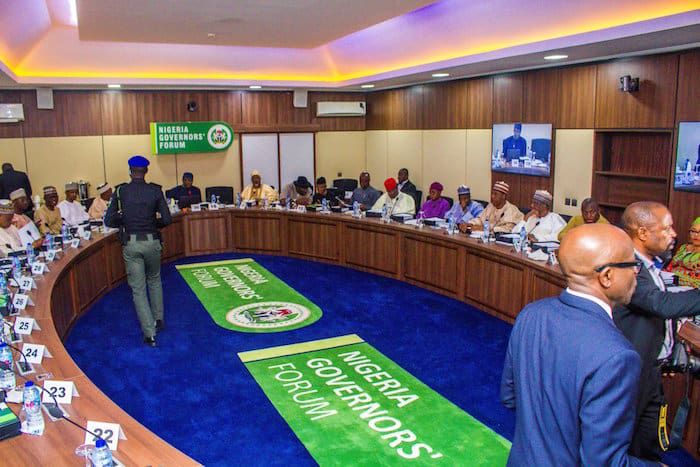
Nigeria governors reject claims of unaccounted subsidy funds as they back a CNG transport plan aimed at reducing fares and easing living costs.
The Nigeria Governors’ Forum (NGF) has dismissed allegations that state governments failed to account for funds received after the Federal Government removed the fuel subsidy, insisting that the claim is unfounded.
Bayelsa State Governor, Senator Douye Diri, made the position known on Thursday after the third meeting of the Nigeria Governors’ Forum, where he responded to questions from journalists on the subsidy controversy, transportation costs and the proposed transition to compressed natural gas (CNG).
Diri, who read the communiqué issued after the meeting, was asked whether the governors had discussed renewed calls from some political stakeholders for the Federal Government to restore the petrol subsidy.
Rather than backing a return to the former subsidy regime, the governor pointed to the proposed National Affordable CNG Transit Programme as part of the measures being considered to lessen the burden created by rising transportation costs.
He explained that transportation had become one of the most important factors behind the rising prices of goods and services across the country.
According to him, when the cost of moving people, farm produce and other commodities rises, traders and businesses eventually pass the additional expenses to consumers.
“Now, these are part of the issues that have been addressed, particularly with the number two that I just talked about today about transportation fares,” Diri said.
The governor said the governors were working with private-sector stakeholders to increase the use of CNG as an alternative fuel for public transportation.
He noted that CNG-powered vehicles could operate at a lower cost than petrol-powered vehicles, creating room for transport operators to reduce fares.
Diri argued that cheaper transportation would not only benefit commuters but could also help moderate prices in other areas of the economy.
“And it will have a multiplier effect on every other sector,” he said.
Governors reject accountability allegation
The Bayelsa governor was subsequently confronted with claims that state governments had not been transparent or accountable in the management of funds that became available to them following the removal of the fuel subsidy.
Diri rejected the allegation emphatically, saying the governors could not accept responsibility for a claim he described as untrue.
“That cannot be true. That cannot be true. But we’ll leave that debate for another day,” he said.
The issue of accountability has remained part of the wider public debate surrounding the subsidy removal, particularly as governments at different levels have received additional resources following changes in the country’s petroleum subsidy policy.
However, Diri did not provide further details about the specific funds or explain the forum’s position beyond rejecting the allegation.
Why transportation remains a priority
The governor was also asked whether focusing on transportation would leave other sectors of the economy without adequate intervention.
In his response, Diri maintained that transportation should not be viewed as a standalone issue because it affects virtually every aspect of economic activity.
“Transportation is key. Transportation is key to several other factors,” he said.
He used food distribution as an example, explaining that the amount spent moving agricultural products from one location to another forms part of the final price paid by consumers.
For instance, a trader transporting yam, garri or other food items from a producing area to a major market has to factor fuel and vehicle operating costs into the selling price.
“Say, for instance, you are talking about foodstuffs—increase in the cost of foodstuffs. They will tell you that ‘I’m moving from point A to point B, the transport cost is XY,’” he explained.
Diri said the additional transportation expense could eventually make basic food commodities more expensive for households.
He therefore argued that reducing transport costs could have a broader impact on inflation and the general cost of living.
“And so by the time you reduce the cost of transport, as I said earlier, it will have a multiplier effect on several other,” the governor said.
NGF reviews affordable CNG programme
At the meeting, the governors received a presentation on the proposed National Affordable CNG Transit Programme, which is intended to reduce the financial burden on commuters by encouraging the use of cheaper CNG-powered transportation.
The proposed scheme is expected to involve support from state governments for vehicle conversions, the deployment of CNG-powered fleets and the development of infrastructure needed to sustain the alternative-fuel transport system.
Participating transport operators would also be expected to make commitments towards maintaining affordable fares.
The governors acknowledged the potential benefits of the proposal, particularly at a time when transportation costs have become a major concern for households and businesses.
However, the Forum said more work was needed on the financing and implementation arrangements before the programme could be fully operational.
This suggests that while the governors are interested in using CNG to reduce transport expenses, questions remain over how the scheme will be funded, implemented and monitored across participating states.
The proposed intervention also reflects the growing effort by governments and private-sector operators to expand the use of alternative fuels following the removal of the petrol subsidy.
States to explore trade and investment opportunities
Beyond transportation and the subsidy debate, the governors also discussed opportunities for states to strengthen their participation in international and African trade activities.
The Forum received a presentation from the Minister of Industry, Trade and Investment, Dr Jumoke Oduwole, concerning CANEX Weekend 2026 and the Intra-African Trade Fair 2027.
Both events are scheduled to take place in Lagos and are expected to provide opportunities for governments and businesses to promote products, services and investment projects.
The governors said state participation could help showcase projects that are ready for investment while also creating greater exposure for locally produced goods and tourism opportunities.
They further identified the events as potential platforms for connecting state-based micro, small and medium enterprises with investors and buyers from across Africa and the wider global market.
According to the Forum, stronger participation in such platforms could help states expand their economic opportunities beyond traditional sources of revenue and create new avenues for private-sector growth.
The governors consequently assured Oduwole of their support for the objectives of the events.
The discussions at the meeting underline the NGF’s focus on addressing economic pressures through transportation interventions, alternative energy use, trade promotion and greater participation of states in investment opportunities.
For Nigerians, however, the success of the proposed CNG initiative is likely to depend on whether lower operating costs can ultimately translate into cheaper transport fares and whether the savings can filter through to the prices of food and other essential commodities.
About The Author
