

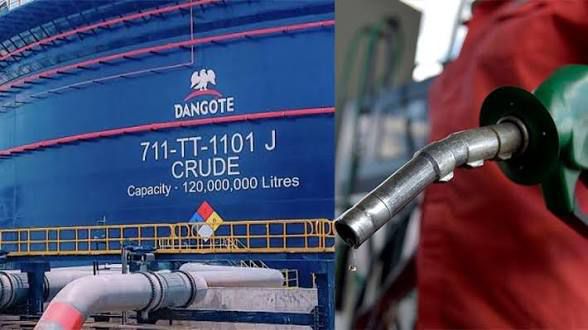
Nigeria’s downstream oil sector faced fresh turbulence on Saturday as a new Dangote petrol price hike pushed the ex-depot price of Premium Motor Spirit (PMS) to N1,275 per litre, marking the fifth upward review within March alone.
The latest adjustment, coming barely hours after a previous increase, highlights the growing instability in fuel pricing under Nigeria’s deregulated regime and signals potential ripple effects across transport, logistics, and consumer markets.
Dangote petrol price hike accelerates amid rapid adjustments
The pace of adjustments has raised concerns among industry stakeholders and consumers alike. Within a single day, the refinery revised its pricing template twice, forcing marketers to discard earlier pricing structures and adopt the updated rates immediately.
The new gantry price of N1,275 per litre represents an increase from N1,175 recorded earlier in the month, while also reflecting a marginal rise from the N1,245 announced just hours before the latest revision.
This rapid succession of increases underscores the intensity of pricing pressure in the sector, driven largely by external market forces rather than domestic supply constraints.
In addition to gantry pricing, the refinery also reviewed its coastal supply rates, increasing the cost per metric tonne significantly. This adjustment further amplifies the cost burden on bulk buyers and downstream distributors.
Monthly surge reflects sharp upward trajectory
A breakdown of price movements since the beginning of March reveals a steep and consistent upward trend. At the start of the month, petrol was sold at N774 per litre at the gantry.
Subsequent increments saw prices climb to N874, N1,050, N1,175, N1,245, and now N1,275 per litre.
Cumulatively, this represents an increase of over 60 per cent within less than three weeks—a development analysts describe as unusually sharp even within a deregulated environment.
The coastal pricing structure followed a similar trajectory, rising steadily in response to global shipping costs and international refined product benchmarks.
Market watchers note that such aggressive price movements are rare and typically linked to extraordinary external shocks.
Global factors driving Dangote petrol price hike
Industry analysts attribute the persistent Dangote petrol price hike to a combination of global crude oil volatility, supply chain disruptions, and geopolitical tensions affecting fuel-producing regions.
Recent disruptions in traditional supply routes, particularly from the Middle East, have tightened global fuel availability, pushing up import parity prices. Despite Nigeria’s growing domestic refining capacity, local prices remain closely tied to international benchmarks.
Freight costs, insurance premiums, and foreign exchange fluctuations have also compounded the pricing pressure, making it difficult for refiners to maintain stable rates.
Experts argue that the deregulated framework inherently exposes the domestic market to such fluctuations, as prices are largely determined by prevailing global conditions.
Implications for consumers and businesses
The immediate consequence of the latest price increase is expected to be a nationwide adjustment in pump prices. Filling stations are likely to revise retail rates upward in response to the new ex-depot pricing, with consumers bearing the ultimate cost.
Transport operators, already grappling with high operating expenses, may increase fares to offset rising fuel costs. This, in turn, could trigger a broader inflationary effect, as higher logistics costs are passed on to goods and services.
Small businesses, particularly those reliant on petrol-powered generators, are also expected to face increased operational costs, further squeezing profit margins.
Economic analysts warn that sustained fuel price increases could erode purchasing power and slow economic activity, especially in urban centres where energy demand is high.
Rising regional demand adds pressure
Compounding the situation is growing demand from other African countries. Several nations, including major economies on the continent, have reportedly turned to the refinery as alternative supply routes face disruption.
This surge in regional demand has intensified competition for available supply, placing additional pressure on pricing dynamics.
The refinery’s capacity and strategic positioning have made it a key player in Africa’s fuel supply chain, but the increased demand also exposes it to the same global market forces affecting international suppliers.
Outlook remains uncertain
Despite expectations that domestic refining would stabilise Nigeria’s fuel market, recent developments suggest that price volatility may persist in the near term.
The continued Dangote petrol price hike trend indicates that external factors—particularly global oil prices and geopolitical risks—will remain dominant drivers of pricing decisions.
Stakeholders are calling for policy clarity and strategic interventions to cushion the impact on consumers, including measures to stabilise foreign exchange and improve supply chain efficiency.
For now, however, the market appears set for further adjustments, with industry players closely monitoring global developments that could influence pricing in the weeks ahead.
Phwin88 App, get it on your phone bro easy access, anywhere any time. That’s the life. They even have casino on there, download it you’ll see. phwin88app
Alright folks, listen up! If you’re like me and constantly forgetting your playtimecasinologin details, this site might be a lifesaver. Gives you a straightforward way to jump in. See for yourself playtimecasinologin
For my Vietnamese gamers out there, been trying out topgamebaivn. Lots of familiar favorites. If you’re looking for a new place to challenge your mates, this is worth a peek. Check it out here topgamebaivn