Fresh concerns have emerged over Nigeria’s democratic trajectory as a Professor of Political Science and former commissioner of the National Electoral Commission (INEC), Okechukwu Ibeanu, cautioned that the country’s latest electoral reform efforts still leave troubling loopholes unresolved.
Delivering a keynote address at a Citizens’ Townhall policy dialogue in Abuja, Ibeanu argued that while legislative adjustments are important, they cannot substitute for deeper institutional strengthening and active citizen participation.
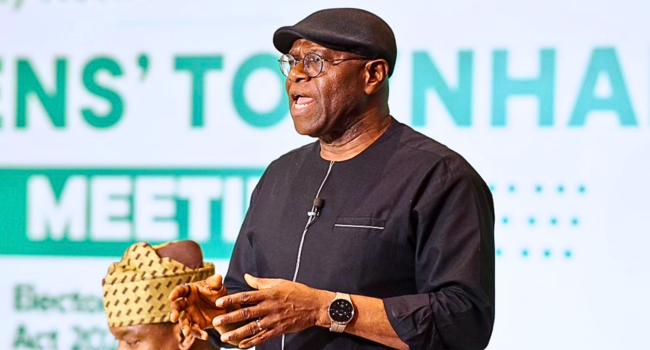
According to him, public discourse in Nigeria often exaggerates the power of legal amendments, assuming that every electoral challenge can be corrected by rewriting statutes.
He warned that the ongoing focus on electoral reform through constant amendments to the law risks creating instability rather than progress.
“We tinker with the legal framework repeatedly as if the law alone contains all the answers,” he said.
“But democracy depends on institutions, enforcement, and the vigilance of citizens—not only the text of legislation.”
Nigeria’s electoral legal structure has undergone several revisions in the past decade, including repeals and re-enactments. Ibeanu described this pattern as unhealthy for a developing democracy.
In his words, amendment should serve as “medicine” when necessary, not become the system’s “daily bread.”
Excessive revisions, he warned, could transform electoral reform into a political bargaining tool instead of a genuine safeguard for voters.
He referenced past debates over electronic transmission of results, noting that disagreements surrounding its interpretation reflected weaknesses in legislative clarity.
According to him, it was unfortunate that the country had to revisit arguments that were previously settled, effectively returning discussions to positions held years earlier.
Such recurring controversies, he suggested, demonstrate the importance of drafting precise and unambiguous provisions.
Another concern raised at the forum was the role of politicians in shaping the very laws meant to regulate them.
Ibeanu argued that allowing elected officials to dominate amendment processes without sufficient civic input creates a conflict of interest.
Over time, he said, this dynamic could produce laws subtly tilted toward political convenience.
Beyond legislation, the professor also cautioned against excessive regulatory oversight of political parties by the electoral commission.
While acknowledging the need for supervision, he warned that over-centralisation of authority could create what he described as the “spectre of military-style control” within a democratic setting.
Balancing accountability with party independence, he stressed, is critical to preserving pluralism.
Nigeria’s most recent legislative shift came when President Bola Ahmed Tinubu signed the Electoral Act 2026 into law on February 18, 2026, replacing the 2022 framework ahead of the 2027 general elections.
The new Act contains notable changes intended to strengthen transparency and efficiency.
Among its provisions are mandatory electronic transmission of results to the INEC Result Viewing (IReV) portal, formal recognition of the Bimodal Voter Accreditation System (BVAS), revised timelines for election notices and candidate nominations, updated procedures for party primaries, and earlier disbursement of funds to the electoral commission.
Supporters argue that these measures reflect meaningful electoral reform capable of enhancing credibility.
However, critics—including opposition parties and several civil society organisations—have questioned aspects of the revised law.
Of particular concern are discretionary powers granted to electoral officials during technical failures.
Observers fear that if not clearly defined and transparently applied, such provisions could weaken accountability.
Ibeanu therefore called for a closer review of specific sections of the Act, including Sections 50, 60, and 62, urging the Independent National Electoral Commission (INEC) to issue clearer regulations and operational guidelines.
According to him, effective electoral reform depends not only on statutory language but also on implementation frameworks that remove ambiguity.
Central to his message was a strong appeal for civic responsibility. He challenged Nigerians to become more actively involved in defending their votes and monitoring public officials.
“This is about citizens,” he emphasised.
“Democracy cannot survive if people disengage and leave everything to politicians or institutions.”
He argued that genuine electoral reform must extend beyond courtrooms and parliamentary chambers.
It should include voter education, transparent party processes, robust media scrutiny, and community-level engagement.
Without citizen vigilance, he warned, even the most sophisticated legal provisions may fail to deliver credible outcomes.
As the 2027 elections approach, debates surrounding Nigeria democracy and institutional trust are likely to intensify.
The effectiveness of INEC regulations, the clarity of operational guidelines, and the willingness of voters to demand accountability will shape the credibility of the next electoral cycle.
While the Electoral Act 2026 represents an attempt to consolidate past reforms, the broader challenge remains ensuring that laws are stable, clear, and faithfully implemented.
For Ibeanu and other reform advocates, the future of Nigeria democracy will depend less on how frequently statutes are amended and more on how faithfully democratic principles are upheld.
About The Author