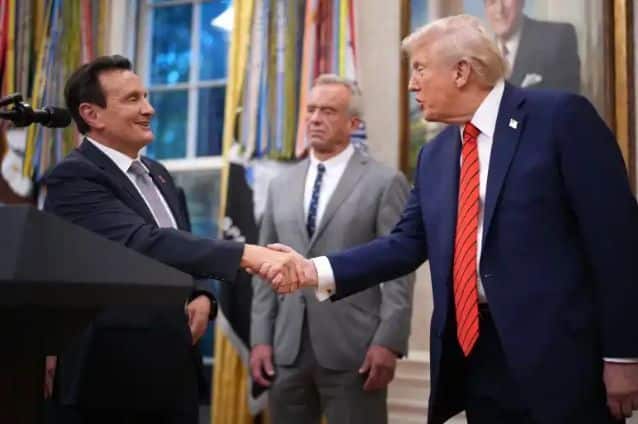
Leaders from more than 20 countries will convene in Egypt’s Sharm el-Sheikh on Monday for a high-level Gaza peace summit aimed at ending Israel’s war.
The Egyptian presidency confirmed that President Abdel Fattah el-Sisi and US President Donald Trump will co-chair the meeting, focusing on restoring Middle East stability and humanitarian aid.
A statement from Cairo said the Gaza peace summit will “end the war in the Gaza Strip, enhance peace efforts, and usher in a new era of regional security.”
United Nations Secretary-General Antonio Guterres, UK Prime Minister Keir Starmer, Italy’s Giorgia Meloni, Spain’s Pedro Sanchez, and France’s Emmanuel Macron are among confirmed attendees, reflecting global urgency behind El-Sisi mediation.
It remains unclear whether Israeli Prime Minister Benjamin Netanyahu or any representatives of the Hamas Palestinian group will participate in the Gaza peace summit, highlighting the ongoing diplomatic uncertainty.
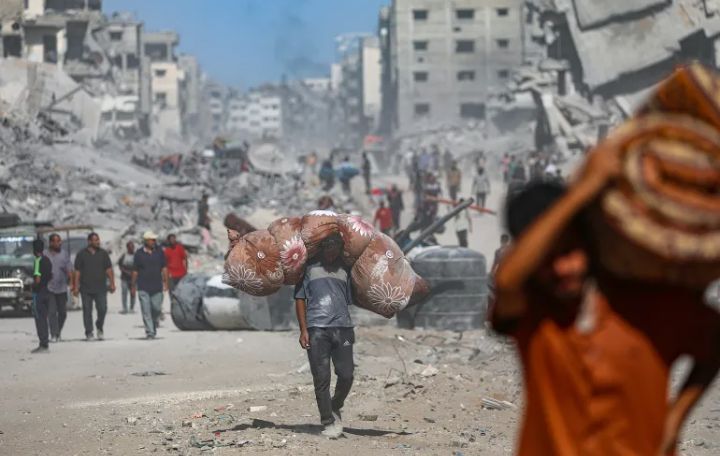
The announcement followed scenes of tens of thousands of Palestinians moving north toward their destroyed homes as the Israel-Hamas ceasefire continued to hold, easing months of devastating bombardment.
Under the first phase of the US-brokered Trump Gaza plan, Israeli forces began a partial withdrawal from the enclave after a war that killed more than 67,000 Palestinians.
Al Jazeera’s Hani Mahmoud, reporting from Gaza City, said the ceasefire “ended one form of violence, but the struggle continues,” describing the fragile calm across the ruins.
“People walk this exhausting, tiring journey back here [in the north] because they belong here,” Mahmoud said. “They keep telling us that they belong.”
He added: “They will never be uprooted from here. But spending a night here is going to be very difficult. The struggle to survive continues.”
Gaza’s Government Media Office said 5,000 operations had been conducted since the truce began, including 850 rescue and relief missions to clear rubble, recover bodies, and secure neighborhoods.
The Civil Defence reported recovering about 150 bodies across the Strip, while Nasser Hospital confirmed 28 more were found in Khan Younis, underlining the grim aftermath of war.
More than 900 urgent service missions have restored water and sewage lines, though these efforts proceed with minimal resources as Israel’s blockade continues to restrict essential supplies and fuel.
During the conflict, Israeli airstrikes destroyed ambulances, fire trucks, and civil defense centers, crippling Gaza’s emergency response capacity, a challenge now facing those rebuilding under the El-Sisi mediation framework.
The mayor of Khan Younis reported that 85 percent of the governorate has been destroyed, with an estimated 400,000 tonnes of rubble still littering the city’s devastated streets.
Humanitarian organizations have pressed Israel to open additional crossings to facilitate aid delivery, calling the Gaza peace summit a vital opportunity to ease the blockade and prevent famine.
The World Food Programme said it was prepared to reopen 145 food distribution centers if crossings are expanded. Before the siege, UN agencies maintained more than 400 such points.
“What is most important now for us to reach the north is crossings to be opened,” said WFP representative Antoine Renard, speaking from Deir el-Balah about the ceasefire’s implementation.
Renard added: “The conditions should be the same [now]. We expect that the good practices we had in January 2025 will again be applied in this ceasefire.”
Meanwhile, Hamas political bureau member Izzat al-Risheq said the group is working with “friendly countries” to secure aid entry into Gaza, “despite the massive destruction caused by the war.”
UNICEF spokesperson Tess Ingram said the agency would expand operations beginning Sunday to deliver high-energy food for children, hygiene supplies, and tents to thousands displaced by violence.
As part of the Trump Gaza plan, 20 Israeli captives and the remains of 28 others are expected to be handed over Monday, with Palestinian prisoners freed in exchange.
Trump confirmed that “Israeli captives held in Gaza by Hamas and other armed groups are expected to come back on Monday,” describing it as a “moment of relief for all.”
In return, Israel will release about 250 Palestinian prisoners, along with roughly 1,700 detainees held without charge since the war began two years ago, according to the Israel Prison Service.
The agency said detainees have been moved to deportation facilities at Ofer and Ktzi’ot prisons “awaiting instructions from the political echelon,” signaling imminent prisoner exchanges under the Israel-Hamas ceasefire.
Rights groups have long accused Israel of mistreating detainees before release, citing “harsh treatment, humiliation, and physical abuse.” Some return in dire health after prolonged detention without trial.
In Tel Aviv, tens of thousands gathered at Hostages Square after two years of protests demanding the captives’ return, crediting Trump’s intervention for breaking the deadlock.
Trump’s son-in-law Jared Kushner, daughter Ivanka Trump, and US envoy Steve Witkoff joined families on stage. Witkoff played a key role in shaping the Trump Gaza plan.
“I dreamed of this night. It’s been a long journey,” Witkoff said, as chants of “Thank you, Trump! Thank you, Witkoff!” echoed, mixed with boos when Netanyahu’s name was mentioned.
Addressing the released captives, Witkoff said: “As you return to the embrace of your families and your nation, know that all of Israel and the entire world stands ready to welcome you.”
Al Jazeera’s Hamdah Salhut reported that relatives of the captives “credit Trump for the deal, not Netanyahu,” accusing Israel’s leader of prolonging the war for political survival.
“The family members of captives have no faith in their government,” Salhut said. “They accused the Israeli prime minister of prolonging the war for personal and political gain.”
“The cheers for [Trump] and for Steve Witkoff come because those protesting say this happened because of the Americans,” she added, underscoring how the Gaza peace summit reshaped perceptions in Israel.
Beyond the emotional reunions, expectations remain high that Monday’s Gaza peace summit could cement an enduring ceasefire and launch a framework for long-term Middle East stability.
Diplomatic sources said Egyptian and US mediators would present a joint proposal combining political, security, and reconstruction components — a plan potentially endorsed by Gulf and European states.
Analysts suggest that El-Sisi mediation reflects Cairo’s push to restore its regional role after years of sidelining during conflicts in Gaza, Libya, and Sudan.

Meanwhile, Washington hopes the Trump Gaza plan will demonstrate American leadership and rebuild trust with Arab nations critical of Israel’s actions and humanitarian fallout.
Observers note that while the Israel-Hamas ceasefire remains fragile, its continuation could pave the way for a broader regional peace dialogue, possibly extending to Lebanon and the West Bank.
As anticipation builds, Monday’s meeting in Sharm el-Sheikh is seen as a crucial test of political will — and the durability of promises forged under fire.
The Gaza peace summit symbolizes both exhaustion and hope, marking what could be a turning point in a war that has reshaped the Middle East’s moral and strategic landscape.
About The Author