
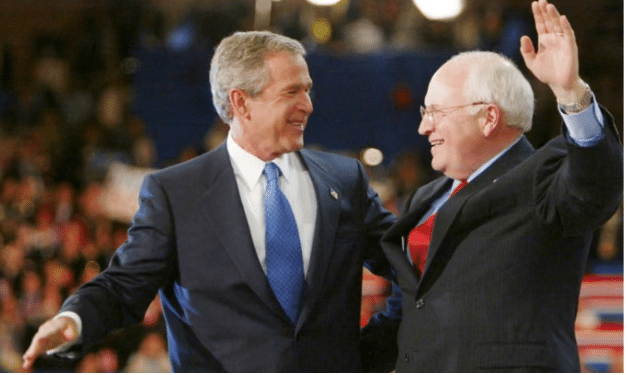
Former United States Vice President Dick Cheney death at 84 has been confirmed by his family, marking the end of a powerful and controversial chapter in American politics.
Cheney, who served under President George W. Bush, was known for his unmatched influence in shaping US defense and foreign policy during one of history’s most turbulent decades.
He was in office on September 11, 2001, when terrorists struck the United States. While Bush was secured elsewhere, Cheney directed crucial national defense operations from Washington.
Working closely with Defense Secretary Donald Rumsfeld, Cheney authorized immediate action against al-Qaida, later overseeing the campaign that led to the invasion of Afghanistan to dismantle the Taliban regime.

However, Dick Cheney death reopens discussion about his greatest political gamble—the 2003 Iraq invasion—launched on claims that Saddam Hussein possessed weapons of mass destruction and ties to terrorism.
The claims were later disproved, sparking international backlash. Yet Cheney remained unapologetic, insisting that strong measures were necessary to protect American lives and maintain global security.
“I believed, and still believe, that America must act to defend itself,” Cheney once wrote, reinforcing his image as a leader defined by conviction rather than popularity.
As Secretary of Defense under George H.W. Bush during the 1991 Gulf War, Cheney had already shaped US military doctrine, emphasizing swift, decisive action in the Middle East.
He later became vice president to George W. Bush, a role that saw him wield exceptional behind-the-scenes power rarely seen in the office’s modern history.
While Bush embodied optimism, Cheney represented the steel of national defense. Analysts described him as the administration’s strategist, the man who preferred results over rhetoric.
The Dick Cheney death thus closes the life of a political titan whose decisions influenced generations of policymakers and left lasting marks on global military and diplomatic history.
Born in Lincoln, Nebraska, in 1941, Cheney grew up in Wyoming and began his political career working for the Nixon and Ford administrations during the 1970s.
At age 34, he became the youngest ever White House Chief of Staff under President Gerald Ford, quickly gaining a reputation as an effective and pragmatic operator.
He later served as a Republican congressman from Wyoming for a decade, advocating for limited government and strong national defense, themes that defined his entire political identity.
During the Reagan years, Cheney became a key voice for conservative values, positioning himself as a hawk on defense and a critic of liberal foreign policy strategies.
He returned to prominence as Defense Secretary under President George H.W. Bush, overseeing Operation Desert Storm, which drove Iraqi forces from Kuwait with overwhelming military force.
Cheney’s success in that campaign earned him national respect, but his corporate career at Halliburton later raised questions about potential conflicts of interest when he reentered politics.
When George W. Bush selected him as running mate in 2000, Cheney initially led the vice-presidential search committee, only to become the nominee himself after party consultation.
Despite having suffered multiple heart attacks, he campaigned vigorously, portraying himself as the seasoned hand guiding the younger Bush through complex global challenges.
The September 11 attacks transformed his vice presidency. From secure locations, he coordinated defense protocols, authorized shoot-down orders, and supported unprecedented surveillance programs to prevent future attacks.
However, the Dick Cheney death rekindles debate over his authorization of “enhanced interrogation techniques,” widely condemned as torture, which he defended as essential to national security.
“We did what we had to do,” Cheney said in a 2011 interview, maintaining that those measures protected the United States from another catastrophic assault.
He faced both admiration and outrage. To supporters, Cheney was a patriot willing to make hard choices. To critics, he symbolized the excesses of post-9/11 American power.
Over time, as the wars in Iraq and Afghanistan dragged on, public opinion soured. Yet Cheney’s steadfast defense of his decisions never wavered, even in retirement.
His daughter, Liz Cheney, followed his path into Congress but broke with Republican orthodoxy when she condemned Donald Trump’s role in the January 6 Capitol attack.
The former vice president joined her in criticizing the party’s shift, calling Trump “the greatest threat to our republic in American history,” during a 2024 public statement.
In an extraordinary move, Cheney declared his intention to vote for Kamala Harris over Trump, citing loyalty to the Constitution above partisan politics.
Despite partisan divides, political figures across the spectrum acknowledged the Dick Cheney death as the passing of a consequential and complex statesman.
Former President George W. Bush issued a statement praising Cheney as “a loyal friend, trusted advisor, and patriot who never wavered in his duty to America.”
Former Secretary of State Condoleezza Rice also paid tribute, describing him as “a man of principle whose strength guided us through America’s darkest hour.”
Historians, however, offered a mixed view. Professor Michael Beschloss noted that Cheney’s vice presidency “expanded executive power to unprecedented levels, reshaping the balance of governance.”

Cheney’s health struggles were well-documented. He underwent multiple heart surgeries and received a transplant in 2012 but remained active in public discourse until recent years.
The Dick Cheney death also invites reflection on his pop culture legacy. He was portrayed by Christian Bale in the Oscar-nominated film Vice, which depicted his rise to power.
In interviews, Cheney’s biographers described him as intelligent, secretive, and fiercely committed to American dominance. “He liked being called Darth Vader,” said author Jake Bernstein.
Throughout his career, Cheney maintained a stoic demeanor. He avoided the limelight, preferring strategic meetings, classified briefings, and the power of quiet influence over public applause.
His long-time colleague, Donald Rumsfeld, once remarked that “Cheney was the mind you wanted in the room when the stakes were highest.”
Even critics conceded that his mastery of bureaucracy and policymaking made him one of the most formidable figures in Washington’s modern history.
From Capitol Hill to the Pentagon, his fingerprints can still be seen on America’s global approach to counterterrorism, intelligence, and defense spending.
For all the controversies surrounding him, Dick Cheney death marks the departure of a man whose policies and beliefs defined an era of American assertiveness.
Whether hailed as a defender of freedom or criticized as an architect of endless wars, Cheney’s influence remains woven into the nation’s political fabric.
His family has requested privacy as tributes continue to pour in from former presidents, lawmakers, and citizens remembering his decades of service.
“History will judge him,” said historian Doris Kearns Goodwin, “but few can deny that Cheney reshaped the American presidency and the very nature of power in Washington.”
The legacy of Dick Cheney death is therefore one of enduring complexity—rooted in patriotism, ambition, and the unyielding conviction that America’s might must never be questioned.
About the Author




