

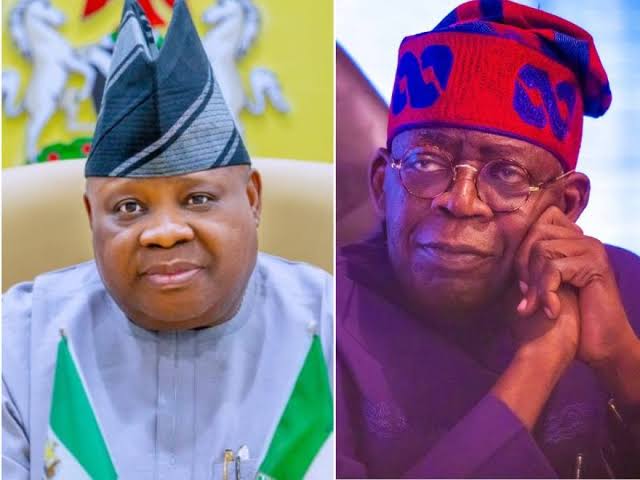
A chieftain of the African Democratic Congress (ADC), Dele Momodu, has described the August 15, 2026 Osun State governorship election as a contest that goes beyond the conventional rivalry between Governor Ademola Adeleke and the All Progressives Congress (APC).
Speaking on Channels Television’s Politics Today, Momodu argued that the political weight of President Bola Ahmed Tinubu has become a central factor in the race, suggesting that the contest should be viewed as a battle between Adeleke and the influence of the presidency rather than a straightforward confrontation with the APC.
According to the ADC chieftain, the APC, on its own, does not possess enough political strength in Osun State to present a serious challenge to the incumbent governor. He claimed that the involvement of the presidency has therefore become significant to the ruling party’s efforts to unseat Adeleke.
“The battle in Osun is not a contest between Adeleke and the APC; it is between Adeleke and President Bola Tinubu. APC is no match for Adeleke in Osun,” Momodu said.
His comments come at a time when political activities across Osun have reached a critical stage, with parties and their supporters stepping up mobilisation efforts ahead of Saturday’s election.
The governorship contest has attracted considerable attention because of the calibre of political actors involved and the wider implications of the outcome for the political landscape of the state.
Momodu highlights Adeleke’s grassroots strength
Momodu based his assessment largely on what he described as Adeleke’s established political structure and popularity within Osun.
The ADC chieftain argued that the governor has developed a strong connection with voters across different parts of the state, making the contest particularly difficult for any opposition party seeking to defeat him.
He also suggested that political calculations within the APC are influenced by an understanding of Adeleke’s grassroots presence.
“Everybody agrees on that. They can make all the noise and hullabaloo, but I can tell you today that even the presidency knows,” he stated.
Momodu further claimed that his relationships with members of the ruling party had given him insight into their assessment of the election.
“I have a lot of friends in APC; they know they cannot match Ademola Adeleke,” he added.
The statement represents Momodu’s political assessment of the race and comes against the backdrop of intense competition among the leading parties seeking control of Osun Government House.
Election enters final stretch
With the election approaching, political parties have intensified their efforts to convince undecided voters and consolidate their support bases.
Campaign messages have increasingly focused on the records of the incumbent administration, the promises of opposition candidates and the broader political direction voters want the state to take.
The final days before an election are often crucial, as parties attempt to convert campaign support into actual votes through grassroots mobilisation, voter engagement and coordination across wards and local government areas.
For Adeleke, the immediate challenge is to defend his position as the incumbent and demonstrate that his political support remains strong enough to secure another mandate.
For the APC and other opposition forces, the objective is to convince voters that a change of administration would better serve the interests of the state.
Tinubu’s influence becomes campaign talking point
Momodu’s comments also reflect the growing importance of national political influence in discussions surrounding the Osun election.
By framing the contest as one between Adeleke and President Tinubu, the ADC chieftain effectively placed the presidency at the centre of the political calculations surrounding the poll.
Such a framing could further raise the stakes of the election, particularly because Osun is regarded as an important political battleground in the South-West.
However, the eventual outcome will ultimately depend on voters and the votes cast across the state’s polling units.
Political endorsements, national alliances and campaign structures may influence voter sentiment, but the ability of each party to translate its support into actual votes will be critical when the ballots are counted.
Final campaign push
As Saturday’s poll draws closer, the major political camps are expected to continue their final mobilisation activities while urging supporters to remain committed to their respective candidates.
The heightened political activity has also placed greater emphasis on the need for a peaceful and credible election.
Momodu’s comments have added to the political debate over Adeleke’s chances, particularly his assertion that the governor’s principal challenge is not the APC structure in Osun alone but the broader influence that comes with presidential backing.
Whether that assessment accurately reflects the political situation on the ground will be determined by the electorate when voting takes place.
The election is therefore shaping up as a major test of grassroots political strength, party organisation and the influence of national political figures in a state where the contest has generated considerable interest.
For the candidates and their supporters, the focus is now on securing every possible vote while maintaining discipline during the final stage of the campaign.
Ultimately, Osun voters will have the final say on whether Adeleke retains the governorship or whether the opposition succeeds in changing the political direction of the state.
The result could also provide an important indication of the balance of political forces in Osun and the wider South-West ahead of future electoral contests.
About The Author
