

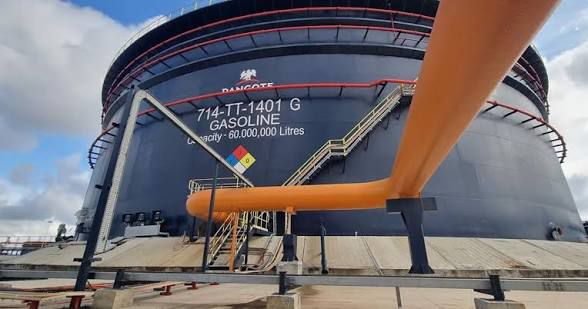
Dangote refinery export threat raises fresh concerns over Nigeria’s fuel security
Nigeria’s downstream petroleum sector is facing renewed uncertainty following indications that the Dangote Group may redirect its refined petroleum products to international markets, a move that could significantly disrupt domestic supply chains and trigger a fresh round of fuel scarcity.
The development, now widely referred to as the Dangote export threat, comes amid lingering controversy over the issuance of fuel import licences and growing competition within the local market. Industry insiders warn that if the refinery follows through with the export plan, Nigeria could witness a reversal of recent gains in fuel availability and price stability.
Dangote export threat linked to import licence dispute
At the centre of the issue is a disagreement between the refinery’s operators and the Nigerian Midstream and Downstream Petroleum Regulatory Authority over the status of petrol import licences.
Senior sources within the refinery have maintained that licences are still being granted to selected marketers, a claim that has been repeatedly denied by the regulator. The agency insists that no new import approvals have been issued in 2026, clarifying that current shipments are tied to licences granted in late 2025.
Despite this clarification, insiders argue that continued import activity undermines local refining efforts. According to them, allowing imports in a market where domestic capacity is expanding creates pricing pressure and limits the refinery’s ability to fully optimise output.
This tension has given rise to the Dangote refinery export threat, with the company reportedly considering selling its petrol, diesel, and aviation fuel to foreign buyers instead of prioritising the Nigerian market.
Supply gap raises stakes for local market
Data from industry sources indicate that Nigeria’s daily petrol consumption averages around 56 million litres, while domestic refining — led largely by the Dangote facility — supplies roughly 36 million litres per day. Although previous stock rollovers have helped bridge the gap, the margin remains tight.
Should the refinery pivot to exports, analysts warn that the existing supply-demand balance could quickly deteriorate. The Dangote refinery export threat therefore presents a real risk of reintroducing fuel queues across major cities and increasing pump prices.
Energy experts note that Nigeria’s downstream sector remains in a delicate transition phase — moving from heavy import dependence to increased local refining. Any disruption at this stage could destabilise the market and erode investor confidence.
Regional demand intensifies export incentives
Adding complexity to the situation is rising demand from other African countries. Nations such as South Africa are reportedly seeking alternative fuel sources as global supply chains face disruptions linked to geopolitical tensions in the Middle East.
With traditional suppliers becoming less reliable, the Dangote refinery has emerged as a strategic supply hub for the continent. This growing international demand strengthens the economic case for exports, potentially making the Dangote refinery export threat more than just a negotiating stance.
Industry observers say the refinery could secure higher margins in foreign markets, particularly at a time when energy security concerns are pushing countries to prioritise supply availability over cost considerations.
Domestic implications: prices, inflation, and energy security
The potential redirection of locally refined fuel to export markets could have far-reaching consequences for Nigeria’s economy. Fuel remains a critical input across multiple sectors, influencing transportation, food distribution, and industrial production.
A reduction in domestic supply would likely trigger another round of petrol price increases, further straining households and businesses already grappling with inflation. The Dangote refinery export threat could also intensify pressure on the naira, as increased imports would require more foreign exchange.
For policymakers, the situation highlights the importance of aligning regulatory frameworks with national energy security goals. Experts argue that clear and consistent policies are essential to ensure that local refining capacity translates into domestic supply stability.
Calls for policy clarity and industry alignment
Stakeholders within the petroleum sector are calling for urgent intervention to resolve the impasse. Industry groups, including the Independent Petroleum Marketers Association, have emphasised the need to prioritise local refining and reduce reliance on imports.
They argue that supporting domestic producers is critical to sustaining recent progress in the sector.
Without policy coherence, the Dangote refinery export threat could evolve into a broader crisis affecting supply chains and economic stability.
There are also calls for greater transparency in the licensing process to eliminate uncertainty and rebuild trust between regulators and industry players.
A critical moment for Nigeria’s energy transition
Nigeria’s petroleum sector is at a pivotal stage, transitioning from decades of import dependence to a more self-sufficient model anchored on local refining. The Dangote refinery, with its large-scale capacity, represents a cornerstone of that transition.
However, the ongoing dispute underscores the fragility of this progress. If unresolved, the Dangote refinery export threat could undermine the very gains the country is striving to consolidate.
As global energy markets remain volatile and regional demand intensifies, Nigeria faces a strategic choice: reinforce its domestic supply framework or risk reverting to the inefficiencies of the past.
For now, all eyes remain on policymakers and industry leaders to navigate the situation and ensure that the promise of local refining translates into tangible benefits for Nigerian consumers.
About The Author
