

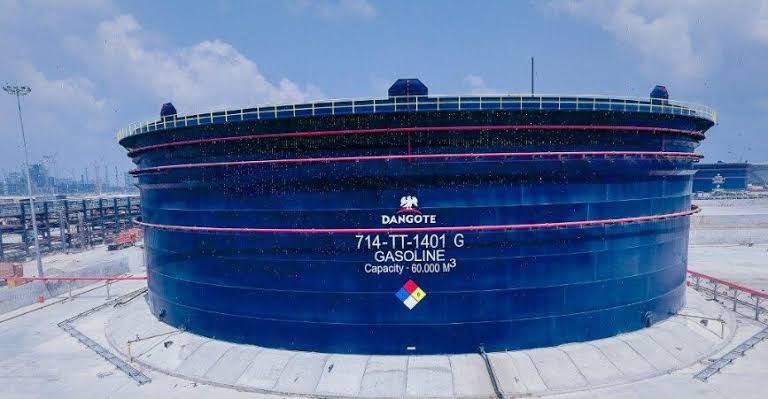
Africa’s richest man and President of Dangote Group, Alhaji Aliko Dangote, has raised fresh concerns over ongoing sabotage attempts against his $20 billion refinery in Lekki, Lagos, blaming entrenched interests profiting from Nigeria’s decades-long dependence on fuel importation.
Speaking at an investor forum in Lagos on Friday, Dangote declared that while the fight to operationalize the 650,000 barrels-per-day refinery was far from over, he remained undeterred in his quest to transform Nigeria’s energy sector.
“We’re still fighting. The fight is not yet finished,” Dangote said, as quoted by international news outlet Semafor. “But I have been fighting all my life, and I am 100 percent sure I will win at the end of the day.”
According to Dangote, the refinery’s journey has been met with resistance from entrenched oil importation syndicates — commonly referred to as “cabals” — who have for decades enriched themselves through government-subsidised petroleum imports.
“These groups have made a lot of money from the old system. They are uncomfortable with the refinery’s emergence and are now funding resistance to key reforms like the removal of petrol subsidies by President Bola Tinubu,” he alleged.
This isn’t the first time Dangote has sounded the alarm over sabotage. In 2024, he accused certain international oil companies (IOCs) of frustrating his efforts by withholding domestic crude supply, despite a government mandate for local crude allocation.
Devakumar Edwin, Vice President of Oil and Gas at Dangote Industries Limited, previously echoed Dangote’s concerns, accusing IOCs of deliberately inflating local crude prices above global benchmarks to discourage refinery operations. As a result, the refinery had to source crude from as far as the United States—an expensive and unsustainable alternative.
“The IOCs want Nigeria to remain dependent on imported refined products, which benefits their home economies,” Edwin said. “They are profiting while Nigeria loses out on job creation, GDP growth, and energy independence.”
In addition to challenges from IOCs, Dangote alleged that the Nigerian Midstream and Downstream Petroleum Regulatory Authority (NMDPRA) has been issuing import licences for substandard fuel products—undermining the refinery’s competitiveness.
He also criticized regulatory bodies for failing to support indigenous investments, even as his refinery continues to reduce petrol pump prices significantly.
At one point, Dangote admitted he almost regretted building the refinery due to the strength of the opposition, comparing the oil mafia to drug cartels in terms of influence and resistance. He recalled being advised by former Saudi Energy Minister Khalid Al-Falih to abandon the refinery project — an advice he rejected outright.
Despite these challenges, Dangote expressed renewed optimism. “This refinery is not just for Nigeria. It’s for West Africa and the entire sub-Saharan region,” he stated.
Since it commenced fuel production in late 2024, the Dangote Refinery has played a pivotal role in lowering petrol prices across Nigeria. Thanks to a temporary naira-for-crude deal initiated by President Tinubu, the refinery slashed fuel prices from over N1,100 per litre to N860.
This move has not only eased the burden on Nigerian consumers but also created a pricing challenge for fuel importers, some of whom now sell at a loss due to the refinery’s competitive pricing.
The Independent Petroleum Marketers Association of Nigeria (IPMAN) has thrown its weight behind Dangote. IPMAN’s Publicity Secretary, Chinedu Ukadike, acknowledged that while the price cuts affect marketers’ profits, the association supports Dangote’s mission to stabilize fuel supply and pricing in Nigeria.
“No businessman doing well will escape competition or sabotage. We see this as healthy rivalry, and we back him fully,” Ukadike said.
However, the Petroleum Products Retail Outlet Owners Association of Nigeria (PETROAN) urged caution. Its President, Billy Gillis-Harry, advocated for a level playing field, saying there’s no need for conflict in the downstream sector.
“We appeal to the Federal Government to supply adequate crude to all refineries, including Dangote’s,” he said. “Competition should be based on merit, not sabotage.”
Despite temporary halts to the naira-for-crude arrangement by the Nigerian National Petroleum Company Limited (NNPC Ltd.), industry experts say the refinery is poised to remain a game-changer. Additional domestic refineries are expected to come online in the coming months, further enhancing Nigeria’s refining capacity and energy self-sufficiency.
While the battle against oil importation interests rages on, Dangote remains resolute. “We are going to win this fight—not just for us, but for Nigeria,” he affirmed.