China’s dancing robots took centre stage during Monday’s China Media Group Spring Festival Gala, the nation’s most-watched televised celebration.
The humanoid machines performed acrobatic stunts, martial arts, and choreographed dance routines alongside human performers, leaving audiences in awe.
Notably, every robot executed lunges, backflips, spins, and jumps without a single mishap, demonstrating a precision and coordination that would have seemed futuristic only a few years ago.
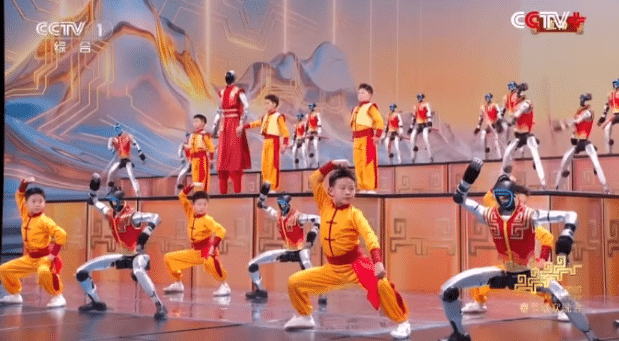
The spectacle, which aired on one of China’s prime-time channels, sparked debates online and among experts about the potential of humanoid robots beyond entertainment.
Many viewers were left asking: if robots can now dance and perform complex movements, what other capabilities might they soon possess?
Developed by multiple Chinese robotics firms, these machines combined intricate martial arts routines, synchronized comedy sketches, and dance moves that matched human performers almost seamlessly.
Clips of the gala quickly circulated on social media platforms, drawing comparisons to last year’s broadcast, where the robots’ movements were simpler and less fluid.
The evolution in choreography suggested rapid progress in both AI and mechanical engineering.
Kyle Chan, a researcher specializing in China’s technology development at the Brookings Institution, noted that public robot performances serve a dual purpose.
“Beijing uses these events to showcase technological prowess to both domestic and international audiences,” Chan explained. “Humanoid robots are highly visible symbols of China’s advancement in AI and robotics—far more relatable than industrial machines or abstract AI models.”
The gala also signals a strategic move in the growing technological competition between China and the United States. Chan highlighted that while AI research continues at a neck-and-neck pace globally, humanoid robots offer China a chance to claim an edge, particularly in mass production and public demonstration.
Georg Stieler, head of robotics and automation at Stieler Technology and Marketing, emphasized the significance of China’s televised display. “What sets this gala apart from similar events elsewhere is the direct connection between industrial policy and prime-time spectacle,” he said.
Comparing this year’s performance to last year’s, Stieler noted that the ability to run large numbers of nearly identical humanoids in synchronized motion represents a key advancement.
The robots maintained stable gaits, consistent joint behavior, and precise choreography, all of which are essential for both public shows and potential industrial applications.
However, experts cautioned against overestimating the robots’ versatility. Stieler explained that the routines are the result of repetitive training: “These performances are rehearsed hundreds or thousands of times.
The robots cannot yet adapt to unpredictable changes in the environment or perform spontaneous movements.” The dance sequences, he said, rely heavily on imitation learning and balance-control algorithms, but do not demonstrate the level of dexterity or environmental perception required for complex industrial tasks.
Despite these limitations, China’s dancing robots illustrate the broader ambitions of Beijing’s technological agenda. By the end of 2024, the country had registered over 451,700 smart robotics companies with a combined capital of 6.44 trillion yuan (around $932 billion), according to official data.
National initiatives like Made in China 2025 and the 14th Five-Year Plan have prioritized robotics and AI, aiming to transform manufacturing from low-cost assembly to high-end, intelligent production.
Morgan Stanley projects that China’s humanoid robot sales will more than double to 28,000 units in 2026, signaling a growing domestic and international market.
Elon Musk has also acknowledged the rise of Chinese competitors, predicting that China could become the leading player in the humanoid robot sector as Tesla pivots toward embodied AI and its humanoid robot, Optimus. “People outside China underestimate China,” Musk said recently. “But China is operating at a next-level pace in this space.”
Marina Zhang, a technology professor at the University of Technology Sydney, suggested that the gala may reflect more than just entertainment value. “This is likely the beginning of a new phase in China’s manufacturing strategy,” Zhang said. “Robotics is becoming a linchpin for transitioning from simple assembly lines to high-tech, smart factories.”
The widespread use of humanoid robots could transform how manufacturing, logistics, and service industries operate, both within China and globally.
The gala’s success also underlines the strategic role of media in China’s technological messaging. Prime-time broadcasts of complex robotics performances are a form of soft power, showing both domestic and international audiences what the country’s AI research can achieve.
The performances blur the line between technology demonstration and entertainment, reinforcing China’s image as a global leader in robotics.
This year’s choreography involved hundreds of humanoid robots performing near-identical movements in perfect sync, a significant improvement over last year’s simpler routines, which primarily featured basic walking, twisting, and kicking motions.
The enhanced performance reflects advances in AI-driven motion control, coordination, and programming. By demonstrating synchronized agility and precision, China has highlighted its growing mastery of robotic design, joint coordination, and balance control.
Yet, the gap between stage-ready humanoids and industrially viable robots remains significant. Experts note that while stage performances are impressive, they do not necessarily reflect the ability to perform reliably in unstructured factory environments.
Environmental awareness, autonomous decision-making, and adaptability remain key challenges for widespread industrial deployment.
The gala also hints at the symbolic value of humanoid robots in Chinese society. Unlike more utilitarian AI systems, humanoid robots capture the public imagination, appearing on television and social media to create a sense of progress and national pride.
They serve as both a technological showcase and a cultural statement, illustrating the intersection of innovation, entertainment, and state messaging.
Observers outside China have closely followed these developments, recognizing the strategic importance of humanoid robotics in global technology competition.
While AI research continues worldwide, the ability to design, produce, and publicize humanoid robots at scale represents a unique advantage for China.
This visibility has both practical and psychological impacts, signaling that the nation is ready to lead in applied AI, robotics, and smart manufacturing.
As China continues to invest heavily in robotics, experts expect future Spring Festival galas to feature even more complex performances, integrating enhanced AI capabilities, interactive routines, and increasingly lifelike humanoid behavior.
The public display not only entertains viewers but also reinforces China’s ambitions to dominate the robotics sector and influence the global perception of AI innovation.
China’s dancing robots are more than just a dazzling spectacle; they represent the intersection of entertainment, technology, and strategic ambition.
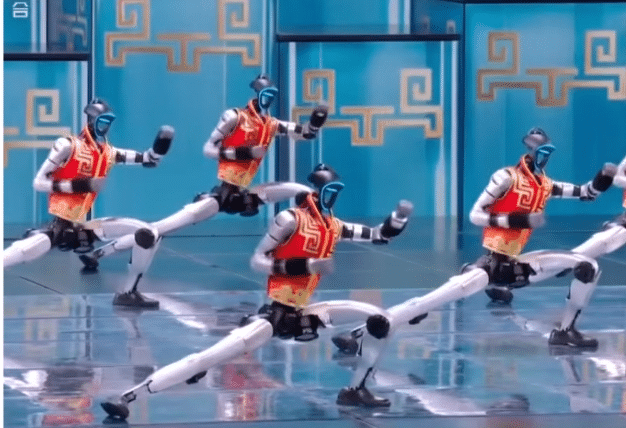
While current performances remain controlled and rehearsed, the progress they showcase points to a future where humanoid robots could become central to manufacturing, services, and public engagement.
The gala has highlighted China’s commitment to being a front-runner in the global robotics race, blending technical achievement with cultural storytelling in a way few other nations have attempted.
The Spring Festival performance demonstrated that China’s dancing robots are no longer limited to simple movements—they are becoming symbols of national technological pride, proof of the country’s advancing AI capabilities, and a glimpse of what the next generation of humanoid robots might achieve in both public and industrial spheres.
Read also: Reform UK vows to repeal Equality Act as Farage unveils top team and claims mantle of opposition
About The Author