

Central African Republic heads to the polls amid tension, fatigue, and cautious hope, as citizens vote in elections widely seen as decisive for stability, sovereignty, and democratic credibility.
Voters are choosing a president, lawmakers, and local officials in what observers describe as a complex quadruple election, stretching fragile institutions already burdened by insecurity and logistical weakness.
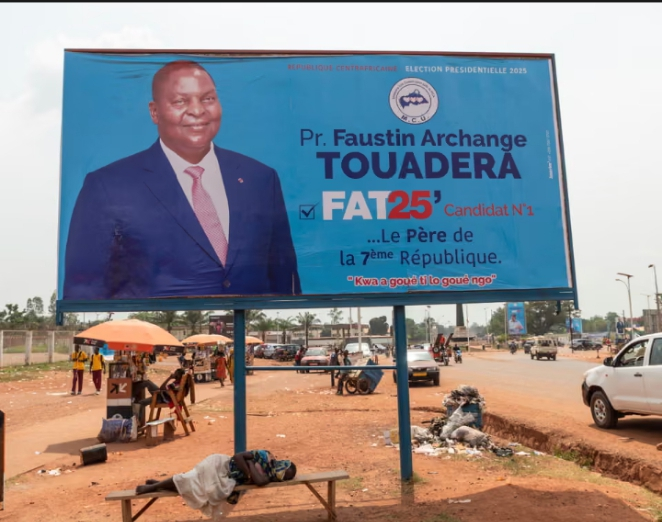
At the center stands President Faustin-Archange Touadéra, seeking a third term after constitutional changes removed limits, extending presidential mandates and reshaping the country’s democratic framework.
Touadéra, in power since 2016, is widely expected to win, despite deepening public frustration over insecurity, displacement, poverty, and perceptions of growing foreign influence.
More than 2.3 million registered voters are eligible, yet participation remains uncertain, particularly in rural areas where violence, poor roads, and administrative failures limit access.
Seven candidates contest the presidency, including former prime ministers Anicet Georges Dologuélé and Henri-Marie Dondra, both previously barred before constitutional court reversals.
Dologuélé, runner-up in the 2015 and 2020 elections, commands name recognition and experience, while Dondra briefly served under Touadéra before breaking ranks politically.
Opposition figures hope popular anger will translate into votes, drawing strength from communities enduring chronic conflict, food insecurity, and weak state presence across large swathes of territory.
More than half a million people remain internally displaced, while similar numbers live as refugees in neighboring states, underscoring the depth of humanitarian distress.
Touadéra’s rise from academia to power followed his appointment as prime minister in 2008 under François Bozizé, before rebellion and sectarian violence toppled that government.
After a turbulent transition marked by civil war, Touadéra ran as a compromise figure, perceived as neutral between rival militias tearing the country apart.
That perception, alongside war weariness, propelled him to a second-round victory, offering voters stability over uncertainty, even as armed groups retained territorial influence.
Since then, his presidency has emphasized security partnerships, often relying on external actors to compensate for weak national forces and fractured institutions.
A peace accord signed in April with two major rebel groups has fueled cautious optimism, with officials citing reduced violence in certain regions.
Human Rights Watch acknowledged tangible progress, while warning that peace remains fragile and dependent on sustained political inclusion and accountability.
United Nations officials similarly praised recovery efforts, highlighting border security measures and dialogue among domestic actors as foundations for consolidation.
Despite optimism, election logistics remain precarious, with supply chain disruptions and insecurity threatening polling in remote regions.
The UN peacekeeping mission, Minusca, continues to provide essential security and logistical support, compensating for infrastructure gaps the state cannot manage alone.
Concerns persist over electoral transparency, particularly claims that voter registers were published only online, excluding citizens without internet or electricity access.
Opposition leaders argue these irregularities risk disenfranchising large segments of the population, undermining trust in the vote’s legitimacy.
Several opposition politicians have announced a boycott, citing flawed preparations and lack of guarantees for a free, credible process.
Analysts warn such fractures could weaken opposition leverage, inadvertently consolidating Touadéra’s grip on power through divided resistance.
The 2023 constitutional referendum, scrapping term limits and extending mandates to seven years, remains a focal point of controversy and public resentment.
Critics argue the changes entrenched executive dominance while sidelining democratic safeguards meant to prevent prolonged personal rule.
Another Touadéra term raises fears of expanded foreign involvement, particularly Russia’s Wagner-linked forces embedded within the country’s security architecture.
Wagner has provided personal protection for Touadéra since 2018, growing influential despite leadership changes following Yevgeny Prigozhin’s death.
Touadéra has resisted Russian pressure to integrate Wagner into the Africa Corps framework, maintaining a distinct but opaque security arrangement.
Rwandan troops also play a stabilizing role, presenting their presence as African-led solutions contrasting with Moscow’s mercenary-driven approach.
Rwanda’s engagement reportedly focuses on commercial interests and targeted security cooperation rather than expansive military influence.
Allegations have surfaced that government forces were evicted from a World Bank-funded youth center to facilitate Rwandan-linked livestock projects.
Pro-opposition media framed the claims as evidence of sovereignty erosion and elite deals sacrificing national assets and youth opportunities.
Such narratives resonate in Bangui and beyond, where economic hardship heightens sensitivity to foreign exploitation and elite enrichment.
Election day unfolds against this backdrop of suspicion, resilience, and political calculation, with citizens weighing continuity against change.
For many voters, survival concerns outweigh ideological debates, as daily life remains shaped by insecurity and limited state services.
Read also: 2025: The world in retrospect and 2026 Projections — Is global war on the horizon?
Yet the ballot still carries symbolic weight, representing agency in a country long defined by coups, rebellions, and external interventions.
International observers stress that credibility, inclusion, and post-election dialogue will matter as much as the final tally.
A disputed outcome risks reigniting tensions, while a managed transition could strengthen fragile peace gains.
As ballots are cast, Central Africans confront a defining question: whether extended rule promises stability or entrenches a cycle of dependency and exclusion.
The answer will shape not only leadership, but the country’s trajectory toward peace, sovereignty, and democratic renewal.


