The California Proposition has passed in a landslide, dealing a historic blow to Donald Trump’s grip on national politics and energizing Democrats ahead of 2026.
Voters overwhelmingly supported the California Proposition, granting Governor Gavin Newsom a defining moment and reshaping congressional maps to favor Democrats after years of Republican manipulation through strategic gerrymandering.
The California Proposition effectively redraws electoral boundaries in ways that could shift the balance of power in Congress, strengthening Democratic influence while dismantling Trump’s structural electoral advantages.
Governor Gavin Newsom celebrated the result as a Gavin Newsom victory, calling it “a win for democracy and a rejection of corruption disguised as patriotism.”
Early counts showed the Proposition passed with a two-to-one majority, reflecting widespread public frustration with Trump-era Republican tactics and a resounding desire for institutional fairness in American governance.
Newsom declared that the Proposition represented “a new era of accountability” and accused Trump of waging an “assault on truth, law, and democratic process” through political manipulation.
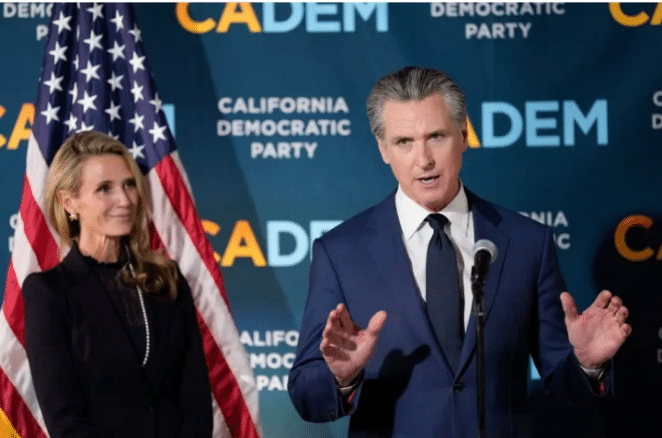
The measure’s success marks a Gavin Newsom victory that could add as many as five new Democratic seats in the House of Representatives, directly countering Republican efforts in key battleground states.
Political analysts say the Proposition was crafted to neutralize Trump’s ongoing Donald Trump backlash strategy, which sought to undermine voter representation under the guise of constitutional conservatism.
Trump reacted furiously to the California Proposition, posting on Truth Social that the vote was “UNCONSTITUTIONAL, CORRUPT, AND RIGGED,” claiming Democrats had weaponized California’s system to “DESTROY REAL AMERICA.”
Democrats, however, celebrated the California Proposition as a model for Democratic redistricting, arguing it restores integrity to elections after years of Republican-controlled states exploiting gerrymandering for political gain.
Barack Obama praised the Proposition, asserting that “Republicans want to steal seats in Congress. This law stops them. Californians just proved democracy can still fight back.”
Under the California Proposition, district maps will apply to elections from 2026 through 2030, reversing the Republican advantage established under Trump’s political engineering campaigns in Texas and Ohio.
Critics of the Proposition, including former governor Arnold Schwarzenegger, warned that “two wrongs don’t make a right,” calling it a disguised Democratic redistricting power grab that damages institutional neutrality.
Schwarzenegger’s intervention highlighted tensions even within California’s political left, as independents worried the California Proposition may erode trust in supposedly impartial democratic mechanisms.
Still, polls indicate the California Proposition enjoyed broad bipartisan support among ordinary Californians frustrated by Republican outrage over fairness while quietly supporting gerrymandering to preserve conservative dominance elsewhere.
For Governor Newsom, the Gavin Newsom victory strengthens his image as a national leader capable of standing up to Trump and defending democratic systems under unprecedented partisan attack.
Observers believe the Proposition cements Newsom’s credentials for a potential 2028 presidential run, positioning him as the Democratic Party’s most visible and combative counterforce to Trumpism.
The measure’s opponents framed the California Proposition as an overreach, but voters viewed it as essential to balancing the political map after Trump-backed legislatures redrew districts in their favor.
The Donald Trump backlash was immediate. Conservative media blasted the move as an “anti-American scam,” warning that Democrats were attempting to “steal Congress through liberal cartography.”
Meanwhile, Democratic strategists said the Proposition showcased the effectiveness of grassroots mobilization, as voters prioritized democratic fairness over partisan loyalty despite the predictable Republican outrage that followed.
In Sacramento, celebrations erupted as the Proposition results rolled in. Volunteers waved banners reading “Maps of Truth,” symbolizing a broader demand for transparency and representation in government.
A viral campaign ad imagined Trump throwing fries at a television as California voters dismantled his advantage — a comical yet potent symbol of the Donald Trump backlash nationwide.
Newsom said the California Proposition was “a message to bullies everywhere — democracy will not yield to the tantrums of power-hungry men seeking to rewrite the rules.”
His words, echoed by Democratic leaders across the country, reinforced the Gavin Newsom victory narrative — that principled defiance against authoritarian impulses can reshape the political landscape decisively.
Republicans vowed to challenge the California Proposition in court, citing alleged constitutional violations, though legal experts predicted such efforts would fail given strong public support and legislative clarity.
“This is not about left or right,” said one campaign volunteer. “The California Proposition is about people taking back control from those who think democracy is negotiable.”
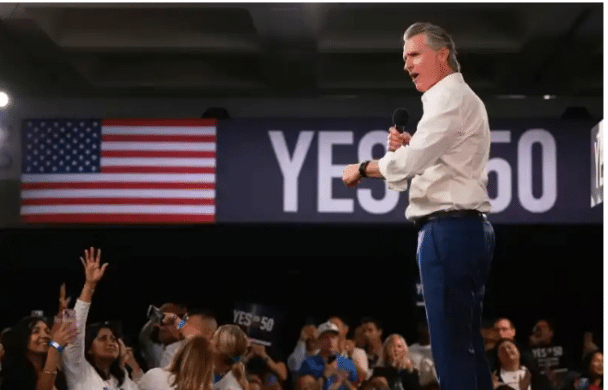
Political scientists noted that Trump’s Donald Trump backlash rhetoric may further alienate moderates tired of election denialism, accelerating Republican decline in diverse states like California and Colorado.
Analysts say the California Proposition could become a blueprint for Democratic redistricting reforms nationwide, encouraging states to fight gerrymandering not with surrender, but with tactical legislative innovation.
For Republicans, the defeat underscored deep fractures within their ranks. The Republican outrage that once energized the base now risks exhausting voters weary of endless grievance-driven politics.
Trump’s meltdown following the California Proposition reflects his fear that Democrats are learning to weaponize his own tactics — only this time, with broader voter legitimacy behind them.
Supporters of the California Proposition insist it is not revenge but restoration — a structural correction to decades of anti-democratic engineering that corroded voter confidence under partisan dominance.
The California Proposition thus becomes more than a regional reform. It’s a national statement that power can be contested, narratives can flip, and democratic renewal remains possible.
As one observer wrote on X, “The California Proposition is a line in the sand — the moment America decided democracy was worth defending, not just debating.”
Even amid the Republican outrage, momentum is shifting. Other blue states are now drafting similar proposals to counteract red-state manipulation and ensure representation reflects actual population shifts.
Newsom’s Gavin Newsom victory speech concluded with defiance: “Trump can scream all he wants. California has spoken. Democracy doesn’t belong to one man — it belongs to everyone.”
The California Proposition may not end the nation’s partisan wars, but it exposes Trump’s diminishing hold on the narrative and the growing resistance to his brand of politics.
Democrats believe the California Proposition will reverberate across 2026 races, creating momentum capable of flipping at least five congressional seats and securing their control of the House.
In contrast, Republicans’ Donald Trump backlash may splinter their coalition further, as suburban and independent voters reject the chaos and conspiratorial tone dominating Trump’s post-presidential politics.
Ultimately, the California Proposition embodies a simple truth: democracy survives only when people fight for it — and in California, they just fought harder than Trump expected.
Meta Description:
About The Author