

A magnitude 7.6 earthquake strikes Japan late Monday night, shaking the northeast coast and prompting tsunami warnings for multiple prefectures. Residents were urged to evacuate to safer areas immediately.
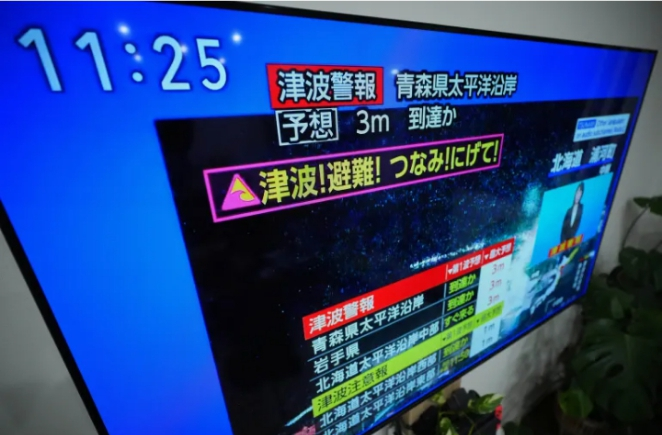
Authorities warned that a tsunami as high as three metres (10 feet) could hit Japan’s northeastern coastline. Early reports indicated that a smaller tsunami, measuring approximately 40cm (16 inches), was observed at Mutsu Ogawara in Aomori prefecture and Urakawa in Hokkaido. Emergency alerts were sent to residents along the affected coast.

Tsunami warnings were issued for Hokkaido, Aomori, and Iwate prefectures. Residents rushed to higher ground as sirens blared, while local authorities urged everyone in low-lying areas to evacuate without delay. The Japan Meteorological Agency (JMA) emphasized that conditions remained highly volatile.
The epicentre of the earthquake was located roughly 80km (50 miles) off the coast of Aomori prefecture at a depth of 50km (30 miles).
The Pacific Tsunami Warning Center stated that hazardous tsunami waves could potentially affect coasts within a 1,000km (620 miles) radius, including parts of Russia.
Several injuries were reported at a hotel in Hachinohe, Aomori, according to NHK. Emergency responders were dispatched to assist victims, and hospitals were placed on high alert. Structural damage assessments are ongoing.
East Japan Railway suspended train services in affected areas to prevent accidents and allow emergency operations to continue safely. Nuclear plants in the region carried out safety inspections, with no immediate problems reported.
Prime Minister Sanae Takaichi confirmed that the government had established an emergency task force to coordinate response efforts. “We are putting people’s lives first and doing everything we can,” she said, urging residents to follow evacuation orders.
Japan sits along the seismically active “Ring of Fire,” making it one of the world’s most earthquake-prone nations. The country experiences roughly 20 percent of all magnitude 6.0 or greater earthquakes globally. Japan also remembers the devastating 9.0-magnitude earthquake and tsunami in March 2011.
The recent quake highlights the risks faced by coastal communities. Emergency services, including the military and disaster response teams, were mobilized to assist with evacuations and assess damages. Authorities stressed that residents should not return to low-lying areas until officially cleared.
The JMA continues to monitor aftershocks, which could trigger additional tsunami waves or structural damage. Residents are asked to stay alert and follow updates from government sources.
International agencies are monitoring the situation. The Pacific Tsunami Warning Center’s alerts note the potential for tsunamis along the Pacific coast, including Russia’s eastern shoreline. Regional authorities have been advised to prepare emergency measures.
Rescue and safety operations remain the top priority. Local governments, emergency responders, and volunteers are working to ensure safety, with temporary shelters providing food, water, and medical care to displaced residents.
Japan’s preparedness systems, including early-warning alerts and tsunami sirens, helped minimize casualties. Officials continue to urge vigilance, as aftershocks and additional waves may occur. Residents are advised to remain in safe locations until the situation stabilizes.
Authorities have confirmed no major damage to nuclear facilities. Continuous monitoring and public reassurance are ongoing. Meteorological agencies are updating the public with the latest tsunami heights and potential coastal impacts.
The magnitude 7.6 earthquake strikes Japan serves as a reminder of the country’s vulnerability to natural disasters and the importance of preparedness, early-warning systems, and community cooperation. Rescue operations continue, focusing on safety and minimizing casualties.


