
Alhaji Adamu Abubakar, son of former Vice President Atiku Abubakar, has officially resigned from his position as Commissioner for Works and Energy Development in Adamawa State, ending his tenure in Governor Ahmadu Fintiri’s cabinet.
This resignation comes at a time of heightened political activity, reflecting broader shifts in Adamawa politics.

The commissioner, who had previously refrained from joining a mass defection of state officials last Friday, formally submitted his resignation on Monday, stating that the decision followed careful consideration and deep personal reflection.
His resignation letter, released to journalists late Monday, emphasized his gratitude to the governor and the citizens of Adamawa State for their support throughout his service.
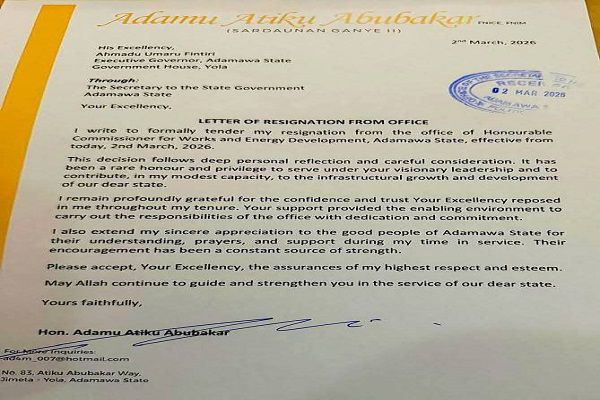
“I am thankful for the opportunity to serve and for the steadfast prayers and encouragement of the people of Adamawa,” he wrote.
The political landscape in Adamawa has undergone significant changes in recent days.
On Friday, February 27, Governor Fintiri officially left the Peoples Democratic Party (PDP) to join the All Progressives Congress (APC).
This move triggered one of the most extensive political realignments in the state’s recent history, with the majority of top officials following the governor into the new party.
A total of 22 commissioners, 39 special advisers, and the entire state executive committee of the PDP in Adamawa switched allegiance to the APC during the defection.
Despite this sweeping change, Adamu Abubakar was one of only three commissioners who initially refused to follow the wave, choosing instead to distance himself from the political transition.
His subsequent resignation, however, reflects the continuing influence of these developments on Adamawa politics.
Observers of state politics note that Adamu’s decision to resign, rather than join the APC, signals a growing awareness of individual political identity and personal principles within Adamawa politics.
Analysts suggest that such moves may reshape political alliances in the state and influence future elections, especially given Adamu’s high-profile background as the son of a former vice president.
In his resignation letter, Adamu expressed appreciation for Governor Fintiri’s leadership and for the opportunity to serve in the state cabinet.
He also thanked the people of Adamawa State for their unwavering support and prayers, underscoring the importance of citizen engagement and public trust in shaping the state’s political environment.
Political commentators in the region have highlighted that Adamawa politics is experiencing a period of rapid change, with defections, resignations, and new alliances altering the traditional balance of power.
Adamu’s resignation is likely to attract attention from party leaders and political stakeholders, as it reflects both personal conviction and broader trends within the state’s political ecosystem.
As Adamawa continues to navigate these changes, the recent series of resignations and defections, including that of Alhaji Adamu Abubakar, underscores the fluid nature of political loyalty and the ongoing realignments shaping the state.
The evolving dynamics of Adamawa politics suggest that more strategic decisions by key officials may follow, influencing governance and policymaking in the months ahead.
In summary, Alhaji Adamu Abubakar’s resignation not only marks the end of his tenure in Governor Fintiri’s cabinet but also serves as a reflection of the shifting tides in Adamawa politics.
His careful consideration and principled decision highlight both the personal and political factors influencing public service in the state.
Ireport247news
About The Author