

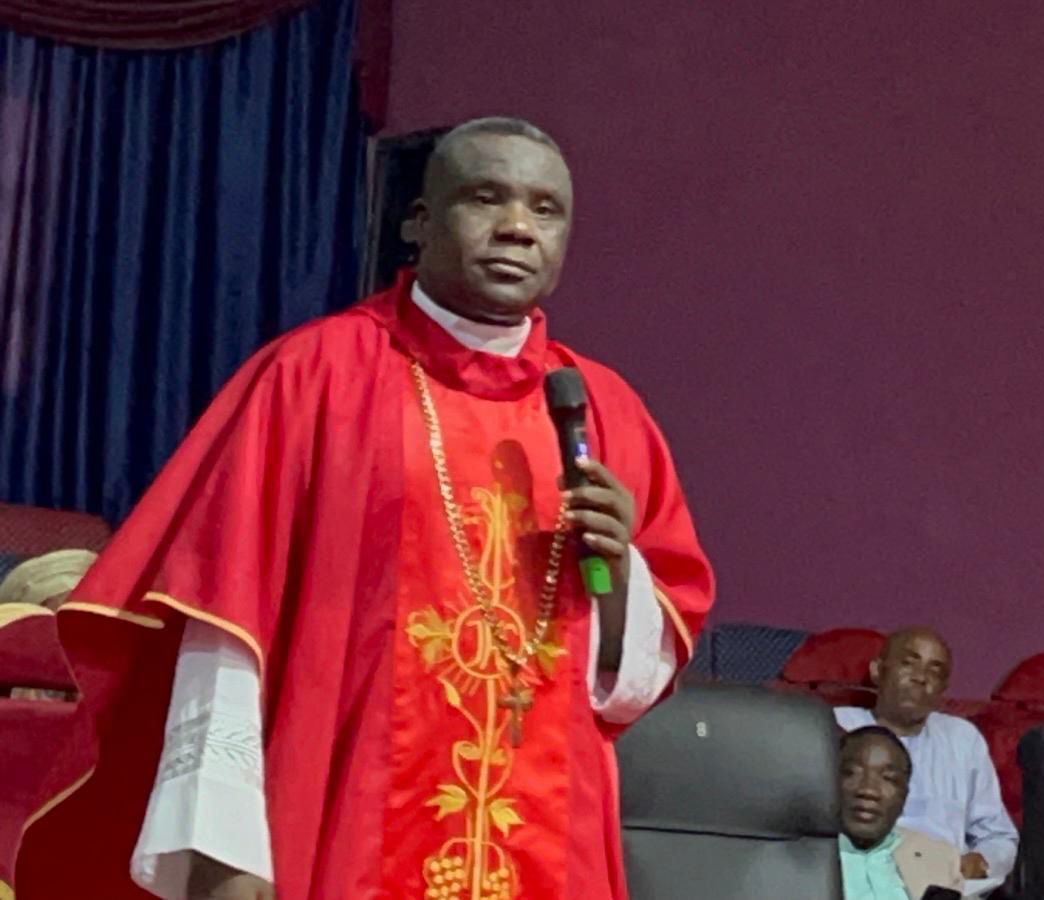
Archbishop Leonard Kawas defends his political activities, saying Peter Obi never paid him for supporting his 2023 presidential campaign across Nigeria.
Archbishop Leonard Bature Kawas, a leading member of Nigeria’s Charismatic Bishops, has pushed back against criticism of his involvement in partisan politics, insisting that his participation in political campaigns did not begin recently and has never been solely driven by financial considerations.
Kawas made the clarification during an appearance on Arise TV’s Prime Time, where he addressed questions surrounding his political activities and the recent decision by the Charismatic Bishops to endorse President Bola Ahmed Tinubu for a second term.
The cleric used his experience with several Nigerian politicians and presidential candidates to explain why he believes his political engagements should not be interpreted as evidence that he is not a genuine bishop.
One of the examples he highlighted was his support for Peter Obi during the build-up to the 2023 presidential election.
Kawas said he backed Obi at an early stage of the former Anambra State governor’s presidential campaign and travelled to different parts of the country as part of the campaign activities.
According to him, despite his visible involvement in Obi’s campaign, he did not receive money from the Labour Party candidate for his participation.
“I supported Peter Obi at the initial stage of his presidential ambition and went with him everywhere in Nigeria and he never gave me one dollar, one naira,” Kawas said.
He explained that his involvement went beyond simply appearing at campaign rallies. He said he participated in prayer sessions and travelled with other Christian clerics to various locations where Obi was campaigning.
Kawas further disclosed that he personally paid the transportation expenses of six clergymen who accompanied him during some of the campaign activities.
“He would just see me at the campaign, we would pray for him, I would pay the transportation of six clergymen, we would come there and support him,” he said.
The archbishop said Obi did not ask him how he financed his movement from one campaign venue to another or where he lodged during the trips.
His comments came as he responded to criticism over his latest political activities and allegations questioning his status as a bishop.
Kawas said some critics had recently described him as a “fake bishop” because of his involvement in contemporary political activities.
He rejected the description and argued that his history shows that he has consistently interacted with political leaders and participated in political campaigns over the years.
He cited his relationship with former President Goodluck Jonathan as another example.
Kawas recalled that his support for Jonathan began when the former president was serving as deputy governor of Bayelsa State. He later became involved in Jonathan’s presidential campaign and served on the campaign council.
“I was in his presidential campaign council. I was the only bishop in Goodluck Jonathan’s presidential campaign council and I took campaign everywhere,” he said.
The cleric also mentioned former President Olusegun Obasanjo among the political figures with whom he had previously been associated.
According to him, he travelled to different parts of Nigeria alongside other supporters after being invited to lead prayers connected with Obasanjo’s presidential ambition.
Kawas said his political activities were also evident at the state level, particularly in Taraba State, where he supported Reverend Jolly Nyame.
Nyame eventually became governor of Taraba State, and Kawas said he was later appointed chairman of the Christian Pilgrims Welfare Board by the administration.
The archbishop used these examples to question why his involvement in politics should suddenly become a reason for people to doubt his identity as a bishop.
“Is it now because I have prayed and God has led me that it is tenable that I suddenly now become fake?” he asked.
The controversy surrounding Kawas is unfolding at a time when the role of religious leaders in Nigerian politics is once again attracting public attention.
As political parties prepare for the 2027 general elections, politicians are increasingly seeking the backing of influential individuals and groups capable of mobilising support across religious, community and professional networks.
Christian leaders have historically played different roles in Nigeria’s political space. Some have openly endorsed candidates, others have participated in campaign activities, while some have chosen to maintain political neutrality.
Kawas has positioned his own activities within the first category, arguing that his participation in political affairs is part of a longstanding pattern rather than a recent decision linked to the 2027 political season.
His political association with Obi became particularly prominent in the build-up to the 2023 election.
In October 2022, Kawas led a delegation of Christian clerics to the Labour Party, where the group publicly declared support for Obi’s presidential campaign.
The development attracted attention at the time, particularly because of the appearance of bishops and other Christian leaders at political events.
Kawas subsequently rejected claims that the clerics involved were “fake bishops.” He maintained that they were legitimate Christian leaders and argued that they represented millions of Christians across the country.
His latest comments have now brought that earlier episode back into focus, particularly because of the change in political alignment surrounding the Charismatic Bishops.
The group’s recent endorsement of President Tinubu for a second term has generated discussion, especially among observers who remember the different political positions taken by some Christian leaders during the 2023 presidential election.
Kawas, however, appears to view such changes through the broader lens of political participation rather than permanent allegiance to a particular candidate.
By recalling his previous support for Jonathan, Obasanjo, Nyame and Obi, he sought to demonstrate that he has interacted with politicians from different political backgrounds over several years.
He also stressed that his previous involvement in political campaigns should not automatically be interpreted as proof that he received financial inducements from the candidates he supported.
His account of the 2023 campaign was particularly aimed at demonstrating that his support for Obi was not based on financial compensation.
Kawas said he was prepared to fund his own participation and even assist other clergymen who travelled with him to campaign events.
The archbishop’s argument ultimately centres on the distinction between religious identity and political participation.
While acknowledging his involvement in political campaigns, he questioned the assumption that a bishop automatically loses his religious credibility by taking a position on political matters.
His remarks are likely to continue the wider debate over the extent to which Nigerian religious leaders should participate in partisan politics, particularly as the country moves closer to the 2027 elections.
For Kawas, however, his past record is evidence that his political engagement is neither new nor restricted to one politician.
His defence suggests that he considers his relationships with politicians and participation in campaigns to be part of his longstanding public activities, rather than something that should be used to determine whether he is a genuine bishop.
About The Author
