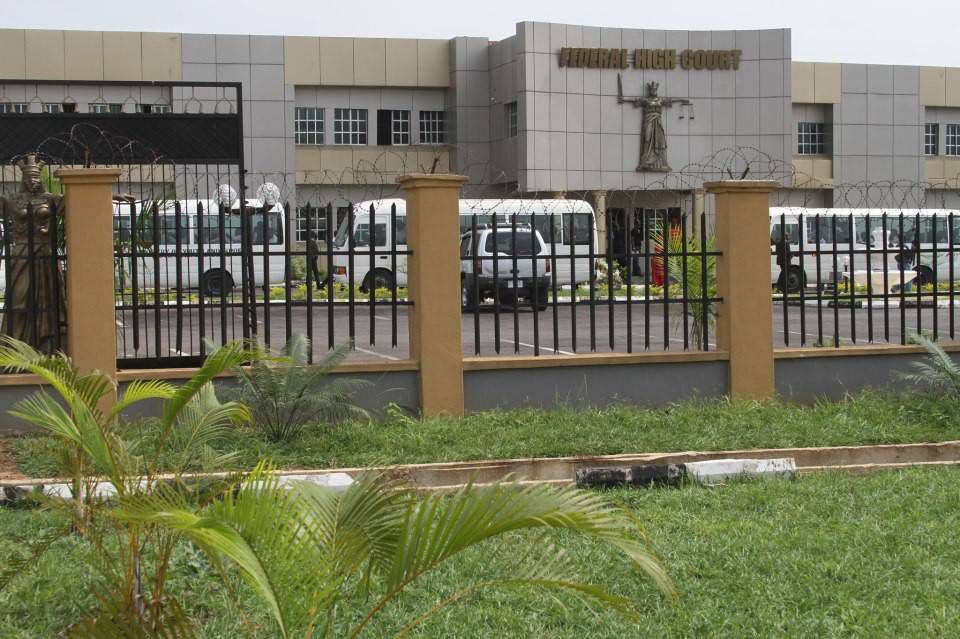
The Federal High Court sitting in Uyo has delivered a landmark ruling that reinforces the judiciary’s resolve against violent crimes in Akwa Ibom.
A 30-year-old man, Nkereuwem Felix Effiong, has been sentenced to life imprisonment for his role in the abduction of a sitting High Court judge, alongside other terrorism-related offences.
The judgment, delivered on Monday, February 23, 2026, followed months of trial proceedings during which the court examined evidence linking the defendant to a criminal syndicate responsible for multiple kidnappings and ransom operations across parts of Akwa Ibom State.
Effiong, who hails from Ikot Ekwere in Ibesikpo Asutan Local Government Area, was convicted on three separate counts: conspiracy to commit acts of terrorism, membership of a terrorist group, and kidnapping.
These charges were brought under the Terrorism (Prevention and Prohibition) Act, 2022.
However, the court discharged and acquitted him on a fourth count relating to concealment of information.
The case stemmed from the abduction of Hon. Justice Joy Unwana, a judge of the State High Court, who was kidnapped on December 18, 2023.
She was seized alongside her driver at approximately 8:00 p.m. along the Okobo–Esuk Inwang–Ndon Ebom Road.
The incident shocked residents and legal practitioners across Akwa Ibom, as it represented a direct attack on the judiciary.
Tragically, during the operation, the judge’s police orderly lost his life after being shot by members of the gang.
The victims were held captive for five days before being released following negotiations.
Prosecutors told the court that the gang received N25 million as ransom for the judge’s freedom.
In his statement before the court, Effiong admitted that he personally received N300,000 as his share of the ransom proceeds.
He further disclosed participation in other criminal operations, including the kidnapping of a pastor in Oron and another victim whose family paid N5 million for release.
According to his confession, he received N100,000 from the pastor’s abduction and N50,000 from the second incident.
He also revealed operational methods used by the group, including the use of a mini bus to carry out kidnappings and occasional robbery of fishermen and local residents to generate additional funds.
Effiong was arrested on July 4, 2024, along Ikot Ekpene Road in Uyo by operatives of the State Security Service (SSS), following months of coordinated investigation into the gang’s activities.
Authorities traced several operations to Esong Inwang Beach in Uruan Local Government Area, believed to have served as a base for the group.
At his initial arraignment, the defendant did not have legal representation. In line with constitutional provisions guaranteeing fair hearing, the court assigned the Legal Aid Council of Nigeria to defend him.
Although Effiong pleaded guilty to all four charges at first, the court entered a not-guilty plea on his behalf for the kidnapping count due to the severity of the punishment attached.
Throughout the proceedings, the prosecution presented documentary evidence, witness testimonies, and investigative findings linking the defendant directly to the terrorist conspiracy and kidnapping network.
The court held that the prosecution successfully established its case beyond reasonable doubt.
In delivering judgment, Justice Chigozie Sergius Onah sentenced Effiong to 25 years imprisonment for conspiracy to commit terrorism and 20 years for membership of a terrorist group. The life sentence imposed for kidnapping stands as the most severe of the penalties.
Legal analysts say the conviction sends a strong signal about the consequences of kidnapping and terrorism-related offences, particularly those targeting judicial officers.
Observers also describe the ruling as a judicial milestone in the ongoing fight against organized crime within Akwa Ibom.
Security experts note that kidnapping for ransom has increasingly evolved into organized criminal enterprise structures, often involving coordinated logistics, intelligence gathering, and financial sharing systems.
The court’s firm stance, they argue, demonstrates a commitment to dismantling such networks.
While several alleged accomplices remain at large, law enforcement agencies have assured the public that investigations are ongoing.
Authorities reaffirmed their determination to track down other members of the gang and ensure they face prosecution.
For residents and members of the legal community, the ruling provides reassurance that the justice system remains functional and resolute despite threats from criminal elements.
The sentencing also underscores the broader national enforcement of the Terrorism (Prevention and Prohibition) Act, 2022.
As the case concludes at the Federal High Court, attention now turns to continued efforts aimed at preventing future incidents and strengthening security infrastructure across vulnerable routes and communities.
Ireport247news
About The Author