A devastating Afghanistan earthquake has claimed dozens of lives after a powerful tremor struck the northern city of Mazar-i-Sharif, shaking entire communities in the night.
Authorities said the Afghanistan earthquake measured magnitude 6.3, with tremors rippling through the Hindu Kush region, damaging homes, hospitals, and religious sites as terrified residents fled into the darkness seeking safety.
Emergency officials confirmed at least 20 people were killed and more than 320 injured, but the toll from the Afghanistan earthquake is expected to rise as rescue work continues.
Witnesses described terrifying scenes as the ground heaved violently. “It felt like the end of the world,” said a resident who fled barefoot into the cold streets of Mazar-i-Sharif.
The Mazar-i-Sharif quake struck around 12:59am local time, catching people asleep and unprepared. Entire families were buried under collapsed mud-brick houses built without proper structural reinforcement.
The United States Geological Survey said the Afghanistan earthquake occurred at a depth of 28 kilometers, triggering an orange alert for potentially significant casualties and widespread destruction across the Hindu Kush region.
Health Ministry officials warned that many villages near the Mazar-i-Sharif quake epicenter remain unreachable due to blocked roads and damaged bridges, slowing down critical Afghan rescue operations across Balkh province.
“The situation is dire, and our teams are struggling to reach the affected districts,” said a local health officer. “We need urgent medical supplies and equipment.”
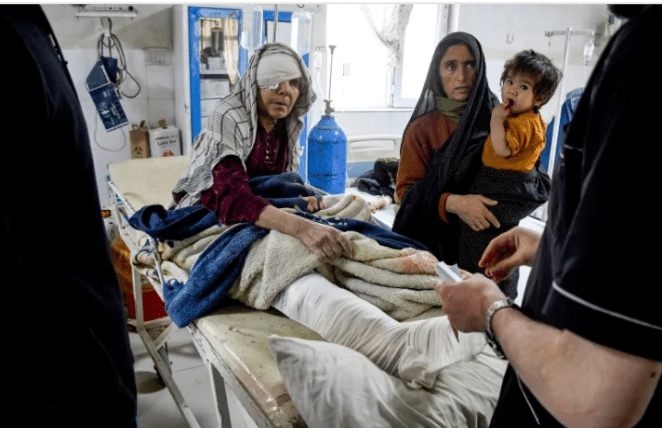
Hospitals in Mazar-i-Sharif have been overwhelmed by the number of wounded arriving since the Afghanistan earthquake struck, with staff treating patients in corridors and courtyards due to space shortages.
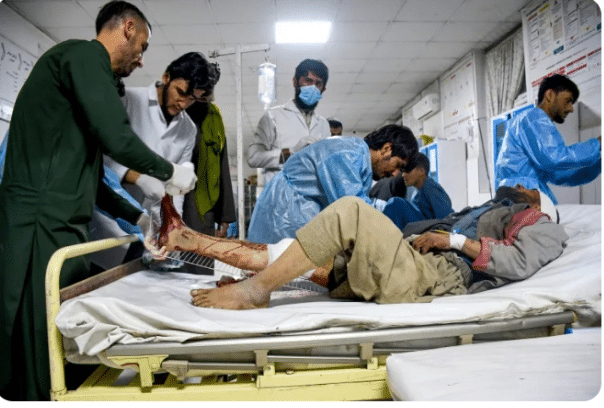
Doctors described a desperate scene. “We are treating patients on the floor,” said a nurse at Balkh Regional Hospital. “The injured keep coming, and many need surgery.”
The Taliban government response has been swift but limited by resources. Officials urged international organizations to assist, emphasizing that the humanitarian crisis exceeds their current logistical capacity.
A spokesman for the Taliban government response said: “We have mobilized all available teams for Afghan rescue operations, but the scale of the tragedy requires global solidarity and technical assistance.”
The Afghanistan earthquake also damaged the historic Blue Mosque in Mazar-i-Sharif, one of the nation’s most sacred Islamic monuments, according to provincial officials who confirmed partial structural collapse.
Eyewitnesses reported that parts of the mosque’s outer walls cracked and some minarets were damaged, leaving locals devastated over the loss of a cultural and spiritual landmark.
In the Hindu Kush region, tremors were felt as far away as Kabul and neighboring Uzbekistan, underlining the seismic volatility of this mountainous zone where tectonic plates converge.
Seismologist Brian Baptie from the British Geological Survey noted that northeastern Afghanistan has recorded 12 earthquakes above magnitude 7.0 since 1900, showing how prone the area remains.
“The Afghanistan earthquake fits a long pattern of seismic instability,” Baptie explained. “The Hindu Kush region lies at the junction of major continental plates, where enormous geological stress accumulates.”
As daylight broke, images from the Mazar-i-Sharif quake zone showed flattened villages, destroyed roads, and rescuers digging through rubble using bare hands and shovels to reach survivors.
“We’ve lost everything,” said one survivor sobbing beside the remains of her home. “My husband and two children were inside when the walls came down. I can still hear their voices.”
Across Balkh province, Afghan rescue operations faced immense obstacles — destroyed infrastructure, communication blackouts, and a shortage of heavy equipment slowing down the search for those trapped alive.
The Taliban government response included appeals to neighboring countries for emergency aid. Pakistan and Iran have expressed willingness to send rescue teams and medical support to assist survivors.
A government spokesman said: “We thank our neighbors for offering help. The Afghanistan earthquake has hit people already suffering from economic hardship and displacement. Every bit of aid matters.”
Humanitarian agencies warned that the Afghanistan earthquake could deepen an already dire situation in a nation battling poverty, drought, and limited international engagement under the Taliban government.
According to relief workers, thousands of displaced people from previous disasters remain in makeshift camps, where tents and shelters were torn apart by the violent shaking.
“This tragedy comes at a time when Afghanistan is barely recovering from the last Mazar-i-Sharif quake,” said a coordinator for a local aid group assisting Afghan rescue operations in Balkh.
Experts believe that the Hindu Kush region’s mountainous terrain amplifies seismic waves, causing more extensive surface damage in rural communities where construction standards remain poor and informal.
Many residents in the north slept outside for a second consecutive night, fearing aftershocks. “I don’t want to go back inside,” said a man guarding his family near a mosque courtyard.
The Afghanistan earthquake is the third major tremor to strike the country in less than two years, after deadly quakes in Herat in 2023 and Nangarhar in 2022 that killed hundreds.
International agencies including the Red Crescent and UNICEF have begun coordinating with the Taliban government response to deliver food, blankets, and temporary shelter to displaced families.
Relief efforts remain complicated by sanctions and restrictions on financial transactions that make it difficult for donors to transfer funds directly to Afghan institutions managing disaster response.
A UN official speaking anonymously said: “The Afghanistan earthquake shows why humanitarian access must remain apolitical. Ordinary Afghans are paying the price for global disengagement.”
Aid convoys from neighboring provinces are slowly arriving in the Mazar-i-Sharif quake zone, but fuel shortages and damaged roads make logistics extremely difficult for Afghan rescue operations teams.
Local residents have stepped in to help, forming volunteer groups to search for survivors. “People are working together, using whatever tools they have,” said an eyewitness near Balkh’s outskirts.
The Hindu Kush region’s fragile infrastructure remains a major concern for seismologists, who warn that future quakes could be even more devastating without urgent investment in resilient construction.
Analysts say that repeated natural disasters threaten the Taliban government response credibility, as communities demand better preparedness plans and safety regulations to protect homes and schools.
The Afghanistan earthquake once again exposes the limits of local governance in a country where decades of war have left the economy shattered and emergency systems almost non-existent.
Even as international headlines fade, survivors face weeks of hardship. “Winter is coming soon,” said a displaced villager. “If we don’t get tents and food, more people will die.”
Satellite images show the scale of destruction around the Mazar-i-Sharif quake epicenter, with several villages completely flattened and agricultural land scarred by landslides from the Hindu Kush region slopes.
Aid agencies estimate that thousands have lost homes and livestock, intensifying hunger in a region already grappling with food insecurity and rising malnutrition among children.
The Afghanistan earthquake has renewed global debate on how to balance humanitarian assistance with diplomatic isolation of the Taliban, whose governance remains controversial yet unavoidable in crisis response.
A Western diplomat commented privately: “We cannot ignore human suffering. The Taliban government response must be engaged for any meaningful relief operation to succeed.”
As Afghan rescue operations continue into the third day, rescuers remain hopeful that some survivors may still be found beneath the ruins despite freezing temperatures and dwindling daylight.
“We have hope,” said a young volunteer lifting rubble with a metal rod. “Even one life saved is worth everything. This is our country, and we must help each other.”
Seismologists continue monitoring the Hindu Kush region for aftershocks, warning residents to stay alert and avoid damaged buildings that could collapse during secondary tremors.
The government announced a day of mourning for victims of the Afghanistan earthquake, urging mosques across the country to hold special prayers for the dead and injured.
In the aftermath, grief and resilience blend across Afghanistan. Communities gather to bury the victims, rebuild shattered homes, and pray for peace in a land so often scarred by tragedy.
The Mazar-i-Sharif quake is not just another headline—it is a reminder of Afghanistan’s vulnerability and the world’s responsibility to support its people in times of unimaginable pain.
About The Author