

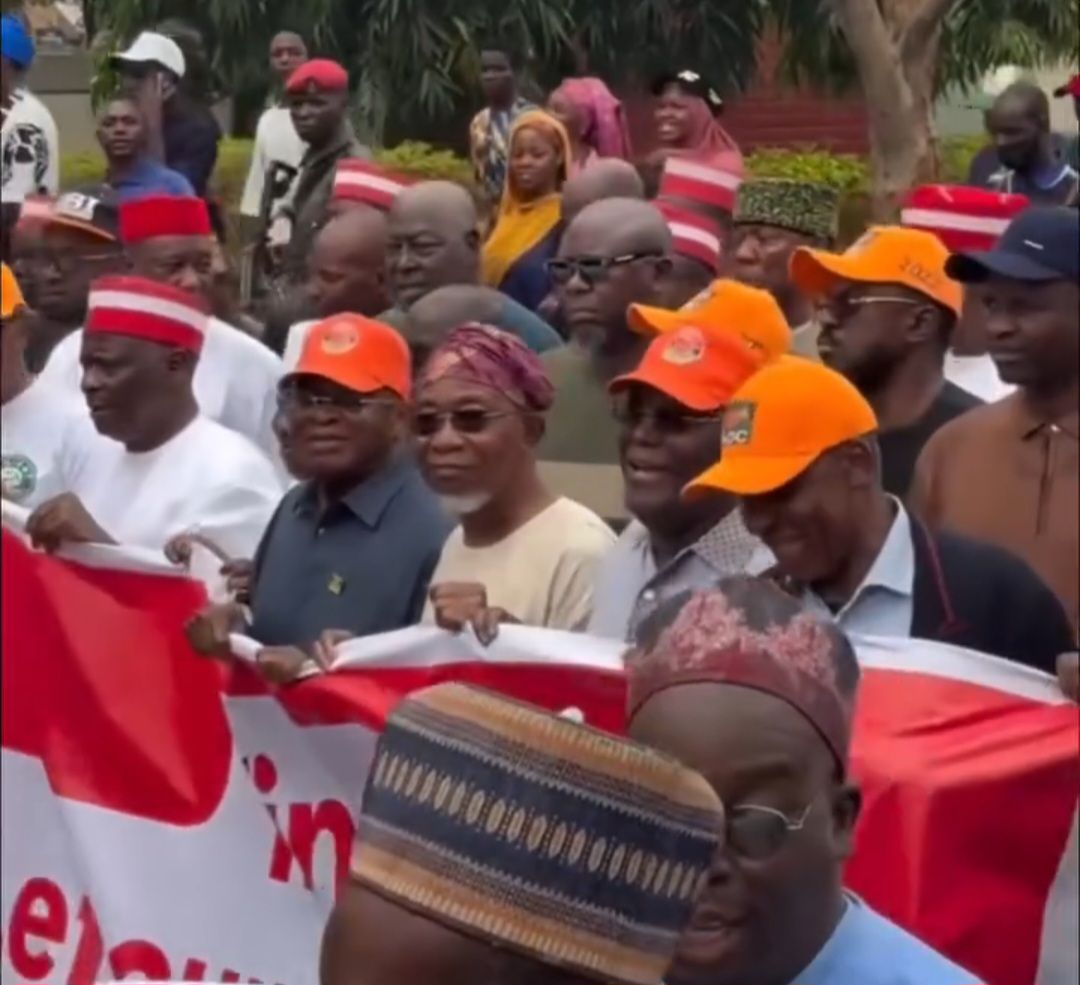
Prominent Nigerian opposition figures took to the streets of Abuja on Wednesday in a major political demonstration under the platform of the African Democratic Congress (ADC), demanding that the Independent National Electoral Commission (INEC) recognise a disputed leadership structure within the party.
The demonstration, widely described as an escalation of internal tensions, brought together some of the country’s most influential political actors. Key participants included Atiku Abubakar, Peter Obi, Rabiu Kwankwaso, Rauf Aregbesola, Rotimi Amaechi, and Aminu Tambuwal, alongside former Senate President David Mark and other senior party stakeholders.
The march began at Maitama Roundabout and moved through key routes in the Federal Capital Territory, drawing attention from residents and commuters as supporters carried placards with messages calling for justice, internal party democracy, and respect for due process.
The protesters eventually advanced toward INEC headquarters to press home their demands.

At the heart of the demonstration is a leadership dispute within the ADC, which has split party stakeholders into opposing camps.
One faction insists that the electoral commission must formally recognise its leadership structure, reportedly associated with David Mark, while the opposing side continues to challenge its legitimacy.
This disagreement has significantly heightened political tensions within the ADC.
As the protest unfolded, leaders emphasised that their actions were peaceful and aimed at protecting democratic institutions.
Many supporters described the situation as a defining moment for the ADC, warning that failure to resolve the leadership crisis could weaken the party’s organisational strength and credibility ahead of future elections.
In a public statement shared via his X (formerly Twitter) account, Atiku Abubakar defended the protest, stating that it was necessary to draw attention to what he described as concerns about fairness and neutrality in electoral oversight.
He stressed that the demonstration was not disruptive but rather a constitutional expression of political grievance.
“The other leaders and I of the ADC are peacefully protesting against the partisanship of the electoral umpire,” he wrote.
“Our patriotic stance is aimed at safeguarding our democracy and preventing the erosion of democratic principles.”
The ongoing situation reflects deeper instability within the ADC, as internal disagreements over leadership recognition continue to dominate party discussions.
Analysts suggest that the ADC must urgently resolve its internal disputes to avoid long-term fragmentation and loss of political relevance.
Observers note that the current ADC protest underscores growing frustration among party leaders who believe that INEC’s position on leadership recognition has effectively stalled internal reconciliation efforts.
The issue has now become a national talking point, drawing attention to how regulatory decisions can influence party cohesion.
Meanwhile, security presence remained visible around key areas of the capital as the procession progressed, although the demonstration remained largely peaceful.
Participants repeatedly insisted that their demand is simple: formal recognition and resolution of the leadership dispute within the ADC.
Political commentators argue that the ADC crisis reflects broader challenges in Nigeria’s opposition landscape, where competing interests often clash over party control and legitimacy.
The outcome of the ongoing dispute may determine the future direction and unity of the ADC as a political platform.
As events continue to unfold, stakeholders are calling for dialogue between INEC and the concerned factions to prevent further escalation.
For now, the ADC remains at the centre of one of the most significant internal political disputes in recent times, with its leadership question still unresolved.

