

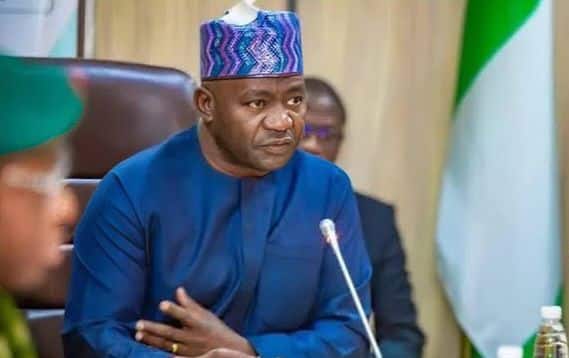
Defence Minister Christopher Musa says peaceful 2027 elections require dialogue, truthful information, political restraint and cooperation among security and democratic institutions.
The Minister of Defence, Gen. Christopher Musa (retd.), has warned politicians and other stakeholders against turning the 2027 general elections into a contest driven by violence, intimidation and misinformation.
Musa said the effectiveness of any security arrangement would ultimately depend on the willingness of political actors to embrace dialogue and respect democratic rules, stressing that security agencies alone could not guarantee peaceful elections.
The minister spoke during the eighth edition of the Blueprint Newspaper Lecture, Impact Series and Awards, where he delivered a keynote address on the theme, “Security Challenges and the Integrity of the 2027 Elections.”
Represented at the event by his Senior Special Adviser on Policy and Strategy, Maj.-Gen. Olufemi Akinjobi, Musa said the country’s preparations for the 2027 polls must go beyond the deployment of security personnel.
He argued that political conduct, public confidence, accurate information and respect for democratic institutions would be equally important in determining whether the elections were peaceful and credible.
According to him, political competition should not be mistaken for warfare, urging candidates and their supporters to understand that elections are designed to provide citizens with an opportunity to choose their leaders through lawful democratic processes.
Musa maintained that political parties had a responsibility to ensure that their pursuit of electoral victory did not come at the expense of national peace and stability.
“No security architecture, regardless of how sophisticated, can guarantee peaceful elections if political actors choose violence over dialogue. No electoral law can succeed where misinformation is allowed to replace truth. No democratic institution can flourish where citizens lose faith in the rule of law,” he said.
He added that the responsibility for securing credible elections belonged to all stakeholders and should not be placed solely on security agencies.
The minister therefore appealed to political parties to put the national interest ahead of narrow partisan considerations, while encouraging candidates to accept the outcome of legitimate democratic processes and pursue disagreements through lawful channels.
He said, “The responsibility before us is therefore shared. Political parties must place national interest above partisan advantage, and candidates must recognise that political competition is not warfare.”
Defence Ministry unveils six-point security framework
Musa also presented a six-point framework that he said could strengthen preparations for the security of the 2027 elections.
The proposed strategy focuses on strategic intelligence integration, threat assessment, protection of digital infrastructure, electoral cyber resilience, civil-military coordination and unified strategic communications.
The minister explained that the framework was designed to help security and other relevant institutions identify potential threats early, coordinate their responses and protect critical electoral infrastructure.
He particularly highlighted the need to pay greater attention to digital systems, given the increasing role of technology in modern elections and the potential for cyber-related threats to disrupt electoral processes.
According to him, safeguarding digital infrastructure should be treated as an important component of election security, alongside conventional measures aimed at preventing physical violence and other forms of electoral malpractice.
He said the six pillars would offer a practical roadmap for protecting the electoral process and preserving the democratic legitimacy that remains essential to Nigeria’s political stability.
Security agencies to strengthen collaboration
The Minister assured Nigerians that the Ministry of Defence would deepen its cooperation with relevant security and electoral institutions as preparations for the 2027 elections intensify.
He listed the Office of the National Security Adviser, Armed Forces of Nigeria, Nigeria Police Force, Department of State Services, Defence Intelligence Agency and Independent National Electoral Commission among the institutions expected to work together.
Musa said such cooperation would help ensure that agencies performed their respective constitutional responsibilities professionally and without partisan interference.
He stressed that effective coordination would be necessary to identify emerging threats, respond to security challenges and protect voters, electoral officials and other stakeholders.
The minister also emphasised the need for security personnel to conduct themselves professionally and within the limits of the law throughout the electoral process.
Military maintains position on political neutrality
Musa reiterated that the Armed Forces of Nigeria would remain politically neutral and would not take sides in the contest among political parties and candidates.
He said the military’s interest was not in determining who won or lost an election but in ensuring that Nigeria remained peaceful, united and secure.
“Let me emphasise once again that the Armed Forces have no partisan interest in the outcome of elections. Our institutional interest is that Nigeria remains peaceful, united and secure, and that every lawful responsibility assigned to us is carried out with honour, professionalism and accountability. That commitment is unwavering,” he said.
Musa further explained that the military’s constitutional responsibility was to defend the country and support civil authorities only when legally required.
He said the Armed Forces owed their allegiance to the Constitution and the Nigerian people rather than to individual politicians or political parties.
“The Armed Forces owe allegiance neither to political parties nor to individual candidates. Our allegiance is to the Constitution of the Federal Republic of Nigeria. Our loyalty is to the Nigerian people. Our commitment is to peace, stability and the preservation of democratic order,” he added.
Media, traditional leaders urged to promote peaceful polls
The minister also called on the media to play a responsible role in the run-up to the elections, particularly in an environment where unverified claims and misleading information can quickly spread.
He urged journalists to maintain accuracy, professionalism and restraint when reporting political developments, noting that irresponsible reporting could worsen tensions during an already sensitive electoral period.
Musa equally tasked civil society organisations with expanding civic education programmes and encouraging citizens to participate in elections peacefully.
“The media must continue to report with courage, accuracy and restraint, while civil society deepens civic education and promotes peaceful participation,” he said.
Traditional rulers and religious leaders were also urged to use their positions to encourage dialogue, tolerance and reconciliation within their communities.
According to Musa, influential community leaders can help prevent political disagreements from escalating into violence by promoting moderation and peaceful engagement among their followers.
Youths cautioned against political manipulation
Musa further appealed to young Nigerians to reject attempts by politicians or other actors to recruit them for violent activities during the election season.
He noted that young people represented a significant part of Nigeria’s future and should use their creativity, energy and skills to contribute positively to the country’s democratic development.
“Our young people, whose energy and innovation will define Nigeria’s future, must reject every attempt to recruit them as instruments of violence or manipulation. Their talents are needed not to disrupt democracy, but to strengthen it,” he said.
The minister’s warning comes as political activities ahead of the 2027 general elections continue to gather momentum across the country.
With concerns over political violence, misinformation, cyber threats and declining public confidence in democratic institutions remaining key issues, Musa’s position underscores the need for a broader approach to election security.
Such an approach, he maintained, must combine effective intelligence and security coordination with responsible political behaviour, credible information, civic participation and respect for the rule of law.
Ultimately, he said, protecting the integrity of the 2027 elections would require collective commitment from political parties, candidates, security agencies, electoral authorities, the media, civil society, community leaders and ordinary Nigerians.
The Minister’s message was that while security institutions have a critical role to play, lasting electoral peace cannot be achieved through security deployments alone.
It must also be supported by responsible leadership, peaceful political engagement and the willingness of all stakeholders to place Nigeria’s democratic stability above partisan interests.
About The Author
